Showing posts with label Books. Show all posts

Thursday, 23 July 2026

Plodding through the heat: Keeping on re-basing

It won't be a surprise to anyone in the UK,  but it has been exceptionally hot here in the past few weeks. and that has slowed down pretty much all activities, including hobby activities. There's also been quite a bit of 'real life' stuff competing for attention, so the toy soldiers have taken a back seat. But I have made a little progress, and made a couple of interesting acquisitions.  I believe there has also been some sort of football (soccer, if you prefer ) competition, which I think has taken many people's attention - though very little of mine! But it did spark a little pondering on the nature of games and gaming..

The great re-basing project continues with the vintage Minifigs 7YW/AWI collection.  I've been working on the slightly mysterious French infantry with unusual green facings ( see my earlier post about identifying them ), which I have decided to designate as the Volontaires Étrangers de la Marine.  Although there were lots of green-trimmed musketeers, I had no command figures for the unit - step forward the Garrison figures I recently acquired from Rob Young of The Eastern Garrison (many thanks, Rob!).  I'm no great shakes with the paintbrush, but I was fairly pleased with my efforts painting them - my first attempt at painting a drummer in the the blue-and-red French royal livery coat came out quite well, I thought, bearing in mind the 'three foot rule'.  I'll admit I have no idea whether this unit had drummers in the royal livery, but it was fun to paint it!


When simply block-painted in an old-school style, the officers looked rather bright and clean compared to their rank and file, who are a little 'aged' so to speak, so I gave the command group a thin wash of Army Painter Soft Tone to dull them a little - but it has been pointed out to me by the excellent Ross from Battle Game of the Month that the officers would probably have higher-quality (and maybe cleaner!) uniforms than the 'PBI', so maybe my newly-painted command group is quite authentic!  

I also enjoyed painting a version of this unit's  interesting flag, with the standard French 'quartered' banner further sub-divided into green and white, fortunately in a quite simple and easy to re-produce way. Having fixed  them to MDF bases and applied a couple of coats of old-school plain green to the bases, here is the finished unit basking in the sunshine in the garden this afternoon: 


 You may have noticed the horsemen behind the Volontaires in the photo - these are my first re-based unit of cavalry from the collection. They represent the Russian Slobodskiy Hussars  and I very much like their lavender-coloured uniforms! Here they are, taking their place in the sun : 


I have a bit of a dilemma with cavalry:  I settled for 50mm x 50mm bases with two figures per base, which fit the suggested base sizes for both Black Powder and Honours of War rules.  But BP has six such bases (12 figures)  for a standard cavalry unit, and HoW  has 4 bases (8 figures).  Given that I am using  4 bases (16 figures) at 40mm x 40mm  for infantry, the standard BP cavalry unit would look a bit too big.  It's also relevant that most of the cavalry I have acquired seem to be in 'units' of 12, so adopting the 4-base HoW format would mean leaving quite a lot of figures unused.  So on consideration, for now I am going to have a cavalry 'unit' of 6 figures on  3 bases, just as shown. I think I might consider them as a 'squadron',  part of a 'regiment' of  2 'squadrons'.  As you can perhaps see in the above pictures, my cavalry and  infantry units have roughly the same frontage, which I am happy with. Admittedly all slightly arbitrary, but to my mind they should  look 'right' on the tabletop. And I have another six figures of these nice hussars, to make another 'squadron'!   

Next up for basing, lots of Russian infantry.. 

There's almost 100 figures here, and I can probably get 5 battalions out of them, so not a bad little force.  The Musketeers (left) have already had their old bases removed, the rest still need to have a paddle in some water to soak off their current stands - which look to be made of balsa, curiously enough. So this will be my job for the next few days..  

I've also done a little light shopping - specifically, I got tempted by Pen and Sword's half-price offer on Henry Hyde's  book Wargaming Campaigns. It arrived at the weekend, and is a substantial tome ( 500 plus  pages! ).  I loved Henry's previous Wargames Compendium when it came out, and I think it was one of the factors influencing  me to move from just reading blogs on wargaming to getting back to actual gaming and starting this blog. So let's hope this one is as good - and provides some inspiration for campaigning.  It will certainly occupy a lot of reading time!  I was interested to see the Acknowledgements page near the front, where Henry lists a whole lot of people who 'helped me to name the vast numbers of places that sprang up as I created the imagi-nations of Dahlia and Chindrastan featured in these pages'.  Many familiar names were on that list, including several I have met (in person or on-line) and a couple who follow this blog. Henry also thanks 'veteran wargamer Arthur Harman', who 'has undertaken the heroic task of creating an index for this monster' .  Indeed, quite a major job,  well done Arthur! 


At the other end of the price range, a charity shop find I couldn't walk away from this week - Alan Clark's Barbarossa, a chunky paperback for all of £1 !  Possibly influenced by listening recently to Al Murray and James Holland's  We Have Ways of Making You Talk podcast, which devoted a series of episodes to the decisions, planning and preparations behind Hitler's attack on the Soviet Union in 1941. This one may go on the backlog pile at first, but I'm sure it will make an interesting read eventually..

Alan Clark was an 'interesting' character of course, I can't say I was an admirer of his politics or his personal conduct - but the relevant question is 'was he a good historian, and a good writer'? The latter will become obvious, the former - well, he may have been superseded by later authors with more access to Russian archives. for instance, but I'll give him the benefit of the doubt. 

 Finally just a bit of whimsy really: here's a picture of the scene at Pizza Express restaurant on the South Bank, Central London last Wednesday evening - at the time England's footballers were playing against Argentina for a place in the World Cup Final. It was all rather lovely, quiet and peaceful. We'd been to the nearby National Film Theatre, to see a rather charming film - Night Train (dir. Jerzy Kawalerowicz,  Poland, 1959) well worth a look if you enjoy a good railway-based movie.      


The fact that I was at Pizza Express should tell you how much I know or care about football - precisely nowt -  but it was interesting to see the reactions to the result and to England Manager Thomas Tuchel's  tactical decisions.  It made me think;  if Monty and Eisenhower on 6th  June 1944 had said 'OK everyone, we got the  landing done successfully, we've got the beach-head established, now we'll sit on the defensive and let the Panzers come at us', how would that have gone?  ( shades of what actually happened at Anzio? ).  But I also thought, if we were wargamers playing the Normandy Campaign  as a game of some sort, we might very well do exactly that, because the victory conditions would doubtless specify that simply establishing  a beach-head and not being thrown back into the sea would give the allies a marginal victory - and Herr (sorry!)  Tuchel only needed a marginal victory..  As players, though, we would have thought that was pretty 'game-y' and not really in the spirit of things.  So I concluded I had little sympathy for Thomas T, and that maybe England need a 'Monty' for manager? Discuss...  😀

With that, I'm sure I've entertained you all for long enough, so I'll sign off. The heatwave does seem to be easing off a bit, and I've got some more free time in the next few days, so hopefully I can get those Russians sorted out, and report my progress in a future post. Until then, keep well everyone, 


p.s. a quick 'plug' -  my old friend 'Liverpool Dave' has had a bit of a rush of blood to the writing fingers and revived his long-moribund personal blog Serener Skies  Recent posts include reminiscences of cartoon strips in the Daily Mirror,  Liverpool Corporation buses,  the dream of a remote lochside idyll versus the reality of modern tourism, and the late Kevin Keegan's triumphant FA Cup Final in 1974 (the latter may have been the last soccer match I watched with any real interest!). Not a wargaming blog, but Dave can certainly write, and wargaming does get a mention - he poses the question of whether  there a correlation between interest in military history and interest in public transport? I think a few readers of this blog may be able to answer that one, while looking at Dave's nice pic of a Leyland Atlantean..    

Sunday, 28 June 2026

Fnurban #41: General Knowledge

Among the worryingly large backlog of unread volumes on my bookshelves (worrying because one starts to compare the probable time required to read them all, to average life expectancy), there is a small but distinct category - that of biographies of  prominent British army commanders. This is a direct result of my reading John Keegan's  1991  Churchill's Generals a couple of years ago.  Keegan acted as editor for a collection of 17 biographical essays  by various authors, covering no less than 20 British generals from the Second World War. 


 I'll freely admit that I really knew very little about any of the subjects, so this book was a very nice introduction to the subject - and of course it left me wanting to know more about quite a few of them! In second-hand bookshops and charity shops I tend to find myself looking at the history/military sections of the bookshelves, and guess what?  Yes, you got it, I have been picking up biographies  and memoirs of some of these commanders. Here is the harvest so far: 

I found Alex , Nigel Nicholson's authorised biography of Field Marshal Alexander, in the excellent  Harris and Harris Books at Clare - and actually managed to read it! Well worth it, and very relevant given my interest in the 'D-Day Dodgers' Italian Campaign 1943-45, in which Alexander was allied C-in-C, and highly successful in commanding truly multinational forces. 

Viscount William Slim's Defeat Into Victory (an abridged, but still substantial tome)  came from Cuirassier Books, I think at the Re:Play show at the Royal Engineers Museum a couple of years ago. I like the 'career arc' of Slim : certainly not the usual public school educated product of a family of soldiers,  he was the son of a Birmingham ironmonger, working as a junior clerk before 'joining up' in 1914.  Defeat Into Victory is his account of his command in the Burma campaign, and according to Duncan Anderson in Churchill's Generals,  reveals 'an ordinary man, one often assailed by self-doubt, who made mistakes.. and did not consider himself particularly brave'.  


A charity shop find next:  Horrocks: The General Who Led From the Front by Philip Warner (1984).  I'll let the cover blurb give a flavour.  'Sometimes described as 'Britain's answer to Rommel', Sir Brian Horrocks was not only a charismatic and courageous leader of men but one of the most successful commanders of the Second World War'. His career spanned  Ypres 1914 (and 4 years as a POW) , Russia 1919, Dunkirk 1940, North Africa 1942/43 and North-West Europe 1944-45 (despite being seriously wounded in 1943), with 'retirement' involving the post of Parliament's  Black Rod, journalism and even presenting military history on 1950s  TV!   

On a recent trip to the National Trust's property at Calke Abbey (well worth a visit!), another little find came up in their second-hand bookshop : John Connell's 1964  Wavell:Scholar and Soldier (to June 1941) .  Much more than a simple soldier, Archibald Wavell was 'also a man of scholarly interests and attainments;  a biographer; an outstanding administrator...; and a Viceroy of India'. He may be better known as compiler of a best-selling poetry anthology Other Men's Flowers than as a soldier.  His misfortune was to be unable to build a good relationship with Churchill, perhaps partly  due to his taciturnity - eventually Churchill relieved him of command in the Middle East, at which point this volume ends.    His Middle East command was much more than just the Western Desert, also covering East Africa, Iraq and Syria, Greece and Crete - a huge responsibility with action in all areas, much of which will probably be new to me.  


And finally, the joker in the pack, so to speak - Sir Adrian Carton de Wiart's Happy Odyssey (1950).  An addendum sticker inside the front cover records that 'in this book General Carton de Wiart makes no mention of the fact that he was awarded the Victoria Cross'.  I think this may give an idea of the character of the man. In contrast to Wavell, he clearly had a very good relationship with Churchill, who has provided a foreword, and also appointed de Wiart  as his personal representative to Chiang Kai-Shek,  'to which he was not entirely suited' , as professor Gary Sheffield puts it in Churchill's Generals.  Multiply wounded (note the eye-patch) and famously courageous in 1914-18, in WW2 he led a British  military observers mission to Poland in 1939,  had an independent command in Norway 1940, and was captured by the Italians after a 'plane crash en route to Yugoslavia in 1941,  subsequently (aged 63) escaping from a POW camp via a tunnel and evading capture, in the company of fellow General O'Connor,  for several weeks. I think this is going to be a roller-coaster ride.. I had never heard of this gentleman until I read Churchill's Generals, and I was pleasantly surprised when a copy if this book turned up in Sudbury RSPCA shop a few weeks ago - snapped up for £5.  Amazingly, last week I was browsing  in our local Oxfam, and found another copy  - but they want considerably more money!        

Now it's very easy to buy books, especially if kidding yourself you are 'rescuing' them from charity shops, but the proof is in the reading, and I have all too many unread books. But I have a good feeling about these, and I think I will start with what looks to be the most straightforward and positive story, that of Horrocks. This is also a rather long-term project, and I won't be trying to get through them all in quick succession, more likely pick up one every so often, in between other reads.  Let's see how it goes.. 

The recent heatwave has driven away any thoughts of hobby painting, or hobby anything much! (in Suffolk we managed to have the record-breaking highest June temperature)  Now we seem to be cooling down a bit, today I managed a tiny amount of painting - here 'on the bottletops' we have four Garrison command figures for my French 7YW infantry unit Volontaires Étrangers de la Marine.   


 They've had a coat of grey primer, and their uniform base colour of white - it's a start. at least. There's some 'real life' stuff coming up this week which means I might not get them finished  until the weekend, but I should get some of the basic details done. There are also various 6mm units for Risorgimento 1859 wanting finishing, and.. and.. and... just like the books, the painting backlog never ends!

I hope everyone reading this  in the UK has got through the hot spell without too much discomfort - I think we all need some decent sleep! Hopefully we can all get back to our hobby now, and I can report a little more progress next  time. Until then keep well, everyone.  

Wednesday, 19 March 2025

The (almost) Finished 1859 Armies

With apologies for the lack of posting recently, I wanted to wait until I had finished painting my 6mm Risorgimento armies for Italy 1859, but that took a bit longer than expected - 'real life', and all that. However, I have finally painted my way through the 'MDF pile' of the semi-flat Commission Figurines* figures I acquired at the Warfare show in November, and these combined with some  Baccus figures I had previously completed have given me ( I hope ) useable Austrian and Piedmontese 'starter' armies.    And here they are - Piedmont first : 

These are based for Neil Thomas'  19th Century Europe rules, with most units having four bases - I decided on 24 figures per line infantry unit ( 2 bases of 8 in line, and 2 bases of 4 skirmishing) and 16 figures per cavalry unit, with 8 figures in a skirmisher unit ( 2 bases of 4 ) and a single base of one gun  and 4 crew for an artillery unit.  The Piedmont army currently has (front to back of picture)  5 Line and 2 Grenadier infantry units,  2 units of Bersaglieri skirmishers,  2 line and 1 heavy Cavalry unit, and 3 artillery units.  

And if you'll excuse the slightly poor photography ( late afternoon sun a bit strong ), here are the Austrian opposition :


The Emperor's force comprises (again, from back to front of picture)  6 units of Line infantry, 3 of Artillery and 3 of Cuirassier cavalry. This is where the 'almost' in the title of this post comes in - having lined them up for the camera, I realised that I have omitted to include any skirmishing infantry in the army. So I need a bit more painting, of a couple of units of Grenze or Croat skirmishers. Back to the painting desk, I suppose.. 

I'm quite pleased with these, and found the painting less challenging that I expected - essentially there's no need to worry about trying to paint tiny details on the figures, because even if you could, no-one could see them at tabletop distances!  If you really insist on seeing the full horror of what I think I can get away with, here is an extreme close-up of Austrian Cuirassiers: 


I will admit I think the 'flock' I have used on the bases is probably too coarse for this scale - but again, no-one is ever going to get that close to these figures, and in the previous pictures at more normal distances, I think the basing looks good enough. I will try to improve that in future units, though, using a finer flock if possible.  The figures here are from  Commission Figurines Napoleonic range - unsurprisingly enough, Austrian Cuirassiers  ( for examples of much better-painted figures from the same ranges, see Richard's My Wargaming Habit blog ). 

 For background reading I found Solferino: The Birth of a Nation by Patrick Turnbull (1985) 


This was a good read and an nice introduction to the Italian campaign  of 1859, culminating in the bloody battle of Solferino and covering the engagements at Montebello and Magenta too. One of my main impressions from reading the book is that frankly the standard of generalship exhibited by all three main protagonists ( Austria, France and Italy ) left a lot to be desired - the three armies more or less 'bumped into each other' at Solferino, having encamped the night before very close together but unaware of each other!   All three were commanded by their heads of state - Emperor Franz Joseph of Austria,  Emperor Napoleon III of France, and King Victor Emmanuel of Piedmont-Savoy, but none of the three were suited to command of large armies.  The author says that none of them lacked personal bravery, and would have made really good regimental commanders, but no more!    If anything, Louis Napoleon perhaps comes across as the most sympathetic and human character,  beginning his first war  with hopes of attaining 'glory' like his illustrious namesake, but being shocked and horrified by the scale of the bloodshed and suffering involved in a big battle.  Immediately after Solferino he determined to make peace, probably to his credit as a human being. Of course, we can discuss why he had not realised just what his ambition for power was getting him into during his rise to the throne, and how far out of his depth he was when later pitted against Bismarck's Prussia.

From a hobby point of view I rather like the ruritanian ineffciency of the armies, it probably puts them on a fairly level playing field and may well suit my own level of tactical and strategic skills! 

Now I just need to acquire some suitable terrain - starting from scratch rather, as this is my first essay with 6mm. There are some buildings coming to me from Timecast, I hope, next we are going to need roads, rivers, trees etc. I also need to get some Austrian skirmishers painted, as mentioned above - the Commission Figurines ACW Confederates in broad-brim hats may come in handy for those.  Once that is all in hand, we'll set 'em up and see how they do, using Neil Thomas' rules for the period.   In the meantime, there may be some gaming in other periods which haven't had a good run out for a while -watch this space.  Until then keep well, everyone. 

 * It seems that Commission Figurines website is no longer available - I am wondering if this is bad news for them and their customers?  Is anyone aware of any news about them? 


Wednesday, 3 July 2024

Fnurban #31 Mr. Spectator and Mystifying Military Jargon

Many years ago I discovered  the works of Joseph Addison and Richard Steele, in particular The Spectator, the daily paper which they jointly produced in London in 1711-1712.  Having started from a Penguin Classics edition with a small selection of their pieces, eventually I found a complete 'pocket edition' ( published around 1900) in six volumes containing all 555 numbers - but this has sat on my bookshelf mostly unread for well over 20 years!  Recently I made a resolution to actually read them, and have tried to do so as a typical reader would have done in 1711 - one issue per day, with my morning coffee.  I have been enjoying them and will keep up with my daily habit - it's like a small daily trip back in time to the London of 1711. The premise is that the paper is written by the titular gentleman ( who is never actually named ), who rarely speaks, but appears in many settings in London society and pays careful attention to what is being talked of. He has a 'club' of friends who meet at a coffee-house, as gentlemen of the time would, and who are a convenient mix of different sorts, allowing him to report from different sections of society - the most famous being 'Sir Roger de Coverley', an old-fashioned and mildly eccentric country squire. In a rather nice series of papers, Mr Spectator spent the month of July 1711 reporting from an extended visit to Sir Roger's country estate, before returning to the bustle of  'town'. 

Joseph Addison (1672-1719)

The Spectator is in effect the ancestor of all newspaper opinion columns ( and possibly internet blogs, too? ). Each issue consisted of a short essay on a topic of current interest, and it aimed to enlighten a rising middle-class readership,  and promote politeness, good manners  and civility, perhaps as a response to what was seen as the rather loose morals of  English society in the 'Restoration' period of the past few decades.  In this they were  highly successful, the paper was very popular from the start,  and no eighteenth or nineteeth century gentleman's ( or gentlewoman's, since the authors  made a particular effort to interest women readers )  library would be complete without an edition of the collected issues.  If you visit stately homes even today, where the library has been preserved you may still see them.  It spawned many an imitator in Britain and abroad in the following years, and of course the title was revived in the following century for a political magazine which still runs - albeit with an outlook that the original authors would perhaps not have agreed with..   

Sir Richard Steele (1671-1729)

Addison and Steele were literary men, but also  political 'insiders' who supported (and held government jobs in ) the Whig administration which had been in power for the past several years, and which had prosecuted the War of Spanish Succession and  appointed the Duke of Marlborough as commander of the British army in Flanders, during his period of great battles  at Blenheim, Ramilles, Oudenarde and Malplaquet.  As a result, the ongoing war does get some attention in the papers, often looking at the powerful influence of French fashions and manners, despite the ongoing hostilities. Recently I was interested by Spectator no. 165, published Saturday, 8th September 1711, in which Mr. Spectator protests at the number of French phrases being adopted in English:   'the present war has so adulterated our tongue with strange words, that it would be impossible for one of our great-grandfathers to know what his posterity have been doing, were he to read their exploits in a modern newspaper. Our warriors are very industrious in propagating the French language, at the same time that they are so gloriously successful in beating down their power'....  For my part, by that time a siege is carried on two or three days, I am altogether lost and bewildered in it, and meet with so many inexplicable difficulties, that I scarce know which side has the better of it.. 

He goes on to publish a letter which he says he had a copy of, from the year of  Blenheim, written by a young gentleman in the army to his father, a man of good estate and plain sense :     

SIR, upon the junction of the French and Bavarian armies they took post behind a great morass which they thought impracticable. Our general the next day sent a party of horse to reconnoitre them from a little hauteur, at about a quarter-of-an-hour's distance from the army who returned again to the camp unobserved through several defiles, in one of which they met with a party of French that had been marauding, and made them all prisoners at discretion. The day after a drum arrived at our camp, with a message which he would communicate to none but the general; he was followed by a trumpet, who they say behaved himself very saucily, with a message from the Duke of Bavaria. The next morning our army being divided into two corps, made a movement towards the enemy; you will hear in the public prints how we treated them, with the other circumstances of that glorious day. I had the good fortune to be in the regiment that pushed the gens d'armes. Several French battalions, who some say were a corps de reserve, made a show of resistance; but it only proved a gasconade, for upon our preparing to fill up a little fosse, in order to attack them, they beat the chamade, and sent us Carte Blanche. Their commandant, with a great many other general officers, and troops without number, are made prisoners of war, and will I believe give you a visit in England, the cartel not yet being settled. Not questioning but these particulars will be very welcome to you, I congratulate you upon them, and am Your most dutiful son, &c. 

Mr Spectator continues The father of the young gentleman upon the perusal of the letter found it contained great news, but could not guess what it was.. ' he talks of a saucy trumpet, and a drum that carries messages: then who is this Carte Blanche?'...   'when he writes for money he knows how to speak intelligibly enough: there is no man in England can express himself clearer, when he wants a new furniture for his horse'.            

I thought this was all rather interesting - many wargamers with an interest in the 'horse and musket' period will be quite familiar with the military slang that confounds the soldiers' father, but it's fascinating to see how much of that language rather suddenly came into English, and mostly from the French, in quite a short period once the British got involved in wars on the continent in the 1690s and 1700s.  This sudden explosion of  martial jargon clearly raised eyebrows back in 'blighty', and it's easy to see parallels with the mass of new phrases and usages that came into the language  during the 1914-18 and 1939-45 wars  ( and who can forget 'Yomping' and 'Exocet' etc, from 1982? ). 

The use of letters is a speciality of the Spectator; often an issue would be based around correspondence received from 'readers', though equally often it's presumed that the letters were actually contrived by the authors themselves to add a little literary colour. But judging from a footnote in my edition, this example may well  be a real letter that had been passed on to Addison, who wrote this number of the paper. 

Well, it all amused me, and I hope it's of some interest to you, in turn. If you are interested, you can see the whole paper  on-line at Project Gutenberg

I will admit that not much time has been available for hobby activities recently, as we were away on holiday - but I did have the privilege of joining one one Jon Freitag's remote games last night, commanding a force of Sumerians and getting a 'driving lesson' on their  powerful, but somewhat unpredictable 'battle carts' . Great fun was had by all, and I'm sure Jon will put up his usual excellent battle report, In the meantime he passed on a picture from the heat of battle, as my cart unit crashed into their opposite number : 

when battle carts collide...


Many thanks to Jon, and the other players, for a great game!  I think I need to get back into a painting routine now, and also run a solo game or two, and I hope, report on them in the near future. In the meantime keep well, everyone. 

p.s. can't resist a little nudge at the General Election here in the UK tomorow: 


(only a joke, I thought it quite witty - let's not get into serious discussions. I hope all sides can take a little gentle ribbing - that should be part of a healthy democracy, after all..)   

Thursday, 13 June 2024

Broadside Show, and Churchills in the Car Park

On Saturday I was able to get to Medway Park Sports Centre, Gillingham, for Broadside 2024, organised excellently as ever by Milton Hundred Wargames Club  ( a fine bunch of guys clearly, and they hail from my childhood home town ). It's always a good show, not one of the larger events but in a good spacious venue, which means it's always easy to see the games, and there are not too many games,  so you are not rushing around to catch them all, can take your time with each one.  A decent selection of traders,  and a nice feature is that a number of tables are available for a sort of wargaming 'flea market', of which more later.

Admittedly several of the games had been at SELWG, Cavalier or Salute so I had seen them before, but they were all good so worth seeing again! I took a few pictures, so here are some of them: 

Postie's Rejects: Ray's Haiti 1792 game
 

Postie's Rejects were there, of course - this is their local show - with a game organised by Ray Roussell,  The Battle of Croix-du-Bouquets 1792, from the Haitian slave revolution against the French (who of course were themselves 'Revolutionaries' - something of an irony there! ). A great-looking game, see Ray's Don't Throw a One blog for much more on this. 

Ray directing operations -  note 'pencil behind the ear' symbol of office 
 

Shepway wargamers' brought their 'Dornier Down'  game, set in a thankfully imaginary Nazi invasion of UK, 1940, and I think it won best in show. 

Shepway - 'Dornier Down'

 Medway Wargames Club put on a Mythical Greek period game, I think the rules were Dragon Rampant. A nice idea - use your Greek hoplite armies wih just a few additions of various gods, heroes and mythical beasts. Very colourful!

Medway - Greek Myths

South East Essex (SEEMS) always do a good setup, this was the  imaginary ACW Action at Bryson’s Crossroad - I think the location might have been inspired by the 1965 James Stewart film Shenandoah. Rules were Rebels and Patriots, I think.  Some really nicely-painted figures, as you can see in the second picture.

SEEMS : ACW 'Bryson's Crossroad'


Central London Wargames promoted the Emperor of the Battlefield Napoleonic rules produced by their member Ian Godwin :

Central London Wargamers: Emperor of the Battlefield

These chaps are always very friendly and happy to talk you through the rules, but I always have to admit that I don't do Napoleonics! However,  I gather the rules were developed from an earlier set for the Seven Years War, and those are hopefully going to be re-issued soon in an updated edition. I shall be interested to see them! 


Skirmish Wargames group brought their Boxer Rebellion game - complete with gunboat! the game used 54mm figures, beautifully and colorfully painted. 


Maidstone Wargames Society showed their 'Summer of 77'  Battle of Britain game, which I had seen at the Cavalier show - based on a free boardgame published in a Warlord comic in 1977.  


Hailsham Wargames club brought their '(Evading) The Devil’s Paintbrush' WW1game - and appropriate headwear. Sadly I didn't get a picture of the players in 'Picklehaube' helmets! 

Hailsham club: WW1

A nice 'Cold War Gone Hot'  (1980s) game - not in the program, but I think it was by the Milton Hundred club? 


Deal Wargamers showed their 1936 Palestine rebellion game : sadly, somewhat topical,  of course, But nice to see  'early war' British kit, including Gloster Gladiatiors


I liked this Peninsular War village setting for a skirmish participation game by  Big on Strategy - 'A Whiff of Grape'


And finally I spent some time with Retired Wargamers Reloaded and their splendid 'Hold Until Relieved' D-Day Pegasus Bridge game


 I had a good chat over coffee with my old buddy Tony who is a member of the 'RWR' group, and with luck some face-to-face gaming may result, in the near future! Great to meet Tony again and have a good talk, and of course get a close look at this amazing layout  ( I also thought it especially realistic as, look where you might, Prime Minister Sunak was nowhere to be seen...must have gone home early).


**UPDATE**: for even more, and  better, pictures, and of more games than I captured, see Ray's 'Don't Throw a 1' blog for his report on the show.   

There was a little shopping done, naturally - the 'flea market' stalls had lots of interesting stuff. I bought some books from one, which turned out to be run by the Whitehall Warlords Group, of which I was  once a member, for a few months in about 1988. I thought  those chaps looked familiar..

Issue 19, from 1966
The copy of 'Tradition' includes part of a series on 18th Century wargaming by Charles Grant, which five years later would be published in book form as - of course - 'The War Game'.  
 

I've been interested to see these rules in use recently by Postie's Rejects for FPW games - I have a bit of a yen for the '19th Century Europe' period, so these may be interesting.  

A couple of slim volumes of Colonel Horace St Paul's journals of life in the 7YW Austrian army - good to be able to try them before possibly buying the big, glossy (and expensive) recent Helion editions...  


And finally this vintage 1970s  'Knights Battles for Wargamers' book on Dettingen. This has some heritage, as it has an inscription inside from its previous owner  Seamus Bradley,  who was  chair of the Whitehall Warlords when I was a member. I remember him as a really nice, friendly and enocouraging chap;  sadly it seems he is in a care home now, suffering from dementia. I think more than one of the above came from his collection. I am quite pleased to become a custodian of them, and hopefully get some enjoyment and use out of them, in a sort of small tribute - thanks, Seamus.

One slight 'downside' of the venue is that parking there was  a nightmare - especially as there was also a large athletics event going on there!  But I had realised that just over the road is the Royal Engineers Museum,  where the car park was (a) nice and quiet and (b)  contained quite a few vintage armoured vehicles! In the week of D-Day, it was interesting to park next to a couple of Churchills: 

Churchill AVRE (post-war Mk VIII version)

  
.. and AVLB Bridge-Layer

I had time enough to spend an hour or so in the museum - luckily the ticket lasts a year, and I hope to be able to return for the 'Replay' gaming show there in October, at least.  One notable treasure they have is the 'Waterloo Map' , which it seems was used by Wellington during the 1815 campaign, and bears pencil marks made by the Duke when planning to take up his position at Mont St Jean. Quite a piece of history! 

Wellington's Waterloo Map

..with positions marked by himself !

So all in all, a pretty good day - I enjoyed it very much, and I hope you have enjoyed seeing my impressions of  it. Many thanks, of course, to all who organised the show, put on games etc. 

This week I have been painting - but mainly '1:1 scale', interior and exterior of my house! But I hope to get some more hobby time soon, time for my 'D-Day Dodgers' to test out the  Rapid Fire Reloaded rules, so hopeully that will be the subject of my next post. Until then  keep well, everyone.

Monday, 15 January 2024

Fnurban #27 Postively Proustian Pocket Publications

A couple of enjoyable recent charity shop finds:  from quite a large batch of 'Ladybird' books, I couldn't resist picking up  Robert The Bruce  and The Story of Napoleon

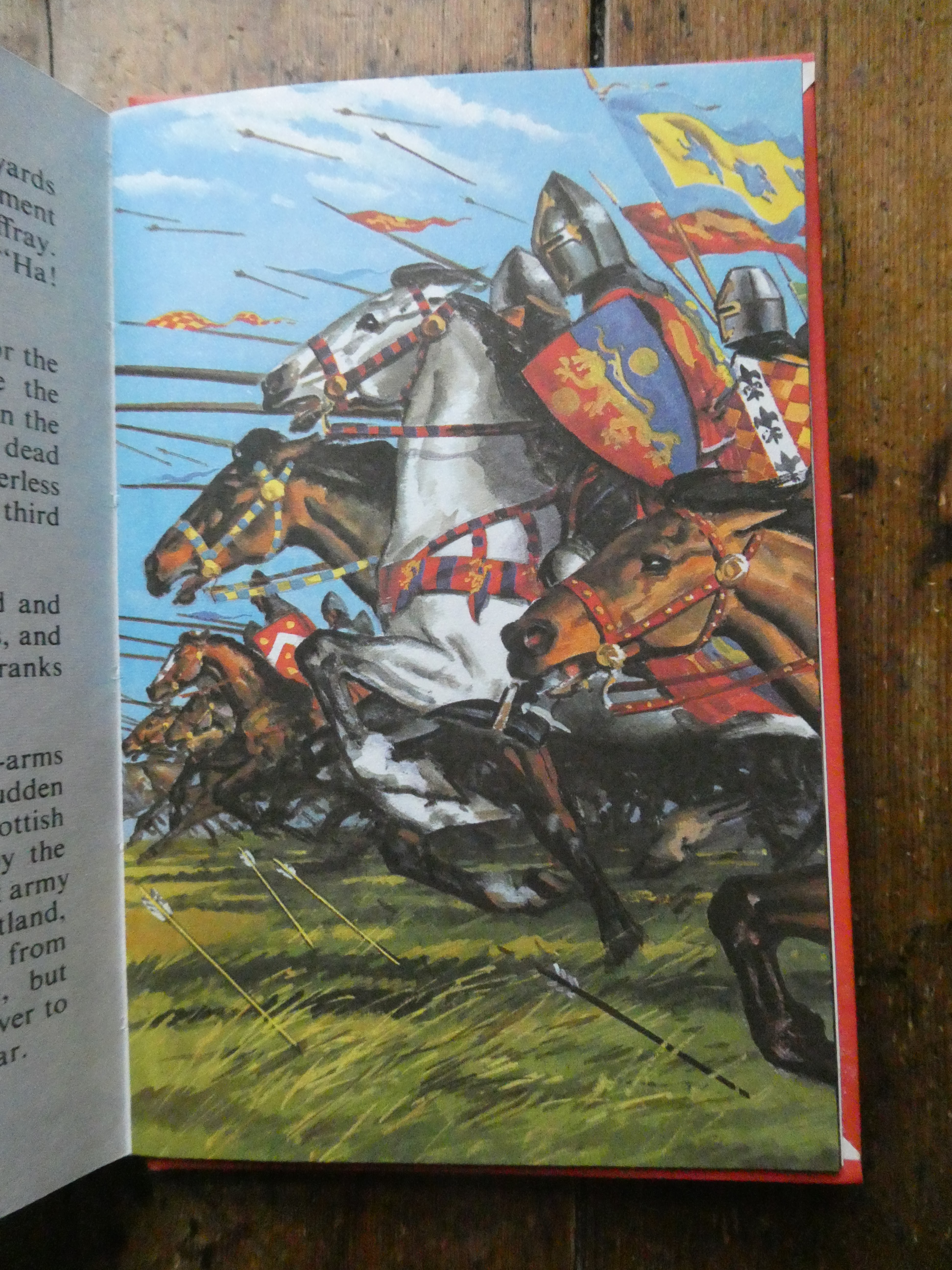
Ladybirds were an extensive series ( over 300 titles ) of small hardback books for children, produced from the about the 1950s onwards, and made a deep impression on several generations of British children, me included. These two are from their 'Adventure from History' series,  and give a (surprisingly unpatronising, non-childish) biography of the subject in 24 pages of text, with 24 pages of often rather  beautiful illustrations. As a child I had a well-thumbed copy of  Robert the Bruce, and when looking through that book yesterday I was amazed by how deeply all of the pictures ( by one John Kenney) had imprinted themselves on my memory! 

'by swift campaigns Bruce beat them in the field and captured their strongholds'


'The army which Edward II gathered to relieve Stirling Castle must have been a fine sight'


'his foot-soldiers were strong and sturdy, and each was armed with a long pike'


'At once the English trumpets sounded for the attack'

 
'Bruce swerved aside, and as de Bohun swept past, struck him to the ground with one blow'

 The narrative is concise and clear, and seems to pull few punches - quite early on it tells of Bruce stabbing to death his rival John Comyn, who Bruce accused of betraying him to the English King.('Comyn had deserved to die for his treachery towards Bruce', says the text), and shows an illustration of Bruce sheathing his dagger while standing over the (partially concealed)  body of  Comyn. Quite strong stuff for 7-year-olds!  Looking through the book was one of those interesting moments where one wonders at the workings of the human memory - I would not have seen these pictures for probably  over 50 years, and yet I knew every one of them.  For that reason alone, I'm glad to have found this little book. I suppose I should by rights be thinking about raising colourful Scots and English armies to refight Bannockburn - but I don't think I could paint all those beautiful coats of arms!


I didn't have the Napoleon book as a kid, but couldn't resist it - and I reckon it will be better, at least  from a historical accuracy point of view, than Ridley Scott's recent essay on the subject(!).  Interesting that there are, however, not many battle scenes in the book, the pictures ( also by John Kenney) seem to focus much more on the man himself.  Rather an effective 'Retreat from Moscow' picture, though.  

The text is interesting in that it concentrates on Napoleon's rise to mastery of Europe, and rather hurries through his decline - the invasion of Russia and subsequent distastrous  retreat, the campaigns of 1813/14 and the 'hundred days' and Waterloo are covered by only four ( out of 25 )  pages of text. The very first page sets out its stall boldly, as perhaps he himself would have : Napoleon Bonaparte was one of the two greatest soldiers the world has ever known...   Napoleon had more energy, more intelligence and a better brain than any other man in Europe ..  Discuss?

There has not been a vast amount of hobby activity over the recent holiday period, but a pleasant time was had, and the Covid infection that I reported on last time turned out to be about the mildest possible case, I'm glad to say; I was fine again within a few days. I have been spending a little time in the world of WW2 aerial combat, which I may report on next time (Tally Ho, chaps!), and another remote gaming opportunity has been kindly offered by Jon Freitag, and gladly accepted.   I hope you all had a pleasant holiday period - it's been interesting to see many bloggers' reviews of the year just passed and plans for the year to come. I'll report on some proper gaming soon,  in the meantime keep well, and a Happy New Year to everyone.