Showing posts with label Ancients. Show all posts

Thursday, 30 April 2026

Where did you get those HaTs?

A slight hobby hiatus occurred last week, while we took a short break in sunny ( but breezy!) Great Yarmouth.  I didn't particularly seek out military history interest there, though the rather good Time and Tide Museum in the town covers the impact of the two world wars - Great Yarmouth suffered the first ever civilian fatalities from aerial bombardment in the UK, from a Zeppelin attack in 1915.  In return,  RNAS/RAF pilot Egbert Cadbury (of the chocolate-making family) shot down down no less than two Zeppelins while based at Great Yarmouth. Here's a picture that's included in the museum display -  Zeppelin L70 falling to Cadbury's DH4 

 (there is a blue plaque dedicated to Cadbury  which we found on a rather posh house on the town seafront where he lived, rather nice quarters for a junior officer). 

I did find a very good hobby  shopping opportunity, though, when I searched for model shops in the area - just down the coast at Lowestoft is the site of no less than the warehouse of Hannants,  "the online store for plastic model kits, plastic figures and accessories" - and the warehouse is open to visitors. We had aimed to take a look at Lowestoft anyway,  so we weren't even going out of our way.

not pretty, but a big enough place.. 
 

Once inside, I grabbed a phone picture of a corner of  the warehouse, which is quite something: 


There are just shelves and shelves and shelves of model kits here, I think the eleven-year-old me would have passed out with excitement! Visitors are allowed to wander round the ground floor, though not the upper decks, but if what you are looking for is shelved up there, the staff will happily go and pick it for you.    

I had worked out a small shopping list, having noticed that they stock the HaT range of 20mm plastic figures, and went away very happy with five boxes of Ancient Indians, Persians and Macedonians :


I bought Persian heavy cavalry, Indian Elephants, Indian Infantry, Persian Heavy Infantry and Macedonian Phalangites - they will bulk up my nascent  ancient armies nicely! I'm particularly pleased to get my first  war elephants  (there are two with crews, in the pack ) - should be fun to paint, I hope. Need I say that Hannants is well worth paying a visit if you are in the area.. 

I have had a little time for painting in the last few days, which I spent (with a table set up in the sunny garden!) applying paint to what should become seven battalions of Piedmontese infantry for my 1859 Risorgimento project. I'm getting into the swing of painting 6mm figures in this fashion;  I've done the jackets (navy blue) trousers (light blue) and shakos (black) of all these in a couple of hours tops, and it's not much more than a single brush-stroke front and back to cover each four-figure strip. 


The great vintage Minifgs re-basing project continues, this week's subjects  are a couple of units of Grenadiers de France. The first lot wear yellow facings and are on rather 'flocky' cardboard bases (which should be easy to remove, at least),  


 and the second unit have red facings, and a really rather lovely painting style, as seen in the close-up below    


The only 'downside' with these is that they are very securely stuck to machine-cut aluminium bases - I think they will be quite challenging to remove! We shall see.. 

Finally for this little round-up, some gaming has taken place: entirely  thanks to Jon at Palouse Wargaming Journal, who hosted a game of the battle of Montebello, 1800 and kindly invited me to join, along with three other players. I won't pre-empt Jon's report, but suffice it to say an excellent game was had with a pretty challenging scenario - many thanks to Jon and the other players!   Jon sent a couple of his pictures of the action, of which I will show one - described as 'the French high water mark', if that's not giving too much away! 


And that's all the news I have for now - the next thing is to keep on with painting the 6mm Piedmontese, which will complete their Division from my planned OOBs. I'd better start thinking how to use those HaT figures to enlarge my ancient armies, too, and make some plans for painting - the main incentive being to get those elephants into  action!   I will of course report progress - until then keep well, everyone.  


Saturday, 18 April 2026

Fighting On All (probably too many?) Fronts..

I've had a little more time for hobby stuff this week, and nibbled away at a few different tasks - though I suspect I am trying to progress, or think about, at least one too many projects! 

Unsurprisingly the vintage Minifigs Seven Years' War/AWI  'great rebasing' continues; Regiment of the Week this week is the French Infantrie Bourbonnais.  They started on slightly scruffy plain cardboard bases, and with no standard: 

  (the regiment was ID'd simply enough - 'Bourbonnais' written underneath the command base).

Looking at the figures, another slight wrinkle is that in common with some other 'French' figures in this collection,  they are actually from the Minifigs Austrian Seven Years War range :

Musketeer figure: code ASW 5  

We'll call that 'wargamer's license'..  They had the usual soaking in water to remove the old base, then new MDF bases - and a flag, simply done with plain paper and acrylic paints, on a plastic broom-bristle flagpole - it's all good...  

..or so I thought.  On proudly showing them off, I've been told 'that flag is upside down!'. Hmmm.. I had found the colours on Kronoskaf Seven Years War, of course, and here they are : 

Copyright: Kronoskaf 
 

Now I was assuming that the pole would be to  the left of the picture, was I wrong? hmm.. Of course, you can search the World Wide Web for 'Regiment Bourbonnais', and get this  (from  a website called Expedition Particuliere ) 


 which looks to agree with me... and then again, also this (from the regiment itself - or at least, a re-enactment group recreating it!) which begs to differ.. 


Now I will admit, the latter pattern seems to be more common on t'internet, so maybe I need to re-do that flag.. Comments welcome - is Kronoskaf wrong, or did I interpret it wrongly?   After the mystery of the Volontaires Etrangers last week, I had thought this next unit was straightforward - yet again it  goes to show the interest and challenges involved in recruiting our miniature armies!

*** UPDATE : I looked around in the boxes containing the vintage Minifigs collection - and I found this : 


 This looks to be the original flag that my Bourbonnais chaps carried, which must have snapped off the  ensign figure at some point, and sadly also broke into two pieces. As you can see, it does not agree with the Kronoskaf version which I used for my source. And so, I think I need to honour the original intention of the person who painted the unit, and I will change my flag to match this.  Many thanks to all who have left comments about this ( Neil invoked the great god Funcken, and Jon found he had  sources on his bookshelf  which disagreed with each other - interesting!), I'm glad it stirred up some interest, all part of the fun! 

I had found that recently the Minifigs rebasing project had elbowed everything else aside, so I am determined to get back to other projects which may be feeling neglected.  I have picked up the 1859 Risorgimento in 6mm project, and have  some works in progress  - first off, four bases (two units) of Jagers and one battery of artillery for the Austrians, to join their 2nd Division. They just need some flags, and colour applied to the bases:


and then the little matter of an entire Brigade, of 6 battalions of Line Infantry, to complete a Piedmontese division. Here are the six battalions, one (24 figures) per coffee-stirrer stick, awaiting priming :


Actually there are seven battalions to do, as the previous brigade is missing one. Even in 6mm scale, I admit that the prospect of painting 168 figures is fairly daunting!  Let 'little and often' be my motto, I think. 

Now for a recent purchase, which I am pleased with: 


  A nice big 6ft x 4ft Battle Mat from Geek Villain, their 'Sicily' mat, which I hope will be useful for my 'D-Day Dodgers' WW2 Italian Campaign project.  Here's the mat (still folded in half, so 3x2 ), please excuse the fold lines, it's been quite tightly wrapped in a parcel!  I thnk it looks pretty decent, and it is good-quality cloth.  Service was good and delivery prompt. too. 


I thought this would  be ideal for Ancients in the Mediterranean region too. I've been reading my copy of Art De Le Guerre rules, and had a look to see if my DBA Macedonian and Achaemenid Persian armies could be used for ADLG.   I looked at the ADLG chapter on army lists to pick out the ('MVP'?) minimum-sized armies suggested for the rules, and found that I do pretty much have sufficient troops. First here is  Alexander's 'pocket army', parading on the new mat: 


The force consists of a couple of units of the famous Macedonian pike phalanx, two units of Companion cavalry  ( actually one of them was painted at Thessalians, but never mind that ), one unit of 'Hypaspists' in the style  of Peltasts, and a couple of units of psiloi (treated as all javelin men). The bases are not quite a match for the suggested ADLG sizes, but are at least all the correct width at 60mm.  The pikes could do with another base (4 figures ) each unit, but that should be simple enough to add. I'm thinking I should also be adding a bit of variety to the bases too, to match the cloth. 

 ..and then, their Persian enemies: 


These have (to the right) three units of Medium Cavalry and one of Heavy Cavalry, a couple of units of Light Cavalry skirmishers (left), and an interesting 'mixed' unit of Heavy 'Guard' Infantry - For these I used Kardakes spearmen as the front rank, and mail-clad archers as the rear rank. From the army list, there really should be another unit of Heavy Cavalry of the Guard, but for now this looks a fairly formidable force.

Once I've got through the rules, these two little armies will clash in a trial battle, which I will report here, of course! More about those rules later, but I am fairly happy with them, on a first reading..


That just about wraps up my recent progress; I will probably have less hobby time in the next week, but hope to resume normal service after that.  Meanwhile I will keep reading and being inspired by all the other excellent blogs  on 'my blog list' here. Until the next time keep well, everyone.

Friday, 21 November 2025

Warfare 2025 - Retail Therapy

Of course, no hobby show is complete without a little light shopping, and I did pick up a few new shiny things at Warfare last weekend. There was a pretty good range of traders present  (see Big Lee's excellent video report on his visit, which featured the trade stands quite heavily ), so plenty of opportunites. Here is a summary of my purchases, the directions they may be sending in.. 

I had pre-ordered a couple of things to collect at the show - first and most important being from Commission Figurines.  I acquired 10 packs of their 6mm MDF semi-flat figures, to increase the forces available to my 'Risorgimento' 1859 Italy armies.  A cunning combination of packs from the Napoleonic and ACW ranges should allow me to represent two divisions of Austrians and one division each of Piedmontese and French - the first time that Louis Napoleon's men have appeared. 


 A major plus point for these figures is that a packet of nearly 100 infantry costs just £2, and that will make four battalions - very economical!  I am using Napoleonic British infantry in 'Stovepipe' shako for Austrian infantry, and ACW foot and artillery in Kepis for the French, for example -  as I think my friend  Chris aka Nundanket has said 'as long as the hat looks right, you're OK'..

My second 'pre-order' was from NewLine Designs  20mm Ancients range - specifically the 'personality' set of Darius of Persia in his chariot. I already had their Alexander figure for my DBA Macedonian army, so obviously I needed Darius.  And here he is, in kit form.. 


 I am quite looking forward to assembling and painting this, along with Alexander  (albeit the latter is a simple single  mounted figure ).  

Having dug out the Macedonians and Persians the other week and tried out Dominion of the Spear rules with them,  I admit I had a hankering to add another DBA-sized army to the collection, allowing a potential three-cornered campaign - so obviously, I needed Porus and his Indians.  I was fortunately able to make good on that idea, thanks to a couple more acquisitions :

First these two HaT 1/72 packs,  which I found on the Grubby Tanks/Brittannia Miniatures stall

These will provide up to 12 cavalry and 3 chariots, which should be plenty for a DBA-size army. I was mildly disappointed that they didn't have the Elephants pack from the same range, but I'm sure they will be available for on-line ordering  somewhere - it wouldn't be  Porus' army without some elephants! 

I also spotted some appropriate infantry on the Newline Designs display, so I picked up 2 packs (4 per pack ) each of their archers and javelin men - I think they are rather nice: 


I am looking forward to painting these too, they are nice figures, and I have a piece of wargaming magazine nostalgia to inspire my efforts too, of which more in a future post. 

Well, the above seem to have go me well and truly into an 'ancients' mood, and that doubtless influenced a couple of purchases from The Society of Ancients stall, and the pen of Phil 'Lost Battles' Sabin :  


Strategos II is a set of fairly simple rules for tabletop battles, using a gridded system. Armies are a little bigger than DBA, for example, which suits my longer-term plans, and I know Phil Sabin is absolutely an expert in this field, so it will be interesting to see how these play.  Empire is 'a very simple game... simulating the struggle for imperial dominance between Carthaginians, Romans, Macedonians and Persians/Parthians, from the 4th to the 2nd centuries BC'  - I am intrigued by the way that this period saw the parallel existence of all those powers, and the resulting campaigning possibilies (real or imaginary). The game has rather a nice map, too: 


 With a simple strategic game and more than one set of relatively simple 'small armies' tactical rules, I can feel  an Ancients campaign coming sometime in the future (though of course that might mean raising Roman and Carthaginian armies too!). 

And last but not least, I couldn't resist a bargain (it was the cheapest item here), from the second-hand books offered by  Stonewall Figures  - not quite directly relevant to the above purchases, but who can refuse a piece of vintage (1981)  Terry Wise, with classic illustrations by Angus McBride?  

file under 'comfort reading' 

 And that, as they say,  is about that - not a bad selection of stuff new and old, which should keep me busy in the winter months. I will need to have some regular painting sessions for the various figures, but I think I have kept them to manageable numbers which can be painted fairly quickly without boredom setting in.  

 As a quick postscript, I was fortunate last week to take part in one of Jon Freitag's remote games - this time the Reconquista battle of Zallaqah 1086.  I took the part of King Alfonso VI, leading his Knights to... well, I'll let you read about it in Jon's battle report.  A very challenging and tense game that went right down to the wire - many thanks to Jon and the other players for a great evening's gaming. The picture below shows an 'interesting' manoeuvre that I tried with Alfonso's Knights..


 Anyway, do read Jon's report for a flavour of the back-and-forth of a nerve-wracking game! 

Next time, perhaps an account of an interesting talk that I attended recently. Until then keep well, everyone. 

Friday, 7 November 2025

Dominion of the Spear : Gaugamela 331BC

Having tried, and enjoyed, Dominion of rules in both Pike and Shot and Bismarck  variants, I saw the 'Ancients' version  Dominion of the Spear being used at The Other Partizan show last month, by Wargame Developments for their Alexander the Brief game.  Of course, that made me think 'I have Macedonian and Persian armies for DBA, could I use them for this?' Well, of course I could!  I also liked the printed booklet edition of the rules that they were using - so I ordered myself a set of 'DotS' from Lulu.  I bought a combined book of the basic rules and army lists, plus scenarios for 36 historical battles from Megiddo (1479 BC) to Agincourt (1415 AD). 

 One of those is Gaugamela ( or Arbela ) from 331 BC,  in which Alexander The Great's Macedonians  fought Darius III's Achaemenid Persians - deciding the fate of the Persian empire.   So let's give it a go.. 

The scenario has opposing armies as follows: 

Macedonians:     1 x Elite Armoured Cavalry ( Companions )  
                            1 x Cavalry ( Thessalians) 
                            1 x Elite Armoured Pikemen ( Phalanx )
                            1 x Spearmen ( Peltasts ) 
 
Persians :             3 x Cavalry
                            1 x Chariots (scythed) 
                            1 x Horse Archers
                            1 x Archers
 
So the Macedonians are outnumbered  6 units to 4, but have two very powerful units in the Companions and Pike Phalanx.  I don't yet have a Persian Chariot unit, but in the rules they are equivalent to 'melee mounted'  cavalry, so I simply replaced them with another Cavalry unit, making 4 in all.  I set up a very minimalist table, like this: 
 
The Persians are on the left of the picture, Macedonians to the right. At the top ( Left sector )  the Persian Horse Archers face Alexander's Companion cavalry; in the Centre  we have Persian Cavalry (standing in for Chariots)  against Macedonian Pike Phalanx;   and in the Right sector (bottom of picture) another Persian Cavalry unit is up against the Thessalian  cavalry.  In reserve (far left of picture) the Persians have two further cavalry units and the foot archers,  while the Macedonians (far right) have just their single unit of  Peltasts.    These dispositions were as specified in the scenario booklet.   And so, to battle.. 
 
First of all,  I diced for Attacker/Defender roles - the Persians rolled highest, and were deemed 'Attacker',  meaning they would go first in each turn. There are no less than three suggested variants for activating units in the rules, and I chose 'Option B', whereby on each turn the Attacker chooses one of the three sectors to initiate combat, and after that combat is resolved then the Defender in their turn  gets to choose one sector to fight in (which may be the same one as the attacker chose). 
 
Turn 1 began with the Persian 'attackers' choosing to attack with their cavalry in the Right sector against the Thessalian cavalry - the least powerful front-line Macedonian formation. Both are 'melee mounted' troops, so combat is a simple opposed 1D6 die roll  with a target of 4,5 or 6 to 'hit'.   The Persians rolled a 6 (hit), the Macedonians a 3 (miss) - so the Thessalians were defeated and removed from the game - simple!   When a unit is removed, it is replaced by a unit from the Reserve, if available  - accordingly, the Macedonian Peltasts moved to the Right sector to plug the gap. 
 
After Persian turn 1 - Thessalians gone, Peltasts move up
 
In their turn, Alexander's Macedonians set their Pike Phalanx moving forward to attack the Persian cavalry in the Centre sector.  Having 'Elite' status gave the Pikes an advantage in attack, and being 'Armoured' gave an advantage in defence, so it was not too surprising when the  cavalry was scattered by the mighty Phalanx ( it didn't help that the Persians only rolled a '2' ).   Darius ordered another cavalry unit to move up from Reserve to replace their defeated comrades.  At the end of Turn 1 each side had lost one unit, leaving 5 Persians against 3 Macedonians. 
 
Macedonian Turn 1 : one less Persian Cavalry! 

 On Turn 2, Darius ordered his Cavalry in the Right sector to attack the Macedonian Peltasts, again steering clear of the Companions and Pike Phalanx.  Cavalry and Peltasts being both 'melee' types were evenly matched - this time the dice went Persians 3 (miss) , Macedonians 5 (hit), and the Persian cavalry were routed.  Darius then ordered his foot Archers forward from Reserve.   With only average units facing  'Elite Armoured' Macedonians in the other two sectors, things looked pretty tough for Darius.  And then...
 
Turn 2 : Macedonian Phalanx overthrown! 

 For his Turn 2 activation, Alexander decided to keep his Pike Phalanx rolling forward in the Centre, ordering them to attack the Persian cavalry there. With advantages for being 'Elite' and 'Armoured', it seemed likely to be a repeat of the previous turn  - until the Macedonians rolled a '2' (miss)  and the Persians a '6' (hit!).  With that, the Phalanx dissolved and routed off the field - a serious blow for Alexander!  With no more units in Reserve,  this left their Centre sector empty - a very big hole in Alexander's battle line.  At the end of Turn 2, the Persians had 4 units against the Macedonians 2. 

On Turn 3, could Darius exploit the advantage so unexpectedly gained? He ordered his Centre sector Cavalry unit to make a Flanking Attack on the Peltasts, who would not be able to fight back. Now this was also 'match point', because if the Peltasts  were to be destroyed, Alexander would have only his Companions left on the field - and the rules say that if an army has zero or one remaining unit, and fewer units  than their opponents, at the end of a turn, the battle is lost.  So, rolling for the game - the Persians' dice showed - a '1' !  The Peltasts survived, and Alexander was still in the game.
 
Persian Turn 3 : Cavalry outflank Peltasts 
 
Now Alexander really needed some success to level things up - time for the Companions to attack! Facing them were Persian Horse Archers, and the combat rules decree that these ('Missile Mounted')  would shoot first at the charging Companions ('Melee Mounted'). They did so, a difficult shot owing to the Companions 'Armoured' status  - and perhaps unsurprisingly, missed.  The Companions charging home, had a 'plus 2' on the die roll  ( Elite status and 'Melee vs Missile'), but could only roll a '1' - no result. So, Turn 3 left the overall situation unchanged.    
 
For Turn 4,  the Persians had little option but to repeat their previous attack - their Cavalry in the Centre making a flanking attack on the Peltasts. Sadly for Darius, they also repeated their die roll of '1' - no result, and the Macedonians breathed again.  In their turn, they too repeated themselves, the Companions charging again at the Persian Horse Archers.  Again, the Horse Archers shot and missed, again the Companions charged home, and this time were not to be resisted. the Horse Archers were routed, to be replaced by the last Persian Reserves, their fourth unit of Cavalry. 
 
End Turn 4 :  can Alexander hang on? 
 
Thus at  the end of Turn 4, things looked a bit more equal - 3 Persian units vs. 2 Macedonians. The Companions still a powerful threat, but the gap in the Greek centre equally dangerous.  Could Alexander save himself?  
 
For Turn 5,  the Persians again had really only one option - keep attacking those Peltasts! Accordingly, their Centre sector cavalry charged for a third time at the flank of the Peltasts - and this time the dice gods were with them. They rolled a  '6' , and the Peltasts were duly destroyed.   
 
Turn 5 : Peltasts finally routed
 
Now this spelled doom for Alexander - even if his Companions could destroy their immediate opponents, at the end of  Turn 5 he would have only one unit against two Persians, and would thus lose the battle. So I could have called the game at that point, but I thought I would give Alexander his chance to even things up a little, so I played the Macedonian round. Of course the Companions attacked the opposing Persian cavalry,  but it seems both sides were becoming tired at this point; the Macedonians rolled '2' and the Persians '3', giving no effect. That ended Turn 5, and with just one Macedonian unit facing three Persian,  a famous victory went to Darius.  Perhaps history would be re-written, as Alexander's invading force  was forced to retire and the Persian Empire lived another day..
 
Turn 5 end: Alexander's last charge can't save him

I rather enjoyed that - once again the 'Dominion of..' rules proved very simple but quite clever. Things looked very tough for the Persians at the start, with no unit really matching up to  Alexander's Companions and Pike Phalanx, all 'Elite' and 'Armoured'.  But the dice intervened and the Pike Phalanx must have become disorganised, to be broken up by Persian cavalry - after that, Darius was in with a real chance, and eventually prevailed, not without some difficulty!  I think 'Quantity has a Quality all its Own' also applied, the Persians being able to keep feeding in their cheaper  units to replace losses, stay in the game and hope the dice came up in their favour, whereas Alexander relied on fewer if higher quality units, and was thus more vulnerable to attrition.  Losing the Pike Phalanx was the real killer!      
 
Not everyone's cup of tea, I'm sure, and very much dependent on '1D6'  results, but a fast and furious game  with some tactical subtlety required when deciding where to attack and  which units to call up from Reserve. Actually having a Reserve is perhaps unusual in table-top wargames, and very welcome  (see Big Lee's recent discussion) - in that respect, does this very simple game prove more 'authentic' as a command challenge than many more complex systems? 
 
Like many a simple game, I'm sure there is scope for tinkering and  expanding - the author (Steve Parker)  discusses options for larger armies ( simply more units in reserve, or perhaps  more powerful units ), and for larger battlefields ( increase the number of sectors ), and I wonder if multiple units per sector might be interesting - I assume all these would make for a longer-lasting game and perhaps less of a 'sudden death' style.  The small numbers of units required for a basic game makes it attractive to try out different armies - I have a few very vintage  Airfix Ancient Britains , who might become a Gaulish army, and I think I bought a box of HaT  Carthaginians - so obviously I just need some Romans now.. and so the megalomania starts! 
 
I hope this has been interesting for you; it was certainly good fun for me, and I will no doubt return to the theme. The next big item on my hobby agenda is the Warfare show at Farnborough  next weekend,  which I hope to visit and will try to report on, and those vintage Minifigs 7YW/AWI armies need some proper storage and organisation - and of course, to be used in a game! Until then, keep well, everyone .


Saturday, 18 May 2024

Fnurban #30 A Mighty (Roman) Fortress

Following on from last time's Roman theme,  I have recently visited an impressive Roman site - Burgh Castle,  on the Norfolk coast.  Last month we spent a few days at Great Yarmouth, and Burgh is just out of town from there, so we took the chance to see it. It was well worth a visit! 

About a 15-minute drive out of  Yarmouth town, the site is owned by the Norfolk Archaeoligical Trust (the stone walls are managed by English Heritage). There's a car park, then a short walk across a field to the site - passing the nearby round-towered church (a Norfolk and Suffolk speciality) which is also worth a  look. .You are greeted with this sight: 


What you are seeing here is just over half the width - the gap in the wall to the left is the East Gate of the fort, which is in the middle of the East wall. Overall, that wall looks to be a bit over 200m long, and as you can see it is pretty much complete.  That goes for the North (shorter) Wall too, and the South Wall is about half-preserved - the West Wall has gone, probably tumbled into the river it sat alongside. So overall, more than half the fort's walls remain, and they survive to their original height, too, with complete bastions at intervals along the walls and at the corners. 

Bastion in East Wall


and a closer view, note red tile courses


North-East corner

Visitors can go through the gate and look around inside the enclosed area, which gives views across marshes and the River Waveney running next to the site.  There are no remaining structures or ruins inside the walls, but you get a good impression of the area that would have been enclosed - about 2.2 hectares in all. 

It seems that Burgh was built in 'the late 200s AD' which I take to mean late in the 3rd Century, as part of the 'Saxon Shore' ( Litus Saxonicum ) chain of forts which stretched from Brancaster, Norfolk, to Porchester, Hampshire - the name seems to mean 'the shore attacked by the Saxons' or  'The shore of the Saxon Sea' .  It is possible that the forts may have originally been built as naval bases for controlling and protecting trade across the North Sea,  but they are now mainly associated with defending the coast of Roman Britain from Saxon invaders, whose first documented raid on Britain was in 286 AD.  The landscape has changed since then, but originally Burgh would have stood at the mouth of a 'Great Esturary' into which flowed several rivers,  with another fort, Caister Castle, standing on the oppoiste side.  The fort would have been able to house 500-1000 infantry, or up to  500 cavalry. It is known that the garrsion included a cavalry  unit called the Equites Stablesiani.  There is also substantial archaeological evidence of a significant civilian settlement ( vicus )  outside the walls.

The walls themselves are about 3.2m thick at the bottom, 1.5m thick at the top, and 4.6m tall - complete except for a parapet which would have stood on top. They were  built with  a rubble and mortar core and  flint facing stones, with up to seven triple layers of red fired clay tiles helping bond the facing stones to the core. Six of the original  ten bastions survive.   All very impressive - the relatively complete walls give a powerful impression of how imposing the fort would have been when in use. Needless to say, if you are interested in Roman military history, you really should see this!  By chance we visited on an 'open day' with a stall and display by the Norfolk Archaeological Trust, which allowed us to buy a guidebook covering Burgh, Caister and Brancaster - from which the information here is taken. Of course there are websites - from English Heritage and Norfolk Archaeological Trust.   

Great Yarmouth itself has a decent selection of historical sites, including some stretches of medieval town walls - and for those interested in the  ECW, you can visit the Elizabethan House Museum,  a 16th Century merchant's house  with its rather grand 'Conspiracy Room': 


 It seems that in 1648 the heads of the New Model Army ( including Cromwell ) were  at Yarmouth, and the house's owner John Carter was commander of the local Trained Bands, and would have hosted the senior officers. It is said that in this room a meeting was held, at which the decision was taken to put King Charles on trial for treason - this of course resulted in his execution the following year. 'A great reckoning in a (fairly) small room', perhaps?

That's enough historical meandering  for now.  In the meantime there has been a little hobby progress, as I have been getting on with painting my 'D-Day Dodgers'  WW2 Indian battalion 


Very much a work  in progress, but we are getting there - perhaps the next post here will show off the completed unit, if I keep up with the painting sessions.  Meanwhile, keep well, everyone.

Saturday, 11 May 2024

Fnuraban #29 I Am Legion

The other day I was fortunate to be able to visit the British Museum, to see their exhibition Legion: Life in the Roman Army.  the first thing to say is that it's well worth a visit if you have any interest in the Roman Army,  but be sure to book ahead and be prepared for it to be pretty busy! ( not intolerably so at 11:00 am on a Thursday morning,  I'm glad to say ). 

I took some pictures, and I'll simply show those I think, with a brief commentary.  Of course these are only a minority of the objects in the whole show. So, in more or less the order of the exhibition: 

Auxiliary Infantry

 There were a fair number of these sculptural pieces depicting Roman soldiers with identifiable weapons, standards etc. I didn't take detailed notes, but I think these are 3 auxiliary spearmen.  


Legionary Sandals 

Some amazing survivials of perishable items were included - there was even a pair of legionary socks, with a division for the big toe,  allowing them to be worn with sandals. Sadly I didn't get a picture of that.  

Legionary equipment: Sword, Belt, Dagger, Tools

An interesting point made was that the mark of being a Roman soldier  was the belt, sword and dagger etc rather than any particular items of clothing/uniform.  One of the caption cards even stated  there was no specific uniform beyond a military belt.   Now that very much caught my eye, given the very uniform appearance of all modern depictions of Legionaries - though it was also stated that helmets, armour etc did tend to be standardised (even if made in local workshops which allowed some variation), and I suppose this would tend to impose a 'uniform' look.  

Another fact that I had not been aware of was that soldiers were expected to provide or pay for their own equipment - the narrative of the show was maintained by following the story of a real soldier of the early second century AD whose letters have survived. In fact, most of the letters quoted seemed to be dominated by his pleading requests for money or equipment ( 'I have replaced my  footwear twice a month').  It was also interesting that there were hurdles to be cleared even to join up - only a Roman Citizen could be a Legionary, and they needed letters of reference to support their application. Our example soldier had to join the lower-status Marines first, before eventually getting into a Legion.   Surprisingly to me, the pay rates quoted were 250 denarii per annum for an Auxiliary (non-citizen) but only 300 denarii for a Legionary. Obviously, more senior ranks were paid a lot more - a Junior Centurion about 15 times the Legionary rate, I think? 

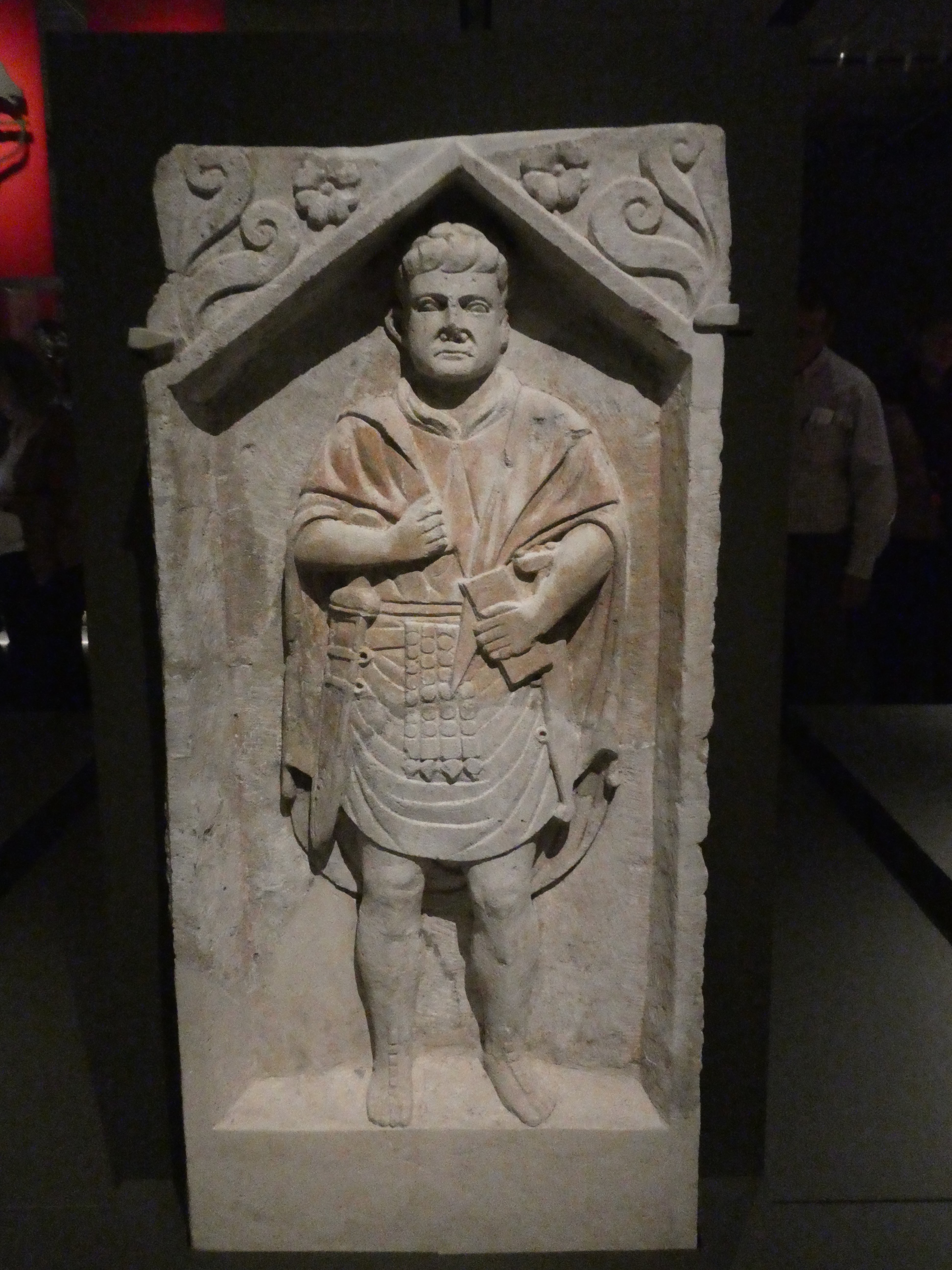
There were quite a few depictions of actual soldiers in their equipment, taken from their funeral monuments - it seems that they signed up for 25 years service, but only about 50% survived to see out the full term, owing to disease as much as battle. Many of the monuments were to men aged 30 or below.  I took pictures of a small selection of them, including a young Centurion named Marcus Favonius Facilis,  who had died at Colchester sometime before the Boudicca revolt of 61AD.  


Literate soldier holding a book 

Standard Bearer with 'Emperor head'


Grave Monument of a Centurion (Marcus Favonius Facilis) at Colchester, 50-60AD 

Legionary Shield and Boss

..and from the back

Now this was really interesting, and may be the only complete example of such a shield in existence?  It was stated that the wood and leather construction means that the curve has been exagerrated by shrinkage/warping over time, it would originally have been more gently curved. Note also the metal boss, of course.  It was fantastic to see this item, along with one or two others (see below) it was worth the price of admission just to see that! 


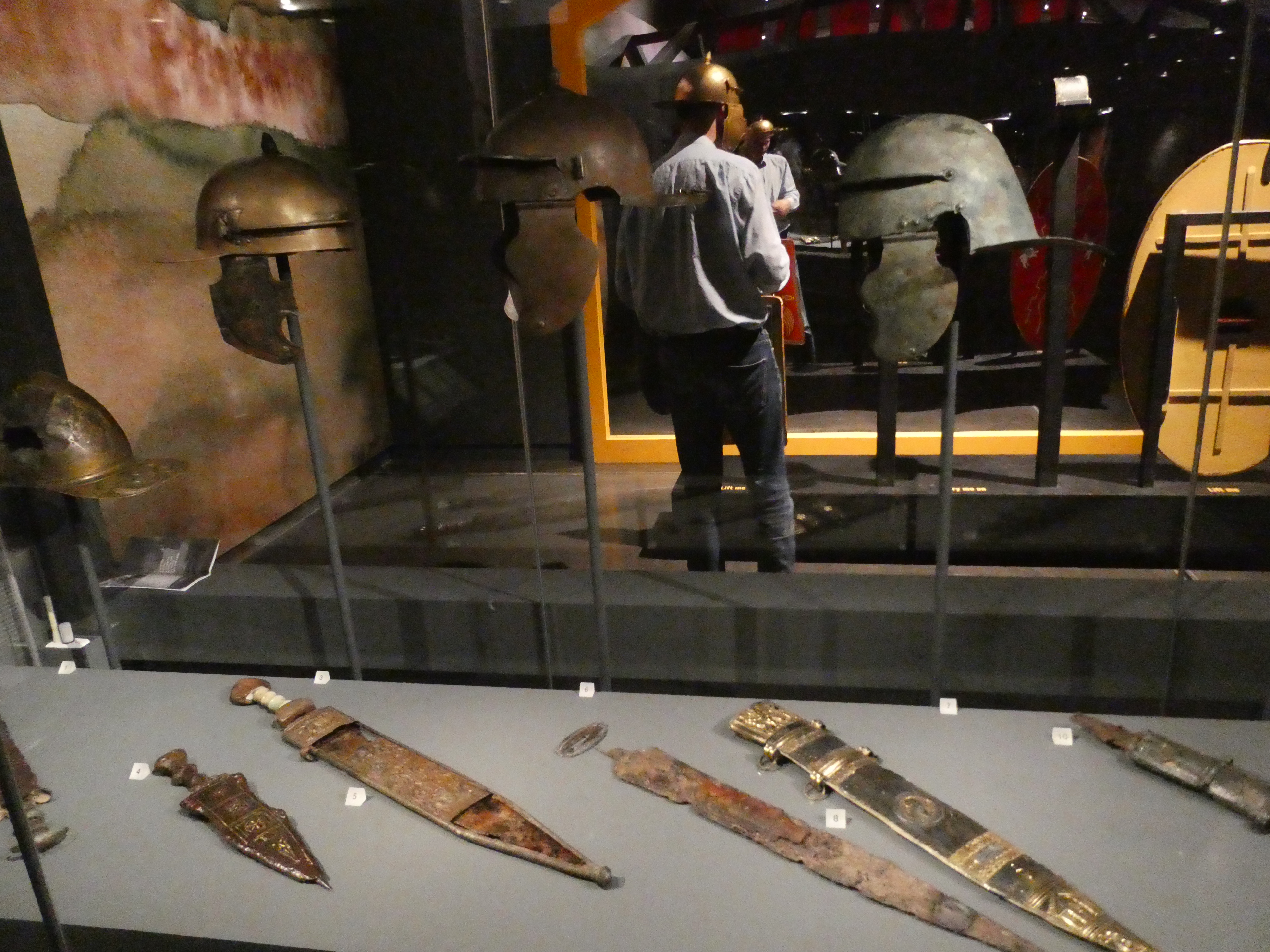
Swords, Daggers and Helmets (and someone trying on a replica helmet!)


'new pattern' short sword, c.79AD

high-quality helmet and segmented armour

Legionaries in Battle Formation

Cataphract Horse Armour c.200AD - amazing stuff!

The Cataphract Horse Armour was another real eye-opener - if you are interested in the later Roman army, you probaly have to see it.   Pretty much the entire 'trunk' of the horse was covered by overlapping metal scales, which must have been pretty heavy, too!   

And then to complete a trio of wonders, an almost-complete Legionary Cuirass...  This was stated to have come from the battle site of the huge defeat in  9 AD , at the hands of Arminius ( aka 'Herman the German')  in the Teutoburger Wald, and I think stated to be the most complete that has been found.   Another 'worth the price on its own' moment? 

Complete Legionary Cuirass - from Teutoburger Wald


Father and Son soldiers - with hand-me-down equipment

After the required 25 years there would be a handsome bonus for retiring soldiers - and non-citizen auxiliaries would be granted citizenship. The Army was a tough life, but was clearly seen as a good career, and sons would follow fathers into the ranks - sometimes weapons and equipment would be passed down, as depicted above. 

I was also interested to learn about the size of the army - we are told that when Augustus first instituted the Imperial  Roman army,  it had a strength of about 300,000 (half of them Legionaries),  while the population of the Empire stodd at about 60 million.  A map of the empire about 100 years later ( which I really should have photographed!) showed I think about 20 to  30  legions and where they were stationed in the Empire - unsurprisingly, most were along the borders with barbarian areas and other empires such as the Parthians. From my memory, the whole of Gaul required only one Legion.  Given the sheer size of the Empire, a surprisingly modest establishment?   ( c.f. today's British army, also defending about 60 million population - much less than 300,000! )   

If all this (and the chance to wear a replica helmet at one point, which I did not take alas )  inspires the re-enactor in you, the gift shop will oblige - I was slightly surprised that the armour was priced at about £200 - I think I would have expected it to be more! Didn't see anyone buying, though. The exhibition catalogue is well-produced and  doubtless most interesting, but at £30 for the paperback version, I thought I'm not quite enough of a Romanist.. 


from the Gift Shop : be your own Legion (for a few hundred quid)

And finally, there had to be a gaming angle - in a display on camp/barracks life,  examples of a Roman board game -  and  a dice tower, just as many gamers would use today. The caption stated that these were seen as a way of preventing cheating when rolling dice. Nothing new under the sun...  

nothing new under the sun: that's a Roman Dice Tower! 

That's about all the pictures I took, I probably should have taken many more and made extensive notes, but it would have been a much slower visit, and I was with a 'civilian' ( i.e.  non-wargaming!) friend! Going at an average visitor pace it was about a 90-minute visit,  I suspect I could have stayed longer. Lunch was required, and the Italian Cafe ( 'Tropea' ) in Russell Square gardens seemed highly appropriate, on a nice sunny spring day.  The exhibition was a thoroughly worthwhile visit;  if you are interested and able to get to London easily then I'd recommend it. 

Meanwhile I have made slow progress painting WW2 Indian infantry, so hope to show the results soon, but next time  I think a bit more recent Roman-related sightseeing. Until then, keep well, everyone.