Sunday, 23 April 2023

Salute 2023 : It's Back and it's Big

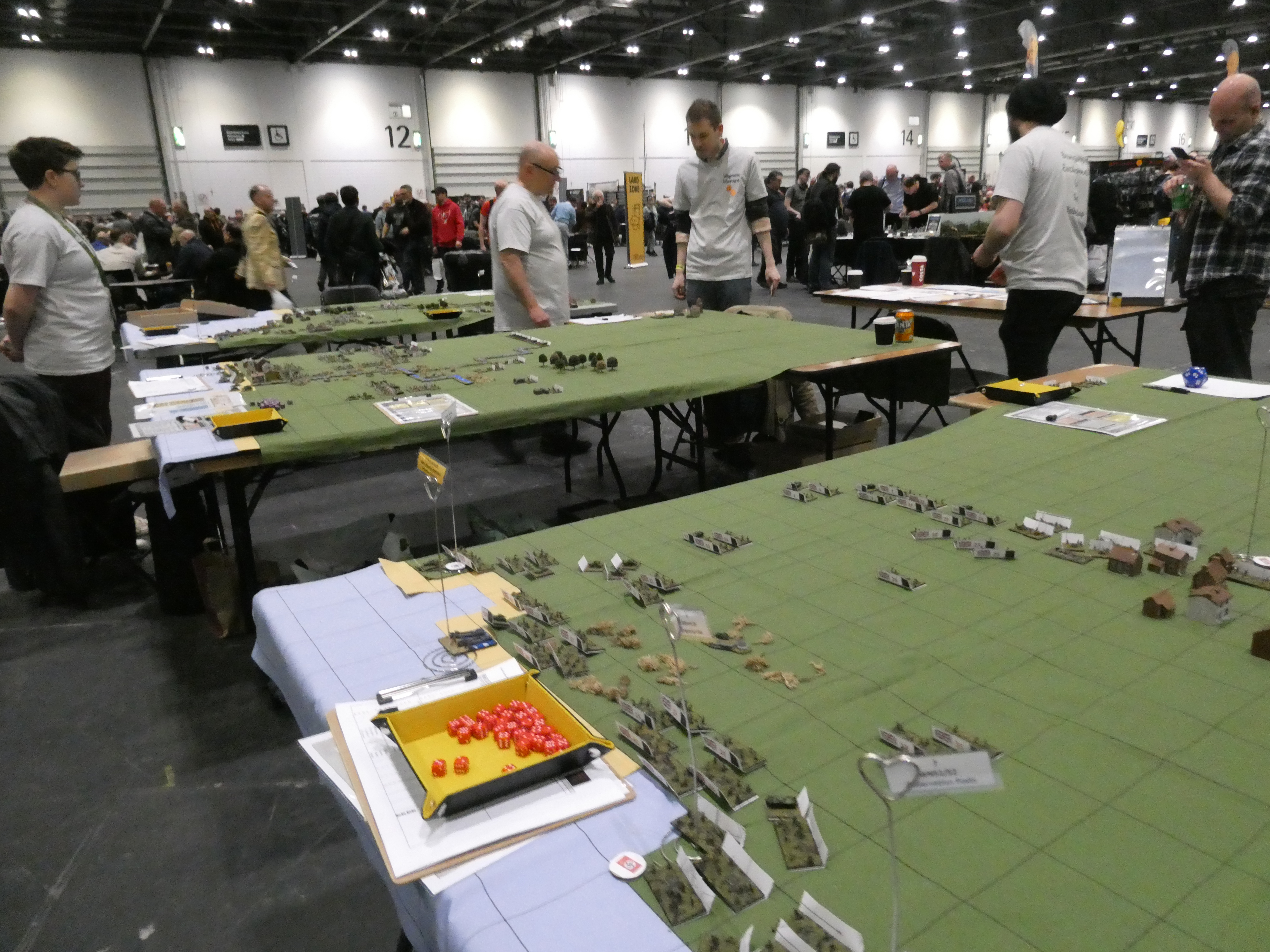
Yesterday I went along to the Excel exhibition centre in London for 'Salute 50', the 50th occurrence of what must be Britain's largest wargaming show.  The show 'didn't have a good war' in the pandemic - the delayed 2020 show in November 2021 was a bit below par  -  but I think it's fair to say it was back to normal this year. The program listed about 60 games and over 120 traders(!), and I gather over 5,000 people attended,  It was big, crowded and noisy, and hard on the feet and legs! But I enjoyed the day, and there were many really impressive games on display. Of course I took a few ( only about 80 in the end! ) photos, so I can show a selection of the games that interested me. These are more or less in the order I walked around the hall - but I admit the first game I saw was one of my favourites! 

This was a large ( to say the least ) Seven Years War game entitled 'Bread and Beef',  depicting the battle of Battle of Domstadtl ( 1758 ) and put on by chaps called the 'Ardhammer Group' who had come all the way from Newcastle for the event. Around 2500 30mm German Flats using The War Game rules by Charles Grant. Austrian Force attacking a Prussian supply column.  That ticked quite a few boxes! One of the group had spent over 40 years collecting and painting the figures, but never previously used them in a game, it seems. The figures were great  and the guys were freindly, chatty and welcoming, and clearly having a great time - it was all rather lovely, and a really good game to have 'on point' by the entrance to the show. 

Some of the 'Beef' caught up in the fighting

 I managed a few close-ups of the figures, which speak for themselves, I think..


proper 'Grant size' regiments


..with artillery support


Charge!

And a moment of revelation - in probably over  45 years since first acquiring my copy of Charles Grant's The War Game,  I admit I have never seen one of these (below) in real life.. I was just delighted to see it!

The fabled 'Canister Cone'
 

The guys admitted it was quite a difficult thing to construct ( from wire and solder ), and that they had baulked at doing the 'howitzer circle' in the same material! 

  
Anschluss Publications always put on a nice-looking game with their War on the Ground rules, this time they were in the early days of Operation Barbarossa, 1941 with  German infantry running into Russian armour 

The War on the Ground, Russia 1941
 

'The Old Guard' group staged a game of Austerlitz, 1805 using the Command and Colours board  game system, with 28mm figures and model terrain replacing board and counters, and it looked great! 

Austerlitz using C & C

A simple yet very effective idea, and  especially interesting as  I assume this was pretty much the same C&C Scenario  that I had played last summer at my good friend Dave's place - now then Dave, how about using your Napoleonic figures on the C&C board? 


 Warlord Games showed a game using their 'Epic' Pike and Shotte system - the recently-released figures of which some were given away free with Wargames Illustrated magazine.  

'Epic' ECW
Here are some of the figures, in an 'Epic' regiment: 


Cornwall Wargames Association used the new 'Mark's Little Soldiers' for The Zagory Rebellion :A Night at Heidi's   , described as a pseudo-nostalgic game based in Mark Coppelstone's..inter-war world.  It did have a certain look about it - I liked the aircraft, and the all-round shinyness.. I can well see the appeal of the figures.


 Rival ancient Greek phalanxes competed in more ways than one, represented by first  Simon Miller's  giant To the Strongest game  of Ipsus (301 BC)  :


"you could have your eye out.. "

and by John and Diane Sutherland's equally gargantuan Command Decision : Leuctra 371BC, Spartans vs Thebans


( if you have very deep pockets, it seems the armies from this latter are for sale.. )

 Gustavus Adolphus of Sweden  rode again in The Friends of General Haig's Dirchau/Tczew 1627 game of Swedes vs. Polish-Lithuanians,


.. and went on his 'Death Ride' at Lutzen 1632,  with The Officers Mess 1:1 scale cavalry fight


Hornchurch Wargames Club's Ntombi River Zulus vs. British action  from 1879 had brilliant terrain and figures plus excellent 'dressing up' :

'Zulus, sir.. thousands,,'
 and worryingly few Red Coats defending their supply wagons - I didn't give the Brits much chance! 


Andy 'Lord Callan' (as it said on his shirt ) was running a Never Mind the Billhooks game promoting the new 'deluxe' volume of those rules, on a splendid Italian Wars terrain 


 Another great terrain model was from the ever-inventive Loughton Strike Force, with their Mordheim: chos in the streets 


But I think my favourite terrain spectacular came from the London Wargaming Guild with Cold Doings In London, a 1650s Frost-Fayre set 28mm skirmish participation game on and around an amazing model of old London Bridge. Impressive indeed!


More conventionally, Hailsham Wargames Club's  Bombay Mix Up  28mm Indian Mutiny 1857 game looked nice 


 but I stupidly forgot to photograoh the equally good Crawley Wargames Club  Sikh War 1845 Ferocious Fighting at Ferozaphur. Hopefully others will show that too!

Finally, I liked Wigmore Warriors WW2  big battle spectacular  D-Day landings game, which used three large tables ( I think each base of troops represented a company ) - maybe not quite so pretty, but they were revelling in just being able to use a big space to put on a big game! 

That's about it for my photos, but of course it's nowhere near all the games, there were loads more that I didn't get round to photographing  - no doubt other blogs will show them, if you look around - Big Lee's review  is a good bet! As I think you can see, there was a really impressive set of games on show - thanks and congratulations to all involve in putting them on.

Apart from the games, there is the social aspect, and the shopping, of course... It can feel like anyone who is everyone in the hobby is somewhere among the 5000 visitors, and also every possible trader! For the social side I plucked up courage to attend the 'blogger meet-up' organised by Big Lee - see Bob Cordery's blog for his picture of the assembled bloggers  ( I am the shifty-looking character second from right )  -  I had a good chat with Bob, and David Crook, and was really pleased to make the acquaintance of Rob Young of The Eastern Garrison - good to meet you,  Rob!

There was also a little light shopping - just a handful of  figures ( 15mm 30YW Generals from Essex,  and WW2 British 20mm PIAT and 2inch mortar crews from SHQ ) and no less than 3 different rulebooks - I may have got carried away there!  But not huge expensive ones, I hasten to add. More of those in future posts, I hope. 

I spent at last 5 hours in that cavernous and slightly dimly-lit space before finally emerging blinking into the afternoon sunshine and making my way home, 'tired but happy' - for once the cliched phrase fits just right. Salute is a real 'Marmite' show and I know lots of folk just don't fancy it, what with expense of transport/parking, the somewhat unforgiving environment of the space ( especially on the feet ) and the sheer size of it. I understand that point of view, but I can just about 'hack it', and it feels worthwhile once you're home and able to put your feet up! So that was 'Salute 50', certainly a long way from the old days at Kensington Town Hall, but still worth the trip, I reckon. Thanks to all concerned - next show for me  is ( I hope )  Broadside, at Gillingham in early June - which will be a little more relaxed, I suspect! Keep well, everyone.     

Wednesday, 19 April 2023

Starting with Saxony.. and Salute

Having set up a 'painting queue' in the previous post, real life promptly got in the way and not much hobby time has been available - I'm sure you all know the story.  But I have made a small start, with the Spencer-Smith figures who will be representing the forces of Saxony in the Seven Years War. 

I have a couple of Portable Wargame infantry units and one of cavalry in the queue, and have been deciding how to paint them, and what real-life units to represent. I have two sources of information; the Helion books Between Scylla and Charybdis ( parts 1 and 2 ) by Marco Pagan, and the amazing Project Seven Years War website on Kronoscaf.com.  

An appealing feature about the Saxon Infantry is their bright and varied colour schemes despite the rather generic 'white coat'  uniform - there are large areas of facing colour in the outfit, and the various regiments give  several different facing colour options - Sky Blue, French Blue, Dark Red, Crimson, Green , Yellow etc. They look to me exactly as the layman would expect for a soldier of this period - and as I remember seeing soldiers portrayed in an opera production of The Barber of Seville.  They do look like a classic 'Imagi-Nation' as dreamed up by Charles Grant or Henry Hyde.

Saxon infantry from Between Scylla and Charybdis
 

Hmm... red is a bit obvious, sky blue could be fun, but what about  Yellow? I also looked at the notes on regimental histories - I decided I wanted to portray troops from 1756, in the imaginary scenario where they did not surrender to the Prussians at Pirna. I want to 'nod' to Pirna too - I looked for units which having surrendered, promptly deserted en masse and marched away to join the fight against Prussia!  Given those criteria, I am going for the Prince Friedrich August regiment, with their White Coats and bright Yellow facings.  Here is an image of the uniform details, from the relevant page on Kronoskaf  - I hope they won't mind me copying  it here

from Kronoskaf.com -  Source: Hannoverdidi

Marco Pagan's book seems to show a slightly different scheme of white gaiters and buff-coloured breeches, which I think I would like to  go for - but a quick re-read for 1756 accuracy is required.  I think this should be fun, and they will look pleasingly  'different' if I can make a decent job of them. I have made an easy start by giving them a first 'base coat' of white pretty much all over, we'll see how it goes. The cavalry are going to be Cuirassiers, in basic white coats with blackened  cuirass for active service - actual unit and facing/trim colours yet to be decided. There seem to have been six cuirassier regiments with the choice of Red, Sky Blue, Dark Blue, Yellow, Green or Orange facings - but again I will consider the 'moral fibre' shown by regiments after Pirna! 

I'll keep this brief ( matching my progress ) for now, better to do some more actual painting than pontificate here!   One other hobby event coming up is of course Salute 50 this Saturday at the Excel in London, I will be there and will aim to join Big Lee,  Bob Cordery and others  at the proposed  blogger snd vlogger meet-up   there.   If any of you are going along, it'll be great to meet and have a chat. Meanwhile, keep well, everyone.  


Sunday, 9 April 2023

Forming an orderly (Painting) queue

I've been meaning to take up the paintbrushes for a while and not quite got around to it - there is plenty of unpainted lead and plastic waiting patiently in various boxes, which need my attention.  A few different circumstances combined to decide what to prioritise : 

1.  18th Century inspiration

I still have quite a few 18th Century figures awaiting painting, including lots of those that came from Eric Knowles collection and inspired me to start this blog - but what has nudged me to get some more 'tricorne' troops mustered was Neil Patterson's recent examples of lovely Spencer-Smith figures on his blog Aufklarungsabteilung.  Neil had very generously gifted  me some surplus Spencer-Smiths, and it's high time I  got some of them painted.  I've decided they will represent  troops from Saxony,  a 'third force' who may side with either  Austrians or Prussians according to whatever  the shifting alliances of my imaginary corner of Central Europe dictate. So, we have 16 infantry and 6 cavalry,  which will make a  couple of Portable Wargame units of foot and one of horse. Specific units yet  to be decided, but the cavalry will be cuirassiers, I think. I won't make as good a job as Neil has, but it should be interesting to try painting this very 'old-school' figures. The officers and ensign came already painted, but in a pale blue uniform (possibly a previous owner's  imagi-nation): sadly I can't really use that, but will try to simply give them new coats and flag while leaving other parts unchanged. Fingers crossed..

Spencer-Smiths: potential recruits for Saxony
 

While I am at it, my Prussian army really needs a further stiffening with line infantry, and I still have plenty of my 1970s-vintage Minifigs Prussian musketeers, awaiting refurbishment, so I have lined up another 16 of those for painting - two more foot units in Portable Wargame terms. Here they are, after a quick spray of grey acrylic primer  The ( slightly singed ) backdrop is a wooden box from a rather upmarket brand of ready meals available here in the UK - when  its original use is done with, quite handy as a painting tray..

Minifigs: vintage Prussians

2. Epic Freebies

The April issue of Wargames Illustrated magazine in the UK includes a free sprue of Warlord Miniatures new 'Epic ECW' figures. My copy carried the Cavalry variant, and here they are

Epic ECW from Wargames Illustrated
 

These are officially 13 or 14mm, I think, but should fit perfectly well with my 15mm 'Pike and Shot' armies, and apart from various mounted troops there are some foot figures ( possibly mounted dragoons and/or firelocks ) and a couple of small cannon - all pretty useful stuff.  I have sprayed them with primer, now just need to decide how they can be fitted in to my existing armies. On Instagram, Mike Siggins has featured the infantry sprue which is also available - he is quite impressed with them,   though less so with the cavalry, he says. They don't look too bad to me, with good but simple detail and the correct proportion that is more possible with plastics - they are hard plastic too, so they won't shed paint. And they were free! 


3. Trial  DBA Forces 

Following my recent post debating options for Ancient Greeks vs Persians, I took the plunge and bought sets of HaT 20mm figures - 'Alexander's Macedonian Army' (set 8088)  and 'Achaemenid Persian Army' ( set 8117 ). Full marks for Models 2U website for good prices and very prompt delivery. 


Each set is a mixture of figures from several other sets, giving a spread of all types in the relevant army and ideal for rules such as DBA.  Consulting my vintage DBA edition, I was quite easily able to select figures for a suitable army for each side ( sadly, no chariots for the Persians ). I spent a pleasant sunny Good Friday afternoon sat in the garden, cutting out  cardboard bases and lightly glueing the figures to them, just to see what they would look like  - and here they are: 

Alexander's all-conquering army..


..and the mighty Persian host


I was quite tempted to use 10mm or 6mm ( or even 2mm ) figures for these armies and go for the 'mass effect', but  given the rather symbolic nature of the DBA units/elements, I think larger figure scales and correspondingly fewer figures can work ( think of them more like chess pieces? ) , and these 20mm plastics are cheap too.  They will get a 'stiffener' coat of diluted PVA glue ( as they are soft plastic ), then a spray of primer, then the painting proper will commence - I am going to try a  'limited palate' approach to keep things simple. I will probably have to remove them from the bases to paint, and they come without long spears and pikes, so I will be raiding the plastic broom/brushes in the house for bristles to use for those..  I suppose I could even give them a try with the DBA rules right away, and never mind the painting - 'sacrilege' to some! 

So, now I just need to try to make a habit of picking up the paintbrushes for a short session  every day or so, and we'll see how all these various mini-projects shape up. I'm hoping that the variety will keep things interesting..


Jon Freitag's picture of his brilliant AWI game setup
 

Meanwhile, there has been some gaming, at a distance: I was lucky enough to be invited to one of Jon Freitag's excllent remote gaming sessions, where I played one of the British commanders in a game set in 1776 Long Island.  I'm afraid our attack on the revolting Colonials didn't go too well, but it was great fun all the same - many thanks to Jon ( who has documented proceedings in a typically well-presented  battle report  )  for brilliant hosting,  and my fellow players Chris 'Nundanket' , Mark 'Jolly Broom Man' and Steve ( of Postie's Rejects fame ). A really pleasant evening was had! 

Finally, I was  impressed with what Mark ( Man of Tin ) has done with the 28mm WW2 figures (acquired free with magazines) which I passed on recently : he is 'kit-bashing' them into  inter-wars imagi-nations skirmish forces, and  provides an interesting  progress report and insight into his approach, here - I will be fascinated to see how they look when painted up.  Great to know they are being used so well, when they could so easily have just been thrown away! 

That's all for now, but as you see I have plenty to be going on with. Keep well, everyone, and a Happy Easter to you all. 


Thursday, 30 March 2023

Lurking in the Loft

Every now and again, real life impinges on 'hobby life' : this week's real life event is the need for a de-clutter and re-organise at home. That required a bit of a review of what lurks in the loft - which is where real life and hobby life cross each other's paths.  I pulled out some quite interesting stuff, which will be spared from the de-cluttering. Such as this: 

Cry Havoc  from Standard Games, c. 1982.  Skirmishes in the 13th Century. Lovely graphics (I think Peter Dennis was involved), three quite large hex-based terrain maps (which could be used for other games/rules, I'm sure) and pretty simple rules - though I seem to remember the bowmen (firing twice each turn) tended to just shoot up all the other characters?   On BoardgameGeek, user HiTracey comments  Time waster for really bright little boys who have lived in a time warp since 1981.  Hmm, I wouldn't claim to be especially bright..

Of a similar vintage, but slightly more obscure, we have Raiders and Traders from The Chaosium, 1979


Quite unusual in that it is set not in Classical Greece but the Bronze Age. I seem to remember this got a few plays back in the day, and I love the map - again, surely could be used for other purposes, would make a nice campaign map. The rules may not be quite so elegant, though! 

Which is all well and good, but I do need to de-clutter after all, and the biggest challenge may be this: 


magazines sah - thousands of 'em!


I bought Wargames Illustrated from issue 1 in 1987, and managed to keep buying every issue up to early 2004 - I think I have 196 of them! Mostly in binders, as you see. Now they've been in the loft for 10 years, which is not ideal as they are very heavy - I have a slight worry they may come crashing down through the ceiling one day! I need to decide what to do with them - are they actually worth keeping? Nowadays I don't tend to keep hobby magazines, I just keep cuttings of any particularly interesting articles, but in my mind these have been  a sort of totemic 'resource' which I have held on to.  However, they do take a lot of space, and they do weigh a lot - are they worth it? I am going to try to go through them, to see just how much of their contents are still of interest. I am reasonably confident that there will be quite a lot of good stuff - to my mind Duncan MacFarlane did a great job in publishing articles that reflected and encouraged original  thinking about the hobby. (only recently I was describing an AWI game using Loose Files and American Scramble by Andy Callan, which were published in  WI's first issue).  I do suspect that by the early 2000s, things had shifted towards the domination of articles giving 'a scenario for XYZ rules',  but we'll see. This could be my coffee-break reading needs sorted for many months ( or even years!) into the future.  Just for good measure, by the way, I also have nearly all of Duncan's issues of Miniature Wargames - which I think is another 50-odd magazines! 

You may have noticed that considering this is a post about de-cluttering, I haven't actually got rid of anything yet... a good point.  I do really need to reduce the number of books in the house - at some time in recent years  ( probably related to my discovery of the delights of charity shops ) the ratio of books bought to books actually read has increased way beyond where it should be. So, time for a clear-out. I wonder if anyone is interested in any of these : 

Western Desert trio

and 1914-1918


and some 'Horse and Musket'

Specifically they are : 

Campaign Series :  Operation Compass 1940  and Tobruk 1941 by Jon Latimer 

                                Jena 1806  by David G. Chandler 

Battle Orders Series: Desert Rats ( British 8th Army, North Africa 1941-43 )  by Tim Moreman

                                British Expeditionary Force 1914-15 by Bruce Gudmundsson  SOLD 

Elite Series :         World War I Trench Warfare (1) and (2) by Dr. Stephen Bull SOLD

Men at Arms Series:   Louis XIV's Army by Rene Chartrand

How about £5 each including postage  ( £4 for Louis XIV, it's slimmer ) - UK only, I'm afraid, if overseas you are probably better off buying from a proper business. It may be a bit cheaper overall if you want more than one.   Leave a comment on this post with your email address, I won't publish it but will get in touch.  

Or if you are going to be at Salute on April 22nd,  £1 less  for 'cash in hand' and the chance to put a face to the name? 

That's enough for now, coffee time, now where are those old issues of Wargames Illustrated? Keep well, everyone.  


Monday, 20 March 2023

No-Score Draw at Germantown

 Faced with the proverbial rainy day ( or at least a 'long morning' ), I took the opportunity to try out a recent purchase:Germantown, a board game from Decision Games 'Mini Game Series'.

I had recently picked this up when I happened to be in the vicinity of  the veteran games shop Leisure Games in Finchley - which I used to visit regularly in the 1990s, but I had not set foot in for 20 years or more. It was nice to see them still trading, with a massive selection of games, of course!  I couldn't leave without buying something, and this was one of the cheapest games they had(!)  - but also an interesting follow-up to my recent on-line gaming experience courtesy of blogger Nundanket and his 'Loose Files and American Scramble' AWI games. 

To quote from the game: A British campaign in the late summer of 1777 had defeated George Washington's American army to capture Philadelphia. The British dispersed their strength to hold the city, reduce Colonial forts along the Delaware River, and watch the Americans, who hovered nearby. Washington saw an opportunity to attack the weakened British at Germantown. The complicated American plan fell apart in dense fog, but a few breaks going their way would have endangered the British position in eastern Pennsylvania. The game uses a simplified 'fast play' version of Decision Games Musket and Saber series rules, and uses a small set of only 40  counters and a mini-map ( 11 by 17 inches ) - so very easy to set up and start playing. The main rules cover  just 4 pages, with a couple more pages for the scenario-specific rules. 
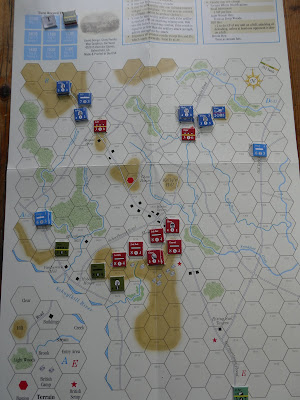

Here it is, with the opposing forces in the second turn ( 06:30 hrs ). The British and Hessians ( red and green counters ) begin deployed around Germantown,  and the Americans arrive in  several columns from four separate roads to the West, North and East - they win a major victory if they can occupy the Market Square of Germantown, or at least one hex of the British camp ( on the hill, just to the South of the town ). The British win a major victory if they can destroy all the American units - no small task. Each hex width  represents about 350m on the ground, and units represent Brigades and Battalions - the Americans also have one battery of artillery, and the British have one unit of cavalry ( part of a small reinforcing column arriving later ).  Some of the units ( American militia and Hessian Jaegers ) can act as light infantry, and make skirmishing attacks rather than getting in close with musket and bayonet. 

The rules are quite simple, with alternate moves and simple D6 die rolls for combat, morale etc. I liked the combat resolution table and its use of the combat strength difference between the opposing units, rather than the old-school 'SPI' style use of ratios ( 2 to 1,  3 to 1 etc ), which I never liked. Combat results can be retreats, routs and step losses - most units can take two step losses, being  'flipped' to the reverse of the counter with lower  strength  for the first one,  then destroyed if another loss is taken - and/or 'disruption' which reduces their combat ability. Both step losses and disruption can be recovered.  Units can 'stack' up to 3 per hex without adverse effect, but only one unit per hex counts for combat, so the stacks very soon shake out into battle lines of single units for best effect - this seems right given the 350m per hex and brigade-size units. Another crucial rule is that when one side's units enter the enemy units' Zones of Control, all the enemy hexes contacted must be attacked - if you decide not to attack the enemy in a hex you have contacted, then the units in that hex can counter-attack you, with their combat factors doubled.  You may decide to concentrate your attack on only some of the contacted enemy, but you have to be confident that you can weather the resultant counter-attacks!  ( it can make sense, if you need to concentrate on the strongest enemy units, maybe ignore the weakest  as their counter-attack will not be too strong, and they may decline to attack)

A major feature of this scenario is the effect of fog - each turn a dice is rolled to decide if the morning fog persists ( with more chance of it clearing as the day goes on, but then a return at the end of the day)  and the presence of fog has some fairly drastic effects.  Movement allowances are randomised and reduced, even road movement is slower, and woods and watercourses have serious effects on movement and combat - there are many small 'brooks' and 'light woods' hexes, and in fog turns these are uprated to 'stream' and 'dense woods' which limit movement and cause combat strengths to be halved.   I get the idea - imagine trying to get a unit of  drilled infantry in strict line formation  to advance and attack across a series of brooks and through woodland in dense fog!  To some extent the the fog blanketed the rules too at the start, as one had to keep remembering that this or that terrain hex  now  behaved like a different terrain hex, but the rules are really pretty simple, and soon picked up. Units on hills get a combat factor bonus in fog, which makes some sense!  

Another important  scenario feature  is the simulation of ammunition shortages for the Americans - after the first few turns the British player gets to choose a number of American units each turn which must take a morale check, and if they fail they will become 'disrupted' , which makes them less capable, especially in the attack. This is quite a bonus for the British, as the number of units to be checked goes up to five in later turns - the disrupted units either have to stop for a turn to recover, or remain  much less useful in any combat. 

And so, to the battle. As you might expect, the fog certainly slowed down the initial American advances, and gave the British time to organise - they elected to use their Hessians ( including  a Jaeger rifles unit )  to  defend their left against US militia,  and to   divide their main British infantry force into two, each division trying to block the progress of one of the columns of  American regulars. The game starts at '05:00 hours', and the fog did not lift until 11:00 ( Turn 5 ), and as a result the main American forces were pretty slow in their advance. By 8:30 ( Turn 3) the Hessians had begun a long series of combats ( lots of skirmishing  in and out of the woods )  with the American militia in the west, in which they held their own and secured the British left flank. The American main forces bumbled their way down the roads, bumping into two outlying  British battalions north of Germantown, and forcing them to retreat - one of them shut themselve up in the Chew House, which becomes a bastion.  There are a whole list of special rules for this house/bastion - but the effect was simply that the battalion occupying it was bypassed and left alone, and took no further part in the proceedings. 
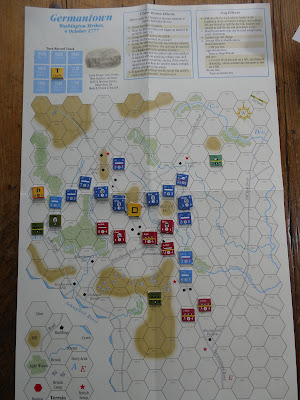
11:00 hrs - US militia ( pale blue, lower right ) threaten the camp
 

As soon as the fog lifted, everything kicked off , the main American forces in the North  making a general advance and attack which went quite well, forcing the British brigades to retreat - and on the Britsh turn, their counter-attacks were easily repulsed, owing to a whole series of low die rolls giving 'Attacker retreat' results.  Meanwhile the US militia on the Eastern flank threatened to sack the British camp  - arriving only one hex away from a rather sneaky victory. Fortunately for the British, their reinforcement of three Grenadier battalions arrived from the South and attacked the militia, while 4th British brigade (wisely left at the camp as a 'backstop' reserve)  hurried to join them.  The fight went badly for them, though - 4th Brigade suffering an 'exchange' step loss against one militia brigade who had occupied some woods, and the grenadiers being forced to retreat - the dice were distinctly American that turn! 

So when Turn 6 ( 12:30 ) began, American militia were still one hex from the British camp and a possible victory - only to be foiled by the 'ammunition shortage' special rule. The British were only too happy to impose an  'ammo check' on the nearest  militia unit, which  promptly became disrupted and could not advance. This may well have saved the day! 

Over the next few turns, it was to-and-fro stuff, especially in the centre around Germantown, with both sides trying to keep a battle line and launch strong attacks on their opponents, and neither gaining a real advantage - I seemed to develop a habit of rolling a '1'  whenever an attacking force had a good advantage, often resulting in 'Attacker Retreat' results. Neither side's troops seemed very determined in the attack! But overall, the Americans made progress and pushed the British back. By half-way through  the 14:00 turn ( Turn 7 of 9 ), the British commander Howe and his Guards brigade had been forced to abandon the crucial Market Square. The game was only saved then because all the American units attacking Howe had been 'disrupted' by the fiendish ammunition shortages, and disrupted units cannot advance after combat...
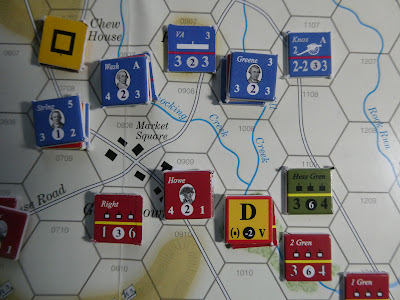
14:00 Market Square cleared - but Americans can't advance!
 

In the British phase, Howe was able to re-occupy the Market Square, and by 15:30 had  his main force formed  into a strong defensive line protecting the town from the North -  though the sneaky American Militia still lurked in the East, again threatening to overrun the British Camp, as the British and Hessian Grenadiers had been drawn into the central fight ( 'all hands to the pumps!'). 
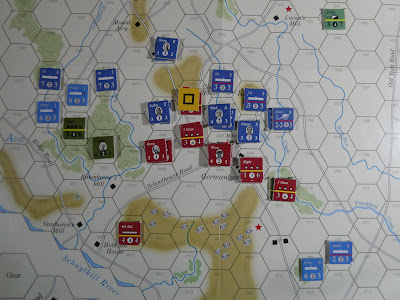
15:30: Brtish line stabilised, but watch those militia..
 

The Grenadiers and depleted 4th Brigade were hurriedly sent back to save the camp, intercepting those militia units, who would not be able to bypass the defenders' Zones of Control.  And then, at 17:00, the final turn, one last American push, perhaps - and the fog returned! In the centre, Washington's forces  ( despite 4 units disrupted by ammunition shortage,  launched two big attacks as the fog came down -  but  in both cases rolled the seemingly inevitable '1', only forcing their opponents back a little, without losses.  The last American push had stalled.  The British line had held, and on their last turn, Howe decided to do nothing - the return of fog meant that any combat into or out of  brook/stream or woods hexes would be difficult, and might well result in bloody repulses. It was enough to have hung on to Germantown. 
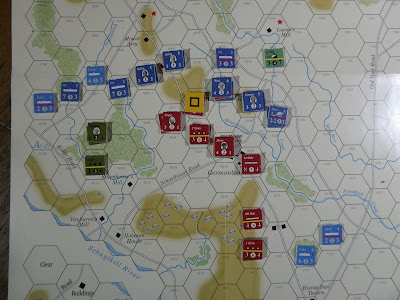
17:00 final situation: fog returns and Brits have held out
 

And so it ended.  The Hessians  on the British left had done well, with a strong infantry brigade and a jaeger unit combining conventional attacks and skirmishing to push  back double their numbers of American regulars and militia. On the right, the British and Hessian Grenadiers had saved the camp from lurking militia, and in the centre the Thin Red Line had held. So, no Major  American victory  - and vey obviously no British Major win ( this requires 'No Colonial untis remain on the map' - could that really ever happen ? ).  The rules say that a minor victory then goes to whichever side has gained the most Victory Points (VPs)   - and VPs are gained at the rate of 2 VPs per eliminated unit  ( step losses to units still on the table do not count towards VPs ).   And the funny thing was, what with all those '1's rolled in the big attacks, and all those 'Attacker Retreat' and 'Defender Retreat' outcomes, in all those to-and-fro combats, precisely zero units  had been completely eliminated on either side! So, the final score was British 0 VP, Americans 0 VP.  A 'no-score draw'!  

I suppose I could have felt like a lower-league football fan on a drizzly winter Saturday afternoon after their local lads ground out a 0-0 'result' - but it had been more fun that that ( and warmer and dryer!). It had been quite a tense game, both sides had advantages and disadvantages : the British had slightly more powerful units with better morale, but less of them, while the Americans had the numbers, with their regulars almost as good as the British in combat power, and their militia able to use the wooded terrain for skirnishing  to good effect,  but a big problem with ammuntion shortages weakening their attacks and the persistent fog delaying them significantly. I felt that if the dice had decreed the fog  lifted at 08:00 instead of 11:00, things could have been very different - and it could have gone either way!  Both sides seemed equally incapable fo 'rolling high' at the moment of crucial attacks, and this led to a lot of  'retreat' combat outcomes with few actual losses, hence the inability of either side to actually eliminate enemy units!  Perhaps that  somehow ties in with the fogginess of the day - were both sides troops a bit disheartened by all that stumbling around in the fog, and not inclined to press their attacks with vigour? Sometimes the dice gods tell a story..  

Overall, I liked the game, and will give it another go : I liked very manageable size ( larger board games seem to me sometines rather long-winded to set up and play, alas! ),  the fairly simple rules and mechanisms, though there were a few questions arising, perhaps inevitable with simple rules and with lots of scenario-specific rules sometines 'countermanding' the basic rule set (the British 'Queens Rangers' cavalry unit was a challenge - moving fast, it was able to range far behind enemy lines, but I could never quite see how it would be able to actually use its 'charge' ability - it ended up just 'lurking' ineffectually, as you may see in the pictures ).  It's an interesting scenario, and I know other bloggers have used it - for example Norm at Battlefields and Warriors, who ran a splendid PBEM mini-campaign game, which I now need to go and read myself, to see how I probably should have played it(!).   I think the game would also suit another one of  Norm's excellent concepts, that of taking part of the action from a board game battle and playing it out as a small-to-medium game with figures on the tabletop. I don't currently have 'AWI' armies available, but perhaps it might translate to somewhere in central Europe, c. 1760 - Prussians replacing the British holding the town, Austrians (with plenty of Grenzers )  looming through the fog?  

Right, I'm off to read Norm's account of his version of Germantown.. Back to the actual toy soldiers next time, I hope - maybe even a bit of painting? Its about time! Meanwhile keep well, everyone.

Saturday, 11 March 2023

Diversionary Tactics

 David Crook recently posted on his excellent A Wargaming Odyssey blog,  about his list of current projects, to which my response was I suspect that often just after such a list is written, something completely different pops up and overtakes all the things one has carefully listed!  And so it proves.  I have been trying to concentrate my somewhat inadequate hobby efforts on Eighteenth Century,  WW2 in Italy, and Thirty Years' War periods - plenty of reading, organising, painting and gaming to be getting on with on each of them, and not enough actually being done.  But then the other morning I strolled into an Oxfam charity bookshop, made a habitual scan of the Military History shelf, and spotted this: 


Blimey, that's a little specialised for a charity shop! Phil Barker and Ian Heath's Armies and Enemies of Imperial Rome, 4th Edition ( 1981 ).  In pretty  good condition, and fairly priced, I thought  - I couldn't leave it there, could I?  Indeed not - money changed hands and I took the book home.  It joins a small collection of books acquired fairly recently, on an 'Ancients' theme, because I've been having certain thoughts..

Charity shops started it, really, because I found a couple of vintage volumes by Peter Connolly : The Greek Armies ( 1977) and Greece and Rome at War ( 1981/2012 ). 


The former covers the period from the Trojan War  to Alexander The Great, and is actually a children's educational book, but none the worse for that - the writing style is clear and simple, but not in the least patronising.  Both volumes have plentiful and rather lovely illustrations. I've always had a hankering to investigate the Ancient Greek world - and the second book adds an account of Rome, up to 450AD. So, I think I've got a good set of introductory texts to work with. 


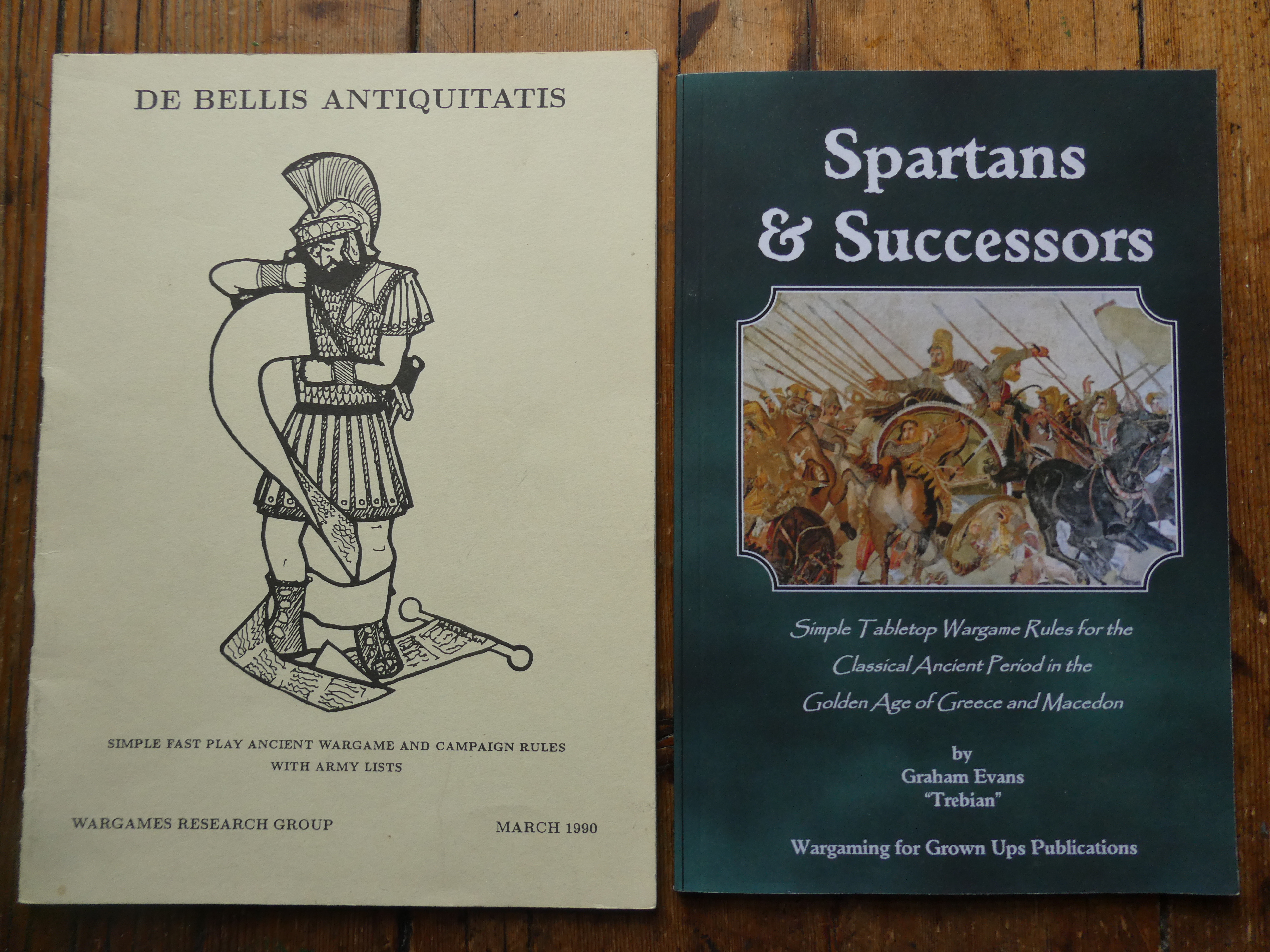
If this is going to lead to any gaming, then rules will be needed, and I have some options there too. Sometime in 1990 or soon after, I spent the princely sum of £2  at Leisure Games in Finchley for a copy of the latest thing in Ancient Wargaming - the first edition of  De Bellis Antiquitatis,  known to us all as DBA. For whatever reason, I never actually played it, but I kept the booklet - 'it might be useful one day'. More recently, what with certain ideas being mulled over and various special offers coming up, I have also picked up  Graham Evans/Trebian's Spartans and Successors, which are billed as Simple Tabletop Wargames Rules for the Classical Ancient Period in the Golden Age of Greece and Macedon. 


And finally, Neil Thomas' well-regarded Ancient and Medieval Wargaming.   Plenty of options and ideas between those three volumes, I reckon. 

Hmmm... if this is going anywhere, some armies will be needed. Although today's find is obviously all about Rome, I admit that the Greek/Persian/Macedonian wars have interested me most so far ( though of course using DBA could allow multiple armies covering various periods to be mobilised quite easily and relatively cheaply ), the triumverate of Greeks/Macedonians, Persians and Indians seems to have all sorts of possibilities and variations. 

But  this is the dilemma - what scale to choose?  Again, if going down the DBA route,  pretty much any scale could be used, for example a 25/28mm DBA force would not involve a large number of figures, and should therefore be fairly quick and cheap to recruit, while smaller scales would give a 'mass' look to the units ( which must be good if deploying Roman Legions or Greek Phalanxes ) while also being relatively inexpensive. Plastic 20mm figures are perhaps  another 'budget' option.  I could do any of  25/28mm,  1:72/20mm, 15mm, 10mm and 6mm - maybe even 2mm, though I have some reservations about those.  I admit I was sorely tempted to try buying  a few nice old-style Lamming  Greeks and Persians, but my timing is not good it seems, as their website says that they are going to stop taking orders for a couple of months due to illness. Sorry to hear that, I wish them a swift recovery and return.

So, I will have to mull over the possibilities of different scales and makes, and we'll see what if anything, comes out of that.  I'd welcome any thoughts from readers who have been down this track themselves.  At the very least, I have some pleasant and interesting  reading options to browse. Here is a bit of inspiration, courtesy of Peter Connolly : 

Also in the next few days the paintbrushes and glue really have to come out - the lead/plastic piles of 7YW, 30YW or WW2 need to be adressed!  Meanwhile, keep well, everyone.  


Wednesday, 1 March 2023

A Course of Study?

Having gone down with a cold, I've been staying indoors, and  reading about the War of The Austrian Succession. A book with that straightforward title, by Reed Browning ( Professor of History, Kenyon College Ohio ),  published  1994, was given to me by my good buddy Dave (aka St Cyr on Wheels),  and seems an ideal introduction. 

It does what it says on the cover
 

My feeling is that having picked up armies from the period ( thanks to David Crook, the Eric Knowles estate and others )  and used them to rediscover wargaming, I really ought to be properly clued-up on the history of  mid-18th Century Europe, so this is a pretty obvious starting point. 

 But the thing is, how to read?  That might sound a silly question, after all you just open the book and start from page 1, don't you... But I want to try to 'study properly',  and make sure it goes into my head - I have read a lot of books which have been jolly interesting and enjoyable while reading, but are then all-too-quickly forgotten: I want to become reasonably knowledgeable on the subject.

So, with this in mind I've tried to approach it like a course of study - and I decided  that means... taking notes. Have not done that since school and university days, which is a long time ago - and my last experience of studying actual history was for 'O' Level (aged 14 to 16).  I would have loved to do 'A' Level History too, but I didn't have any other good arts subjects, and the school would not allow a mix of arts and sciences - so I ended up doing sciences for 'A' Level and Degree, and saying goodbye to formal study of History. I assumed the science-y sounding degree was good for getting a job - but having said that, Dave and I met while doing the same job, and he had done a degree in  Byzantine History! Ah, the Wild West of mid-80s IT recruitment..

Anyway,  I've been simply using a notebook and pen - the book is quite conveniently divided into multiple sections within each chapter, usually about 4 or 5 pages each, so I've opted to read each section, and then make a synopsis of it in a few lines - maybe half a notebook page.  Just for a laugh, here's a sample of my spidery notes  (actually the handwriting is terrible, isn't it? Well, I was a bit under the weather!) : 


I think it is probably helping me take on board the information - I think having to go back and try to summarise the important points is probably good brain training.  However  I am already wondering if the notebooks are the way forward - sadly, making notes on my computer might be a better idea, if only  for legibility!  Though that means a lot more 'screen time', which I was trying to get away from. I will persist like this for this book - 'I've Started, so I'll Finish' -  and see how it goes. Next up for this topic really should by Christopher Duffy's 'Instrument of War', on the Austrian army. 

So having said that, I wonder if anyone has thoughts on the best way to 'study properly'?  I'd welcome any good advice, and it would be interesting to see if you have any hints, tips and clever tricks for absorbing and retaining the contents of books - while hopefully still enjoying the reading process, of course.  It is meant to be fun, after all.  Until next time, keep well, everyone.