Tuesday, 29 November 2022

Fnurban #19: If Books Could Talk

 Real life -  albeit some pleasant stuff related to birthdays  -  has been getting in the way of hobbies recently, hence my second attempt at 'Kirchendorf'/Cheriton has not been played yet. But in the meantime an interesting little bookshop find came up.  I happened to be in Muswell Hill, London,  looked in at the Oxfam bookshop there, and chanced upon this :


Professor Sir Charles Oman's 1929 Studies in the Napoleonic Wars - a set of essays on various aspects of the period. Presumably not particularly rare or collectable but it looked interesting, and a nice old-looking edition in reasonable condition - so I paid the princely sum of £3 and took it home. 

On closer insprection, the volume  turned out to be a first edition from 1929, and there was a small label stuck to the inside of the cover, presumably denoting a former owner :  'Mr. L.K.J. Cooke,  Pembroke College, Oxford'.


Well, that was intriguing - I wonder who he was?  Not so many years ago, that would be the end of the story - but now we have the world wide web, and search engines...

With just a few minutes searching, I came up with a couple of interesting documents : first the King Edward's School Chronicle of June 1972.  It seems King Edward's was a prominent boys' Grammar School in Birmingham, and the  'Chronicle' looks to be the school magazine. It records the retirement of Mr.  L.K.J. Cooke after a splendid 28 years on the school staff, since 1944, and it confirms He was educated at Emmanuel School and Pembroke College, Oxford , where he took a second class honours degree in modern history in 1934.   Bingo!  We have our man.  

There follows a nice little sketch of the personality of the man ( the 'L' was for Leslie ). It states that  he was very much a military figure, always immaculately dressed and groomed in the style of an army officer wearing " civvies."  He also commanded the school's C.C.F. ( Combined Cadet Force )  contingent, and was awarded the OBE for his services. Indeed, later in the magazine there appears an article on the history of the school's C.C.F, the author signing themself 'L.K.J.C.'   He clearly had a  head for business, and for his 'retirement' he had bought a preparatory school in Brentwood, which he would presumably have planned to run himself.  I assume that if he gained his degree in 1934, he would have been born around 1913, and by 1972 be aged about 60.   Presumably long gone now, of course - or he'd be 110 by now! 

If anyone fancies to read the whole article - or indeed the whole magazine, and be transported back to the doings of an English Grammar School 50 years ago, it is here.   I have not read it all myself, so I can't guarantee that the content will meet what might be called 'current attitudes and values'. The past is, indeed, another country.. 

And there's more - a further search turned up a personal memoir website by one Robert Darlaston, who was a pupil at King Edward's school in the 1950s, and has written  ( in about 2009 ) quite a long entry on his time there, 1951-1959, and a postscript relating a visit to the school 50 years on. Of course his time there coincided with that of 'LKJC' , and there are indeed some mentions of our man: Our form master in Shell ‘C’ was Mr L.K.J. Cooke, a kindly man with a velvet toned voice and a leisurely speech delivery.   In consequence, unkind schoolboys had nicknamed him “Slimy”, but he was an expert at easing new boys into school life.  There's a short passage and photo concerning the C.C.F. - but it's the RAF section and their attmempts to fly a glider, which do not seem to to have involved LKJC. But there is one final lovely nugget of pure gold - a detail from the 1959 school photograph :


This picture evokes some fond memories,for those of us who took part in similar exercises - I still have a copy of an  equivalent picture from 1977, marking the centenary, no less, of my school ( a much less grand institution than King Edward's, I should say ), and I'm sure everyone knew the story that it should be possible to appear twice in the picture, by standing at one end and then running around the back to the other end, as the panoramic camera swivelled on its tripod. Whether that was actually possible, and if so whether anyone achieved it without also achieving a spell in detention,  I don't know.    

The caption states that LKJC is 3rd from right among the masters, so I think we have him :


He looks a decent chap, doesn't he? Not a tyrant, I hope, and clearly a man with an abiding interest in  matters military. It occurs that as a student at Oxford in the early 1930s, he may even have attended lectures by Sir Charles  Oman, who was the pre-eminent military historian of the day, and had been a professor of Modern History at Oxford since 1905 - though he was also the MP for the University of Oxford constituency from 1919 to 1935, which may have limited his academic work. All the same, it's nice to imagine the possible link. 

This has been a thoroughly pleasant and interesting little diversion, and a great  example of the ability  of the internet to allow us to waste time, albeit  in a pleasurable  and rewarding way. Now I just have to read the book, and learn about Oman's ideas on 'British Line vs French Column' ( later de-bunked by wargaming's own Paddy Griffith, I am told? ),  and as I do so, I can try to picture its first reader, back in 1930s Oxford - I wonder what he would make of me?  And I wonder how it came to be in Oxfam, Muswell Hill, on a winter's afternoon  nearly 90 years later ? That's another story, presumably - if only books could talk. 

Next time, I hope to finally give an account of '2nd Kirchendorf' and my impressions of the Twilight of the Divine Right rules - until then, keep well, everyone.    


Wednesday, 16 November 2022

Return to Kirchendorf, by Twilight

Having used the introductory Cheriton scenario to put on a trial game using In Deo Veritas rules, it was very convenient to find that the same battle is also one of the introductory scenarios in the Twilight of the Divine Right rulebook. A great chance to compare and contrast the two systems!  (Fleurus, 1622 is also an introductory game in both sets - perhaps because they both involve fairly small forces and should be quite simple battles? Twilight was published in 2018 and IDV only in 2020, so perhaps the latter couldn't resist being 'inspired' by the former? ) . So, let's look at the battle  again, this time through  the Twilight lens. 

First thing to note is the much wider area of battlefield that is used - where IDV started with the armies close together and action imminent in a relatively small space, Twilight places them much further apart and with a commensurately wider field of action and much more terrain.  Here is the map they use  ( I photographed the page from the rulebook, if this breaks any copyright then I will be happy to remove if asked ):  

That's an awful lot of hills..

The previous game really only covered the Cheriton Wood and Middle Spur area in the centre, as you can see this is much wider.  The main armies start on baselines and behind ridges, so main bodies can't actually see each other at the start.  Parliament has an advance party of detached musketeers in Cheriton Wood ( top right ) , and the Royalists have a foot regiment on the highest ground, marked 'Lisle' in the centre of the map - so there should be some action pretty quickly as the respective main battles run into  those two parties. 

Ok, so how about trying to set up that table? One nice thing about the rules is that they use 'Base Widths' for measurement, and the size of the battlefield is given in Base Widths (BW)  too. That made it quite simple to scale the suggested 20BW by 20BW battlefield to my roughly 3 feet by 3 feet table - I have ended up with a 'Base Width' of 40mm as a result.    What was not so simple was finding all those hills and roads - it took almost every piece of 15mm  terrain I had!  Luckily I made a habit some years ago of picking up a few more hills from Total System Scenic ( TSS ) every time I went to the SELWG show at Crytal Palace - several of these were taken out of their stapled bags for the first time for this setup. 

I had just about enough terrain!

Note that the higher 'South Spur' is made by the time-honoured method  of placing CD cases under the cloth for the first contour,  then TSS hill pieces on top for the second contour.  Not so elegant, but effective.

Now for the opposing forces: as in the previous game, I have used my vintage 15mm Thirty Years War 'Imperialists'  to stand in for Parliament, and French as substitute Royalists. Given the 30YW setting, this will of course again be the imagined battle of Kirchendorf.  Forces as follows: 

The Imperialist / Parliamentary army..

First the Imperialists ( Parliament ), commanded by Waller ( shall we call him a Germanic-style  'Mauer' ? ), organised as follows: 

Infantry ( Waller / 'Mauer' ) 

     1 unit Detached Musketeers, Trained, 'M' ( Muskets only )

     3 units Trained, 'MX'  ( about 3:2 muskets to  pikes )

     1 unit Trained, 'MX'   ( London Trained Band ) 

     1 Field Gun,  Trained

Cavalry ( Balfour,  google translate suggests 'Balvier' ) 

    2  units Trained, Dutch style

    4 units Trained,  Dutch Style 

    1 unit Trained, Dragoons 


..and their French/Royalist opponents

Now the French ( Royalists ),  commanded jointly by Hopton and Forth, organised as follows:

Left Wing ( Hopton  - shall we call him Sautville [ hop' + 'town' ] in French? It has a ring to it..  ):

        Detached Musketeers : 1 unit Elite, Small, 'Assault Tactics', Musket only 

         2 units Infantry,  Trained, Small, 'MX'  

         1 Field Gun, Trained 

         2 units Cavalry, Trained, Large, Swedish style 

         2 units Cavalry, Trained, Swedish style 

Right Wing ( Forth - I'll go with Le Quatre, which is cheating, I know! ) :

        1 unit Infantry, Trained, Small, 'MH'  ( about 2:1 muskets to pikes ) 

        2 units Cavalry, Trained, Swedish Style

I had some fun with English to German and English to French translation web pages for the commanders' names, but of course plenty of English, Scots, and Irish ( and no doubt,  Welsh ) officers fought in the Thirty Years War, in many forces on all sides, so I could have just kept  the English names, I guess!    

A few words of explanation - units are 'Regiments' or equivalent, and each unit ( except guns and baggage ) has two bases.  A standard Infantry 'regiment' is made up  of about 1,000 troops,  but they can also be designated as 'Small' (about 800)  or 'Large' (about 1200). Infantry are also categorised by the ratio of Musket to Pike  - see 'M', 'MX', 'MH' in the descriptions above, and then there are some other special attributes such as the 'Assault Tactics' which denotes foot who fire a salvo and immediately charge into combat. 

Cavalry regiments are about 500 for a standard unit,  400 for Small and 600 for Large. As you can see they are also categorised in different ways, and we have Swedish ( charge at the trot firing pistols as they close ),  and Dutch ( fire pistols first, then charge if the target is disrupted ) style horse,  and some  Dragoons.    

Artillery are either Field Guns ( 3 to 12 pounders )  or Light Guns ( under 3 pounder ) - we have only Field Guns. Both armies have a 'Baggage' unit - 'used to show the direction for pursuit', say the rules. 

Finally, all units have a 'quality' rating which is 'Raw', 'Trained' or 'Elite' - self-explanatory, I hope. I think you can see that there is quite a bit more detail to keep up with in the makeup of units than there was in In Deo Veritas - I think I'm glad to see things like 'Swedish' and 'Dutch' style cavalry being included, though they ( and the musket:pike  ratios for foot ) will need to be remembered and recorded on some sort of roster,  or by using labels or markers.  

Over all, the Imperialists have 5 Foot and 7 Horse units, versus the French 4 Foot and 6 Horse, and each side has one Field Gun battery - so a slight strength advantage to the Imperialists. The French have those 'Elite' musketeers, and perhaps a bit more 'dash' with their Swedish-style cavalry.  The  scenario Victory Condtions  are simple for this scenario - the Royalists ( French ) simply have to remain undefeated under the rules. As with IDV, the armies are organised in 'Wings', and if half of an army's Wings are lost then the army as whole tests for morale - failing that test results in defeat. 

Now at last, the table with forces deployed - not necessarily the final dispositions, just a trial to see what they looked like,  with Imperialist / Parliament nearest the camera.

As you can see, the armies fit into the space well enough - I was able to deploy the Imperialists near the camera in two lines, which is sensible for the period. The French are a little more spread out, with infantry in a single line - I may revisit that for the actual game. 

So there we are. I've had a read-through of the rules - I need to allocate some single mounted figures to be the commanders, but given that,  I think we are just about ready to go.  Alas 'real' life may now intervene, so there may be a bit of a pause before the game gets played, but I'll try to get it done as soon as I can.   

I hope this is interesting for readers,  I'm looking forward to playing the game and seeing how the rules play out, and reporting back on how it goes.  Until then, keep well, everyone.  

Sunday, 13 November 2022

Fnurban #18 : Knit Your Own Remembrance

Today has of course been Remembrance Sunday : my very minor contribution to that was to ensure that the village church clock was keeping good time and chimed for 11:00 am at spot-on 11:00am.   If we have the telly on for the Cenotaph, and our front door open to hear the church, we can compare our 'bongs' with Big Ben - and we were within a few seconds,  not so bad. Apart from the novelty of King Charles and the absence of his late mother, and the chance for sarcasm at the expense of the increasing gaggle of former Prime Ministers ( collective noun - a 'Crisis'  of Prime Ministers ? ),  of course the most important part is to see the march past by the many and various veterans, who have all our respect. 

Then a stroll to the village shop and Post Office, where we saw our local essay at a recent trend - the pillar box 'topper' -  on a Remembrance theme. 


I think it's rather splendid, and all services are represented :

Though considering it was made by ladies of the 'Craft and Chat Group', perhaps they should have taken the opportunity to make  one of the figures a  'Wren' or a 'WAAF' ?  ( by the way, I'd guess they are about '200mm' scale ). 

Anyway, a rather sweet  gesture which cheered us up, and also made it into the local newspaper. Very sadly, there was a  murder of a mother and child in the village a couple of months ago, which has dominated local media   - as a friend of ours  ( who is one of the creators )  said, it was nice to get our village a positive mention in local news for a change. 

I'll be back soon with the set-up of a trial game with Twilight of the Divine Right Pike and Shot period rules, to compare with In Deo Veritas as featured in recent posts. Meanwhile, keep well everyone, and of course, Lest We Forget..

Thursday, 3 November 2022

After Kirchendorf : thoughts on 'In Deo Veritas'

As promised, in this post I will give my impressions of the In Deo Veritas Pike and Shot period rules for  'big battles' following my recent game based on their Battle of Cheriton scenario. Overall I'm quite positive about it, though there were one or two issues worth raising.  I'll also show a few more pictures of  the game in progress.


First the  plus points : 

Simplicity - there were no really  complex mechanisms,  only 'D6' dice are needed. Tests for unit disorder, wing fatigue and  army 'general will' involve one D6 and a few modifiers. For combat, units usually roll 1 to 3 dice, it's always  4,5 or 6 to hit or save, and variable factors for advantage or disadvantage will add to, or subtract from, the number  of dice rolled. All quite easy, and to me has quite a nice 'old school' feel - '4,5 or 6' takes me right back to Charles Grant and 'Battle'!   Charts with modifying factors are quite short, easy to assimilate. It would also be simple to add your own modifiers if you wanted to 'tweak' the rules. 

They read quite well: the rules are set out in a logical order, with not too much detail up-front.  'Army Composition' comes first and starts with Commanders, then the Wing concept, then different troop types are described in plain English  (  'the most common unit of the period was the formed infantry unit of between 900 and 1200 men. Frequently called a 'Brigade', each unit represents a grouping of regiments' ) - technical stuff about how many hits they take or shots they fire can wait till later. I found that made it easy to assimilate information in gradual stages.  The explanation of different parts of the rules generally follows the turn sequence - Orders, Movement, Combat, Retreats, Pursuit, Cohesion (wings), General Will ( army level ) - all pretty sensible, and the writing is pretty clear and easy to understand. 

Scale: use of the 'Brigade' as the basic unit  ( 900-1200 foot, 400-600 horse ) is sensible for battlefield units in larger battles.  There's not a specific 'figure scale' - the Brigade is defined by its base size, so you can decide whether to use 6mm ( or even 2mm ) figures and pack loads in, or 10mm/12mm/15mm with less figures in the Brigade.  

Orders and Move sequence are quite neat - you  move  a 'Wing' ( from either side ) at a time, using a  card draw - the order that wings move in can  be crucial and is effectvely random, giving some uncertainty of outcome. You could rationalise this as different Wing Commanders responding more or less promptly to orders, which feels right.   Orders are given each turn, but at the level of a whole  Wing - so you are only issuing maybe four orders per turn -   and are v. simple,  just Attack/Hold/Withdraw.  

Vive la France..
 I very much liked the use of Levels of Disorder - Sound/Disordered/Disrupted/Routed/Destroyed - as the main mechanism for the effect of combat, rather than tracking casualties. I suspect that  reflects the period correctly - the deep blocks of pike and shot units depended on keeping cohesion, probably more than on simple numbers of losses.  It was obvious to use counters ( e.g. coins ) with the number of counters indicating disorder level - casualty markers could be even more appropriate. Simple!

Sensible combat outcomes - units hit by fire, or losing a melee, suffer increases in disorder level, may be forced to Recoil or Rout,  and can be destroyed completely if losing by a wide margin or suffering enough hits. The 'Recoil' result  makes it sensible to keep a sufficient distance between front and supporting lines,  allowing front-line units to recoil without disordering the second line, and that feels right, too. The simple  interpenetration rule allowed a second line unit to step forward and replace a first line unit that was halted by artillery fire - straightforward.

Wing 'Fatigue' seems sensible - once a Wing suffers  routed or destroyed brigades, it can be fatigued (i.e. demoralised) triggering automatic 'Hold' or 'Withdraw' orders.  Similarly 'General Will'  for the whole army. It looks like with 1/4 to 1/3 of the army's  brigades routed there is a 50/50 chance of defeat -  .go over 1/3 routed and it gets more likely. Finally the after-battle 'Pursuit' mechanism is fun, simple but effective and a useful device in campaigns.

Turn 2, imminent action
 I did have a few issues, though:  

The melee combat mechanism felt a bit long-winded : although the 'hit' and 'save' rolls are simple, the problem is that you have to roll for Unit 'A' to hit, then Unit 'B' to save those hits, then Unit 'B' to hit, then unit 'A' to save those hits, and then finally compare the number of unsaved hits for each side to get the result.  When the armies got to grips, with melees all along the line, I ended up with 7 or 8 sets of melee combats to do as above, so that could be up to something like 30 die rolls! For a solo player, that started to feel like hard work - though I suppose with two players it would be less work for each.  Hmm.. do we really need the 'saves' part?  Could we just combine the charts of variable factors for 'hits' and 'saves' into one, and have one die roll per unit instead of two? In melee that would still give 'opposed' die rolls so both players involved, but less drudgery..

Shooting ranges : admittedly I probably shouldn't have halved all the movement rates and shooting ranges to fit my small table.  The 'normal' move distance for an Infantry Brigade is 12 inches, and their muskets have a range of 3 inches. Once I halved those, trying to measure  1.5 inches for musket range (and one inch for cavalry pistol/arquebus fire) became a bit ridiculous. Even at the unmodified 3 inch musket range, it felt a bit awkward, and of course if Unit A starts its move less than 12 inches from Unit B, then A could charge into contact in one move, wihout ending a move within musket range. There's a mechanism to deal with that - Unit A stops at musket range and both units exchange fire, before A closes in for melee, if not stopped by B's fire.  That does give an authentic-feeling sequence of events, with units advancing, giving fire and then charging home, but it also adds two more sets of 'hit and save' die rolls per combat!  

Now I've always had the impression that effective musket range was really quite short - even in Napoleonic times, probably not much more than 100 yards, and I suspect that 40 yards might be more realistic ( and by the way, how terrifying must that have been, and how did anyone have the courage to do that? ), and as a result I can't help feeling that we might be better off simply rolling musketry up with melee into something called simply 'combat',  which occurs when units get sufficiently close to each other. This seems even more appropriate when playing 'big battles', where the basic unit is a Brigade. The player represents  a General, and  he doesn't know or care whether the Yellow Brigade defeated their opponents with a musket volley only, or by charging home - they probably did both, anyway. So maybe we don't need to replicate the combat at  such a level of detail?  I think my halving of the distances and ranges perhaps just served to emphasise this point. 

Turn 5, fighting all along the line
Cavalry are, in general, all the same ( fully armoured cavalry get an extra 'save' die, but that's about it ), and I wondered why the 'Trotters vs Gallopers' or  'Dutch vs Swedish style'  concept that appears in other rule sets was not used - I feel that is a big part of the 'feel' of the period. I suppose perhaps the rules are taking up my point about not going into too much detail? But it felt like something was missing somehow. It might be addressed by simply adding a variable - one exta 'hit' die for 'Gallopers' charging at 'Trotters',  perhaps? 

I was confused by the 'Impetuous Pursuit' rule, used when a unit losing a melee retreats, and the winners may pursue - as so often the ECW Royalist cavalry would, for example. If the losing unit ends its rout move within 18 inches and line of sight of the winning unit(s) then the winning unit(s) must test to see how it.. responds to the opportunity to attack the enemy at his most vulnerable  says the rulebook - but in the earlier paragraph on Retreats,  Routing Units use the March Column move rates.. They must attempt to move the full distance..  For a cavalry Brigade, the March Colmn move is 27 inches -so if Prince Rupert's regiment gets the better of some of Parliament's   'old decayed servingmen and tapsters' and put the latter to rout, the Roundheads will be 27 inches away at the end of the rout move, and the Royalists won't even get to roll a die to pursue, whether they want to or not. Hmm.. have I missed something?  As a result, the only Impetuous Pursuit that happened in my game was by an Imperial  cavalry unit against a French Infantry brigade - none of the many routed cavalry units were pursued by their vanquishers. That seems to be wrong, doesn't it? 

For the life of me, I can't find a mention of Dragoons dismounting or mounting-up. There's a rule for changing formation between 'normal' formation and March Column ( it takes a full move), and there's a rule for deploying/limbering  artillery ( e.g. field guns - a full move without moving to deploy, may then fire ). But Dragoons dismounting - no mention. Hmmm... have I just missed it? 

I didn't make much use of commanders ( army generals and wing commanders ), I kept things very simple by not attaching them to units, simply kept Wing commanders  close to their units, so as to keep all brigades 'In Command' - if 'Out of Command', units cannot move toward the enemy. The command radius is 6 inches, so the units of a wing have to be quite close together. But in the Cheriton scenario in the rulebook, both sides have three units each of  'commanded musketeers' - Company sized units, deployed in the woods to the East of the battlefield. Those units are very likely 'out of command' right from the start, given the specified deployment. So they should not be able to advance against each other, unless their Wing commander personally comes over and leads them - which would leave the rest of his wing 'out of command'. I suspect a special rule was intended, to the effect that these detachments don't have to be 'in command' to operate normally. But I don't see any such rule. 

by Turn 6, French line has swivelled to along the road
That's about it, I hope this has been of some interest.  I may have outstayed my welcome! I should add that the above are only my personal opinions, you are entirely free to disagree with them ( please feel free to use the comments area  below )  and  if I am factually wrong on any of them, I am happy to be corrected. Overall, it was positive experience using these rules, I enjoyed the game and most of it felt 'right' for the period. The organisation of armies  into Wings which are ordered and moved as a whole, and the use of Disorder rather than casualties seemed particularly good - my favourite parts, I think.  The influence of Frank Chadwick's much-loved 'Volley and Bayonet' rules is strong, I suspect, and that's no bad thing. 

I had also hoped to have a look at a rival set of rules - Twilight of the Divine Right from the Pike and Shot Society / Wyre Forest Wargamers.  But I've banged on for far too long about In Deo Veritas, and as a result I haven't even fully read Twighlight..  so that will have to wait for another time. It will be interesting to compare them, as both sets of rules are for a similar 'big battle' scale of game, and obviously in the same period. 

I'd better get on and read those rules, and next time I should set out the details of a battle to be played with them, so we can see how they play.  Meanwhile I hope this was interesting and/or useful; keep well, everyone.


 .  


Tuesday, 25 October 2022

SELWG 2022 : A Good Day

The other Sunday I had the pleasure of attending SELWG 2022, at the Lea Valley Athletics Centre in Norrh-East London.

As you can see, it's rather a splendid venue, no shortage of space and quite an improvement on the old location at Crystal Palace.  I met up with my old buddy Dave ( St Cyr on Wheels ), and we followed our usual habit - toured the games first, then a spot of lunch, and finally a look at the trade stands, and a little retail therapy/essential purchasing.  I took a few photos of games that looked good, as follows :

SEEMS - Battle of Britain

South East Essex Military Society ( SEEMS ) put on a rather nice-looking Battle of Britain game entitled Attack of Eagles  - the aircraft were 1/144 scale ( Revell, I think they said ). Luftwaffe Ju-88s and Me109s crossed the British coast, as some of 'The Few' come to meet them.  

'Retired Wargamers Reloaded' had a splendid WW2 game Eagles and Lions at Carentan ( 15mm,  I think? ).  It looked lovely, and that church was quite something! The Germans were defending in depth, and as you surveyed the battlefield, more and more concealed A/T guns and other defensive positions became apparent - just as it should be!  

Carentan - allies advance on the splendid model town

German defenders: quite a few A/T guns lurking here  

Deal Wargames Society showed  Luxembourg 1940 - something of a walkover, one would imagine, Panzer Divisions vs. the 'home guard' of a medium-sized town, in effect!  

Deal wargamer's Luxembourg 1940

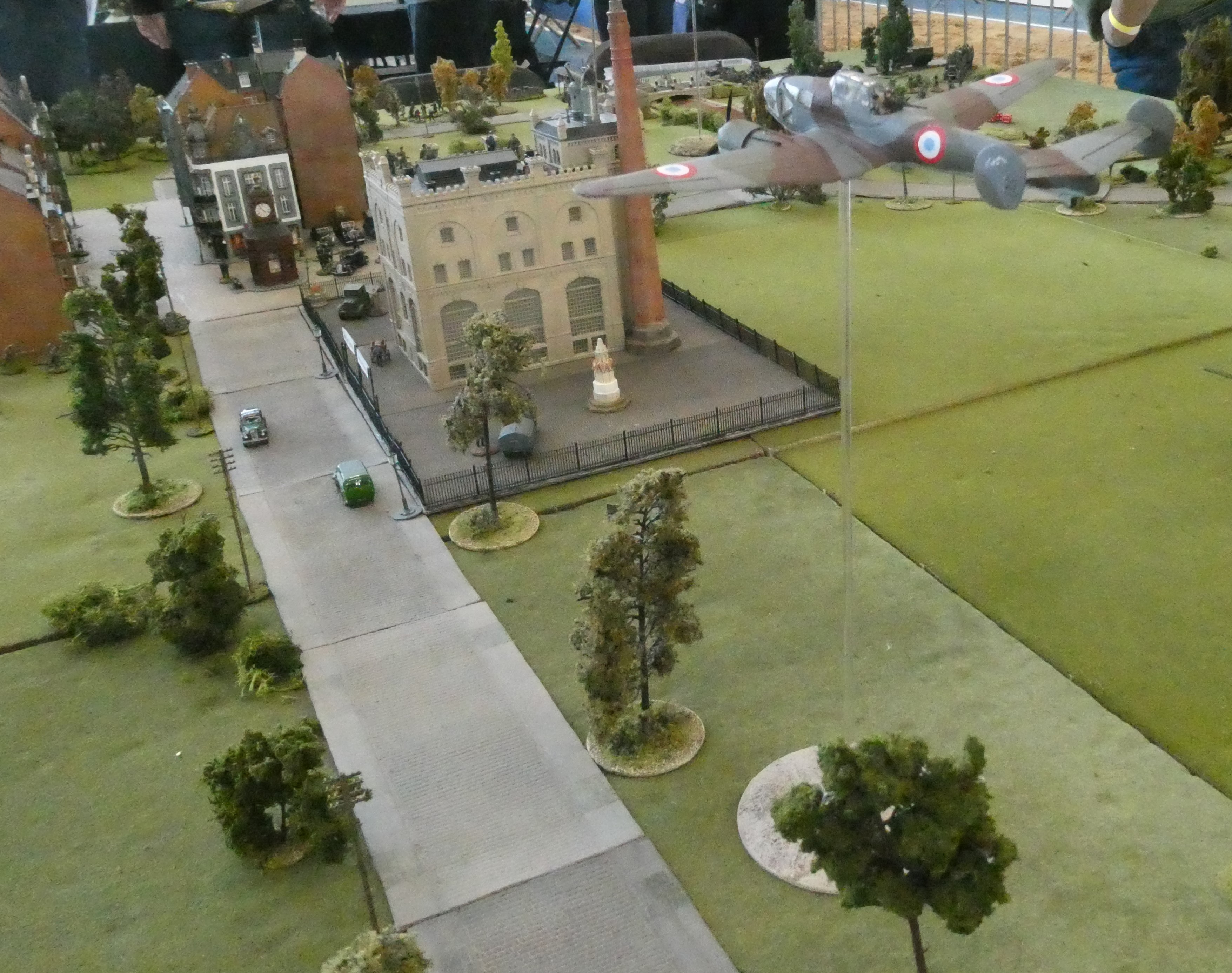
There was some help from the French Armee de l'Air, however.  I liked the bomber (below), but I am still  struggling to identify it, even  after spending far too long on Wikipedia looking at French bombers 1939-45..

I'm told it's a Potez 63-11...

The League of Gentlemen Anti-Alchemists - Ducrot's Day Out was a 'Sharpe Practise'  Napoleonic game with excellent figures and scenery 


Shepway Warganes Club's Cold War game   Hahausen 89 looked great too, I liked the typically Germanic wooded terrain ( we all need more trees, I reckon )  and a brilliant model of a Russian missile-launching AFV in action!


The Society of Ancients are always reliable, they had the Battle of Gaza 312BC, using Impetus rules. I must say I always liked those big pike blocks and elephants etc, if I ever venture into Ancients I think Alexander and his Successors would be my choice.  ( 'dipping a toe' into it with  DBA's small  armies is on the increasingly long wish-list ).  

Gaza 312 - phalanxes get stuck in

Prince Rupert's Bluecoats had The Storming of Bristol ( ECW ) using Donnybrook rules, they were very friendly and happy to chat and the layout  looked good. The players were in period costume ( I think perhaps they take their name from the Sealed Knot regiment that they are members of ? ) and I liked the 'old school' trope of leaving 'casualties' lying on the table, giving a sort of visual guide to how the fighting had ebbed and flowed. 

Storming Bristol  ( + player's hand, oops! )
 

Too Fat Lardies were out in force, running several games with their rules. One was Strength and Honour Spartacus revolt  in 2mm ( I'm sure that when recruiting players, they could not resist asking 'who is Spartacus...' )   

Now in principle the idea is great, the rules are very well-regarded, I think, and I did wonder about trying 2mm - but somehow, the look of it left me a bit cold, and I think it is due to the tiny figures. Of course it's great to represent whole Legions as units, but they are just a bit too minute for my taste. It may be a trivial thought, but I wondered if perhaps a bit more bright colours - flags, standards etc - would help, or if Napoleonics with their vibrant coloured uniforms might work better?  This is of course only personal taste. 

Close-up of 2mm Legions

Also from the 'Lardies, a 'Chain of Command' game - The Northern Perimeter at Oosterbeek 1944. Fantastic scenery and models! 

Too Fat Lardies 'Chain of Command'

 'And finally'..  Milton Hundred Wargames Club showed a Vietnam game, which had an interesting concept of fighting in 'The Delta' - US patrol boats on a search and destroy mission against the Vietnamese. It made for an intriguing combination of land and water-borne movement, and made it difficult for those on land to move around since they were forced to cross bridges to reach the next island, and were very vulnerable while doing so.  Sadly I forgot what the rules were...but it was really interesting. 

Milton Hundred - from the Swale 'Delta' to the Mekong
 

There were loads more games, of course, I just couldn't photograph them all ( I admit I have a blind spot with Fantasy/Sci Fi - sorry! ) . Of course other bloggers will have posted masses of pictures of the show - Tamsin at  Wargaming Girl especially has a comprehensive set, I think she managed to photograph every single game!   Special mention to one I forgot to photograph - Tunbridge Wells Wargames Club using 'Paperboys'  paper model Trafalgar-era ships for an 18th Century Naval Battle Spanish Gold.  A great alternative to what can be pretty expensive ship models in some proprietory rules systems/games. Dave has the Paperboys Trafalgar book and a taste for the age of sail, and it got him thinking.  

We broke for lunch - the one issue we had with the show was that I think  there were only three catering vans, one doing  Burgers, one Greek Souvlaki etc, one for teas and coffees. With a rumoured 700+ visitors, the queues for food got pretty long and slow-moving - although I'd concede that there might not have been much room for more caterers.  There was however, plenty of seating available, with the banks of spectator seats around the running track in the main hall as well as some tables outside.

After lunch, a selective  tour of the trade stands. My biggest purchase was not at all photogenic, being a pack of self-adhesive magnetic paper from Magnetic Displays. These should allow me to make unit bases for my Pike and Shot infantry, which are based in ones, twos and threes to allow flexibility of regiment/battalia/tercio size, but are a bit of a pain to move on the table with lots of small bases! The plan is to mount all the small groups of figures on magnetic paper, then use steel paper to make unit-size movement bases at whatever size is required. I could also line the storage boxes with steel paper, for safer storage. So, I was pleased with that purchase, saving the P&P.

I am still picking up odds and ends ( in a completely unplanned way ) for the 'D-Day Dodgers' ( WW2 in Italy ),  and I noticed that a couple of traders did 20mm Indian Army, so I bought a few samples - Sikh, Gurkha and Rajputan command groups ( 4 figures per pack ) from SHQ, and a pack of  6 Gurkha riflemen from the Combat Miniatures range sold by Stonewall Figures, whose proprietor had come all the way from Cornwall. Both traders very pleasant to deal with, and the figures look nice. More for the painting backlog.. 

Test-purchases: Indian Army from SHQ ( left ) and Stonewall

On the same theme, the 1:72 Model Figures stand usually produces something, and this time it was Italians - a must for an Italian campaign, and they can fight on both sides!  This set from Strelets are probably more suited to the North African campaign, I admit ( those with sun helmets and feathers might not be so useful to me ! )  but I'm glad to have them, they will fit in somewhere. The box art is interesting - I wonder if the makers have pasted-in the faces of friends/colleagues onto the picture?  


Last but not least, a visit to Helion's stall and a nice chat with the guys there, who I had spoken to before at their 'Festschrift' for Christopher Duffy, and I came away with a copy of Barry Hilton's new book about wargaming the late 17th Century,  Every Bullet Has Its Billet.   Not sure I will ever actually game this period, but having seen some reviews it just looked to be a good read! The author pays tribute to Charles S Grant's From Pike to Shot which covered a similar period,  and which I have a treasured copy of - but I think Barry covers a wider range of armies, and gives quite a lot of space to Naval affairs too, of which he is an afficianado.  Lots of really nice pictures of figures and ships etc, and it looks to be a good introduction to a lot of different armies and conflicts. It feels like a similar concept to George Gush's lovely old Renaissance Armies from the 1970s, and I think it will be a worthwhile piece of reading. I will try not to get tempted by figures for the Polish/Lithuanian Commonwealth just yet, though..


And that was about that.  having arrived about 10:30 am, I said my goodbyes to Dave as we left at about 3:30 pm - the time had positively flown. Having arrived quite early, I had wondered if I might give a participation game a go, but there just wasn't time ( probably too much time on shopping! ) . So that will have to wait for another time. Having got the show 'bug' again, I am wondering about 'Warfare' at Farnborough next month...

I hope you've enjoyed reading about SELWG 2022, I certainly enjoyed visiting it, and many thanks to all involved with the organisation of the day.  Next time,  some thoughts on In Deo Veritas rules, and a look at Twilight of the Divine Right, which cover a similar period and format of game, so comparisons will be interesting. Meanwhile keep well, everyone.

Tuesday, 18 October 2022

In Deo Veritas : battle of 'Kirchendorf'

 A couple of posts ago I set out the likely forces and terrain for a Thirty Years' War battle, trying out Philip Garton's In Deo Veritas rules and using my 70s/80s vintage 15mm figures.  This week I played out the game, and there follows a sort of battle report, and some reflections on the rules. 

So, the inital setup:  having discovered the 'selfie screen' on my camera allows a birds-eye view of the battlefield,  here are the armies in their starting positions. The French are in the  North ( top ), Imperialists to the South.

Let battle commence...

A quick review of the armies in keeping with the period, the units in each army are grouped into 'Wings' - in this case each has left and right wings of  Cavalry, and left and right wings of  Infantry. 

The French have 4 brigades (each of 6 figures)  of cavalry on each wing. Their left wing of infantry has 2 brigades (each of 16 figures) of foot, plus 3 companies (each 3 figures)  of detached musketeers in the woods, and their right wing infantry has 3 brigades of foot and a battery of field artillery.  This gives a  total of 14  brigades plus artillery. All units are designated 'Trained',  except the commanded musketeers who are 'Veteran' and one of the right-wing foot brigades is 'Raw'. 

The Imperialists have 5 brigades of cavalry and one company of dragoons on each wing,  Their left wing of foot has 3 infantry brigades and one battery of field artillery, and the right wing of foot has 2 brigades of infantry and one battery, plus 3 companies of detached musketeers in the woods.   Hence a total of 16 brigades plus the dragoons and guns.  All units are 'Trained' except the dragoons and the commanded musketeers, who are 'Raw'. 

Now the kicker - although the French have a slightly weaker force, the scenario ( actually the ECW Battle of Cheriton, 1644 ) specifies that the objective for both sides is 'To control the road off the table to the South'  So the French ( playing the part of the Royalists ) simply must attack, attack, attack!  They are going to have to do very well to win - but at least it gives a strong incentive to 'get stuck in', and should result in a proper scrap. 

 The rules specify that for each turn,first  each 'Wing' is given an order, which can be 'Hold', 'Attack' or 'Withdraw'.  Then the wings are moved one at a time, and this is determined by a card draw, where each wing has a card - I used 8 cards from a normal pack of playing cards, each card representing one cavalry or infantry wing. So there is no 'player turn', rather the various wings of both sides move in a random sequence decided by the card draw. Once all moves have been made, the resulting combats are resolved - shooting first, then melees - with the order of resolving combats decided by the winner of a die roll between the players. I liked this method, as the random sequence of moving brigades injects some nice uncertainty - will my cavalry wing be able to extend its front before the opposing cavalry can charge? 

Given the scenario objectives, the French pretty much had to issue 'Attack' orders to all wings from the start, while the Imperialists could simply order 'Hold',  but the Imperial Commander gave his left wing of cavalry 'Attack' orders, sending them forward to meet their French opposite numbers. Thus on turn 1, battle was joined as the opposing cavalry met on the West side of the field.  

French(top) suffer congestion on the right; opposing cavalry engage on the left 
 

The combat system is relatively simple - for each melee combat  'player 1'  rolls a number of 'to hit' dice for his unit ( a cavalry brigade gets 3 dice, for example ) - advantage or disavantage factors cause the number of dice to be increased or reduced - and 4,5 or 6 is a 'hit'.  Then the opposing unit rolls 'to save' dice ( a cavalry brigade gets 2 saving dice ) , with modifiers again affecting the number of dice rolled, and a 'save' requiring a 4,5 or 6.  Subtract any 'saves'  from the 'hits' suffered - and then in turn  'player 2' rolls his 'to hit' dice for his unit, and 'player 1' rolls 'saves'.   The final numbers of hits on each unit are compared, and the result of the combat depends on the difference between them.  Equal hits means 'stand-off' and the melee continues; a difference of one hit causes 'Recoil' with the loser forced back,  a difference of two causes 'Rout', and three or more is 'Destruction' of the losing unit.   There is no recording of casualties - rather the level of disorder of each unit determines their fate, going from 'Sound' to 'Disordered', Disrupted', 'Routed' and finally 'Destroyed'. I used my trusty 1p and 2p coins placed next to units to show disorder levels ( 1p = 'Disordered', 2p = 'Disrupted' etc ).  Shooting uses a similar method of 'to hit' and 'to save' dice, indeed using the same charts of modifiers, with the 'hits minus saves' result potentially causing different levels of disorder in the target.

In this opening cavalry fight, 2 brigades of Imperial Harquebusiers met 2 brigades of French horse, and the dice favoured the Imperials. On the first fight the Imperial 'Blue' brigade scored 2 hits and the French 'Conde' brigade 1 hit, resulting in Conde having to recoil - in the second fight the Imperialist 'Red' brigade scored 1 hit to the French 'Turenne' brigade's none, and Turenne were forced to recoil. So, an early setback for the French cavalry.  I learned quickly that I needed to leave a decent space between the lines of units in each wing - if a unit is forced to 'Recoil' and contacts its comrades behind, they too suffer an increase in disorder.  That seems entirely right for the period - indeed for any grouping of units in multiple supporting  lines, in any period ( It makes the characterisitc 'chequer board' formation of infantry brigades in 30YW armies entirely sensible - a good example of rules making the players use correct period tactics ).

On turn 2, that cavalry melee continued, with the French die-rolling improving and achieving 'stand-off' results, while the rest of the French army simply advanced, their infantry incoming into range of the Imperial artillery, who concentrated fire on the leading red-coated brigade in the French Right wing, and 'Disrupted' it - good shooting. 

Turn 3, the French were now suffering a bit of congestion, as the available space narrowed - their left-hand infantry had to close up to allow the left wing cavalry to expand  their first line to a two-brigade frontage.  The Imperial right wing of cavalry could have taken advantage of this to sweep forward in a massed charge - but their orders were to 'Hold' -  'Scheisse', muttered their commander.   

On the other flank, the Imperial cavalry did better - in the  continuing  melee, the Conde brigade suffered 2 hits to nil, gained two levels of Disorder,  and were the first unit to be Routed, while Turenne was again 'Recoiled'. When a brigade is Routed, its parent Wing must test for Fatigue, and the French right wing cavalry failed this test and became 'Fatigued', which meaning it must be issued 'Hold' or 'Withdraw' orders - so the French Right wing attack was stalled.  

But the French must press on - on Turn Four, their right wing Infantry charged, reaching the Imperial guns. However,  with the Imperialist cavalry having the advantage on that flank, a brigade of  black-armoured Cuirassiers from their second line were able to turn and attack the French right wing's 'Bleu' infantry brigade ( a 'Raw' unit )  in the flank. Meanwhile on the other side of the field,  French left and Imperial right wing cavalry met, the Imperials having remembered to order 'Attack' this time! So there was combat nearly all along the lines - good stuff! Or so I thought, but the Dice Gods disagreed with me - after a lot of 'to hit' and 'save' rolls, every single melee combat was inconclusive,  with even the Raw infantry brigade attacked in the flank managing to hold on.  I guess it just happens sometimes - once close combat is joined, it can be a slow grinding, attritional business. 

The French infantry attack stalled rather  -  the rules specified that the attacking infantry moved to 'close range' and exchanged fire with the defending guns before charging home, but the concentrated fire of both Imperial batteries told, the attacking infantry were 'Disrupted', and thus when they reached the guns, their melee rolls were ineffective. The guns only suffered  a lesser 'Disorder' result from French musketry.Hardly a smashing impact on the Imperial centre. 

Turn 4: contact all along the line. Centre-left French Bluecoats flanked by Cuirassiers! 


 Turn 5 - on the Imperial left, the cavalry melee continued, with the French 2nd line ( of mercenary 'English' horse now facing  the victorious Imperial Harquebusiers. The French infantry wings continued their attack - the left wing of foot now contacted their  opposing Imperial Guns, while the right wing foot tried to press forward while also dealing with cuirassiers on the their flanks ( the Red-coated brigade which had been Disrupted by the early artillery fire gamely charged against the black cuirassiers ). On the Imperial right, those brigades of horse already in contact continued fighting, while both sides tried to extend their frontage to the East,  by wheeling out units from their 2nd lines.

Now for shooting - and what shooting. The lone  Imperialist dragoon company on their left wing having swung inwards, gave a volley into the flank of the leading French 'Redcoat' foot, and scored 2 hits - and there were no saves. Two hits on an already Disrupted unit - the Redcoats broke and fled, 'Routed'. What's more, they crashed through the frst-line Green-coated brigade to their right - inflicting 'Disorder'. That would not help the Greencoats' melee rolls, though to their credit, their musketry drove off the gunners in front of them with a 'Disrupted and Recoil'  result - 3 hits! All the same, those plucky dragoons had inflicted complete chaos to the French infantry attack. 

Melee - the Imperial right-wing Harquebusiers were not to be denied - both 'English' horse brigades were forced to recoil and Disrupted, their entire wing now being in a parlous state.  The black Cuirassiers fighting both red- and blue-coated French foot dealt a smashing blow - 2 hits to none on the redcoats, who promptly routed but also faced a further Disorder test, and failed, resulting in their destruction.  To make matters yet worse, on the Imperial right the French Chevaux Legers were forced to recoil in melee by Imperial 'Green' cuirassiers, and they recoiled straight into the other Red-coated French foot which had been routed by Dragoon fire. It was all too much for those redcoats, the extra level of disorder inflicted causing them to disintegrate. Disaster!   The French right wing of foot now had only one brigade in fighting condition, and that brigade was being attacked in flank by cavalry. It was the French commander's turn to mutter -  'Merde' , or perhaps stronger words.  Some consolation was however given by the King's Musketeers on his left wing,  who won their melee against Imperial 'Blue' Cuirassiers, who were routed off the table and thus out of the fight. 

After all that trauma, the French right-wing infantry amazingly passed their 'fatigue' test and remained sound, but the Imperial right wing cavalry, having lost a cuirassier brigade, rolled badly and became Fatigued - so no more 'attack' orders for them. Some relief  for the French, then, but their situation still looked pretty bad!  


Battle rages in the centre - both French 'red' units were doomed


On Turn 6, the Imperial commander went for the coup de grace, with the three brigades of his left wing of infantry given 'Attack' orders, aiming to sweep away the one surviving  French brigade opposite. His right wing of foot, however were told to 'Hold', and be prepared in case the 'Fatigued' cavalry wing to their right gave way. On the French side, right wing horse and foot were both given  'Hold' , but on their left, both horse and foot kept up the 'Attack' in hopes of breaking through to the Southern road - this might be seen as a 'brave'  choice.. The French foot duly charged into contact with their opponents, and the opposing cavalry  extended frontage such that both sides had all four remaining brigades in melee with each other. But it all fell apart - the charging French green-coated foot were stopped in their tracks by Imperialist musketry and 'Disrupted', so could not charge home, and their left wing cavalry lost badly, with Chevaux Legers routed and two Curiassier brigades recoiled, only the Kings Musketeers hanging on. Over on the French Right, their cavalry was finally defeated, with both 'English' brigades routed - so 3 out of 4 brigades gone.  The brave bluecoat infantry were finally routed too, by the flanking black cuirassiers, so the entire  French right wing of both horse and foot were out of the fight. Surely, the end? 

how it ended - badly for the French
 

And so it proved, as 'Fatigue'  tests left the French right wing of cavalry 'Exhausted'  ( must withdraw ) and both right wing infantry and left wing cavalry  'Fatigued'. There followed a 'General Will' test on the whole army - duly failed by the French, having no less than 7 out of 14 brigades routed or destroyed. Failing this test meant defeat for them.

A nice touch is that the rules have a post-battle 'pursuit' phase whereby disordered, disrupted and routed units in the losing army must dice for whether they are destroyed, and commanders of 'fatigued' or 'exhausted' wings dice for being captured - this might be quite useful in a campaign, I think. for once the French rolled well, losing only the Blue-coated foot, no doubt ridden down by those nasty cuirassiers, and the unlucky commander of their right wing of horse. With 9 brigades and 3 generals to test, it could have been a lot worse! 

Finally, you may be wondering what had been occurring in the woods? No teddy bears picnic, but essentially the Veteran French commanded musketeers advanced, and overpowered their Imperial counterparts ( a detachement of MacFarlane's Scots ) who were rated 'Raw'. But this was entirely separate from the main battle, and there was no chance to exploit any advantage gained before the main French army collapsed.  

I have rambled on far too long, so I will save my thoughts on how the rules and scenario worked,  and what I liked or didn't like, for another post.  I hope you've enjoyed reading this account anyway, and maybe picked up an idea of how the rules worked in general. It was a good game, and the rules mostly seemed to go pretty well  - the scenario was always going to be a tough one for the French!  

Next time, a bit of chat about the SELWG show, which I attended last Sunday ( and enjoyed, of course!).  Meanwhile, keep well, everyone.