Friday, 31 May 2024

Punjabis Painted (almost) and an Italian miscellany

I have, at last (almost) completed painting my Indian battaltion for the 'D-Day Dodgers' Italian Campaign 1943-45 project.  So here, on parade for the camera on what looks suspiciously like a stopover in rural England before deployment, are the gallant men of the entirely imaginary  11/8th Punjab battalion:


They comprise (from the front )  the HQ company with Battalion commander, PIAT team, 2-inch mortar team and truck;  three  rifle companies each of 8 figures with a truck;  a fourth company with 8 figures and 2 Bren carriers;  and the Support Company with 6-pounder A/T gun,  3-inch mortar, Lloyd carrier and Bren carrier. 

Keen readers may remember that I was unsure how to recruit the fourth company, having limited numbers of figures with Punjabi Muslim style turbans or British steel helmets - I am grateful to Neil from the excellent aufklarungsabteilung blog who suggested that I could consider a Sikh company in a Punjabi battalion.  I had enough Sikh-turbaned figures to do that, and it seemed a nice idea, giving a bit more interesting variation in the battalion. So we now have 'A', 'B' and 'C' Companies of Punjabis, and 'D' Company of Sikhs. I'm quite pleased with them

 As I said, they are 'almost' complete - if you look very closely at the back, you'll see that the 6-pounder crew are in need of a change of uniform colour and skin tone. So indeed not quite finished yet, but almost! Also the transport is 'from the pool' so to speak (specifically the vehicles bought recently from the collection of the late Eric Knowles),  hence their carrier crews also look distinctly White British. So the next step is to provide some more appropriate crewmen - which should be simple enough. 

If you'll excuse my 'impressionistic' painting style (as ever, button-counters should look away now), I'll risk a close-up :


 hmmm... those HQ company bases may need a little work. You may notice that the only White British figure is the  battalion commander - as far as I know, this is pretty much true to reality (note that this is a battalion for Rapid Fire Reloaded, in which one figure represents about 15 men). Anyway I am quite pleased with them overall, and hope they acquit themselves well when they finally get to the gaming table! 

When  painting them, I decided to be a little more adventurous than a very simple 'block-painting' style, and found  some useful tips in Andy Singleton's book Painting Wargaming Figures: WW2 in the Desert


I liked this book, as it starts from the very basics and really assumes no prior knowledge of various painting techniques, hence great for beginners.  He also has step-by-step instructions (with plenty of good photos)  for painting figures at each of three levels of skill, which he calls 'Conscript' ( block colours and a little dry-brushing )  'Regular' ( some dry-brush highlights, and shading to finish ) and 'Elite' ( using layering and spot-highlights ).  My chaps are somewhere between Conscript and Regular, I think, and that will do nicely for me. We'll have to see what level they fight at..

This week has coincidentally provided some more Italian-related interest and events, as follows: 

(1) a trip to the BFI ( National Film Theatre, as was ) in London for a showing of  Roberto Rossellini's  Rome, Open City , which I had shamefully never seen before (and I call myself a film fan?). Absolutely  relevant to the 'D-Day Dodgers'  period, this neo-realist classic depicts life in Rome under the Nazi occupation of 1943-1944, and the hazards of involvement in the political/violent resistance movements. It's famous for being filmed very close to the time it depicts, and as the program notes say it was 'made on the streets of the war-ravaged capital with stolen electricity and scraps of 35mm stock supposedly sourced on the black market'.  It was first shown in September 1945,  less than a year after the Allies liberated Rome, and only months after the German forces in Italy had surrendered. It struck me that the people of the areas where filming took place (and the allied troops in Rome) may have been pretty shocked if chancing across the filming, as tenement blocks were surrounded and 'residents'; rounded up by parties of SS troops in full uniform, distinctive helmets and fully armed! There must have been some delicate negotiations between the film-makers and the authorities, and the locals. It's a great film, well worth catching. 


(2) Picked up at a neighbourhood 'give a book, take a book' box,  A Walk In the Sun  by Harry Brown, a slim novel recounting the experiences of a fictional US Army platoon landing on an un-named  beachhead in Italy in 1943 or 1944,  Harry Brown was a US Soldier, but not on the front-line - he was a writer for Yank magazine ('the army weekly')  from 1942. He went on to be a film screenwriter, with Sands of Iwo Jima among his credits.   I was pretty suprised to learn that this novel was published as early as 1944, as it is not in the least 'gung-ho' and does not paint a romantic picture of war, quite the opposite indeed. The platoon finds their commanding officer incapacitated before even reaching the beach, and then try to follow what little they know of their orders, given  no  contact with their parent unit. The writer  must surely have interviewed real-front-line troops, and the story 'rings true' in its depiction of ordinary men in the  extraordinary situations of war.  I haven't finished it yet, so no plot spoilers, please!  


 (3) Last but not least,  a different period but also Italy-based, I was lucky to take part in another of Jon Freitag's remote games, this time recreating  the battle of Bassignana, 1745.   

I'll give nothing away except Jon's picture of the initial deployments, trusting him to provide his usual excellent report of what was one of his usual excellent games, which came to quite a dramatic last-gasp  conclusion!


 I was privileged to play the 'Gallispans' C-in-C Mallebois, with a small brigade command too, while Chris 'Nundanket' and Dave 'St Cyr' took the Spanish and French wings, against Piedmontese and Austrians led by Mark 'Jolly Broom Man' and Tony 'MS Foy'.  Many thanks to Jon and all concerned, as usual, for a great game! 

Next, it must surely be time to actually try a game of Rapid Fire Reloaded : and next weekend there is the 'Broadside' show at Gillingham which I hope to attend. Plenty of material for future blogging, then. Until then, keep well, everyone.

Saturday, 18 May 2024

Fnurban #30 A Mighty (Roman) Fortress

Following on from last time's Roman theme,  I have recently visited an impressive Roman site - Burgh Castle,  on the Norfolk coast.  Last month we spent a few days at Great Yarmouth, and Burgh is just out of town from there, so we took the chance to see it. It was well worth a visit! 

About a 15-minute drive out of  Yarmouth town, the site is owned by the Norfolk Archaeoligical Trust (the stone walls are managed by English Heritage). There's a car park, then a short walk across a field to the site - passing the nearby round-towered church (a Norfolk and Suffolk speciality) which is also worth a  look. .You are greeted with this sight: 


What you are seeing here is just over half the width - the gap in the wall to the left is the East Gate of the fort, which is in the middle of the East wall. Overall, that wall looks to be a bit over 200m long, and as you can see it is pretty much complete.  That goes for the North (shorter) Wall too, and the South Wall is about half-preserved - the West Wall has gone, probably tumbled into the river it sat alongside. So overall, more than half the fort's walls remain, and they survive to their original height, too, with complete bastions at intervals along the walls and at the corners. 

Bastion in East Wall


and a closer view, note red tile courses


North-East corner

Visitors can go through the gate and look around inside the enclosed area, which gives views across marshes and the River Waveney running next to the site.  There are no remaining structures or ruins inside the walls, but you get a good impression of the area that would have been enclosed - about 2.2 hectares in all. 

It seems that Burgh was built in 'the late 200s AD' which I take to mean late in the 3rd Century, as part of the 'Saxon Shore' ( Litus Saxonicum ) chain of forts which stretched from Brancaster, Norfolk, to Porchester, Hampshire - the name seems to mean 'the shore attacked by the Saxons' or  'The shore of the Saxon Sea' .  It is possible that the forts may have originally been built as naval bases for controlling and protecting trade across the North Sea,  but they are now mainly associated with defending the coast of Roman Britain from Saxon invaders, whose first documented raid on Britain was in 286 AD.  The landscape has changed since then, but originally Burgh would have stood at the mouth of a 'Great Esturary' into which flowed several rivers,  with another fort, Caister Castle, standing on the oppoiste side.  The fort would have been able to house 500-1000 infantry, or up to  500 cavalry. It is known that the garrsion included a cavalry  unit called the Equites Stablesiani.  There is also substantial archaeological evidence of a significant civilian settlement ( vicus )  outside the walls.

The walls themselves are about 3.2m thick at the bottom, 1.5m thick at the top, and 4.6m tall - complete except for a parapet which would have stood on top. They were  built with  a rubble and mortar core and  flint facing stones, with up to seven triple layers of red fired clay tiles helping bond the facing stones to the core. Six of the original  ten bastions survive.   All very impressive - the relatively complete walls give a powerful impression of how imposing the fort would have been when in use. Needless to say, if you are interested in Roman military history, you really should see this!  By chance we visited on an 'open day' with a stall and display by the Norfolk Archaeological Trust, which allowed us to buy a guidebook covering Burgh, Caister and Brancaster - from which the information here is taken. Of course there are websites - from English Heritage and Norfolk Archaeological Trust.   

Great Yarmouth itself has a decent selection of historical sites, including some stretches of medieval town walls - and for those interested in the  ECW, you can visit the Elizabethan House Museum,  a 16th Century merchant's house  with its rather grand 'Conspiracy Room': 


 It seems that in 1648 the heads of the New Model Army ( including Cromwell ) were  at Yarmouth, and the house's owner John Carter was commander of the local Trained Bands, and would have hosted the senior officers. It is said that in this room a meeting was held, at which the decision was taken to put King Charles on trial for treason - this of course resulted in his execution the following year. 'A great reckoning in a (fairly) small room', perhaps?

That's enough historical meandering  for now.  In the meantime there has been a little hobby progress, as I have been getting on with painting my 'D-Day Dodgers'  WW2 Indian battalion 


Very much a work  in progress, but we are getting there - perhaps the next post here will show off the completed unit, if I keep up with the painting sessions.  Meanwhile, keep well, everyone.

Saturday, 11 May 2024

Fnuraban #29 I Am Legion

The other day I was fortunate to be able to visit the British Museum, to see their exhibition Legion: Life in the Roman Army.  the first thing to say is that it's well worth a visit if you have any interest in the Roman Army,  but be sure to book ahead and be prepared for it to be pretty busy! ( not intolerably so at 11:00 am on a Thursday morning,  I'm glad to say ). 

I took some pictures, and I'll simply show those I think, with a brief commentary.  Of course these are only a minority of the objects in the whole show. So, in more or less the order of the exhibition: 

Auxiliary Infantry

 There were a fair number of these sculptural pieces depicting Roman soldiers with identifiable weapons, standards etc. I didn't take detailed notes, but I think these are 3 auxiliary spearmen.  


Legionary Sandals 

Some amazing survivials of perishable items were included - there was even a pair of legionary socks, with a division for the big toe,  allowing them to be worn with sandals. Sadly I didn't get a picture of that.  

Legionary equipment: Sword, Belt, Dagger, Tools

An interesting point made was that the mark of being a Roman soldier  was the belt, sword and dagger etc rather than any particular items of clothing/uniform.  One of the caption cards even stated  there was no specific uniform beyond a military belt.   Now that very much caught my eye, given the very uniform appearance of all modern depictions of Legionaries - though it was also stated that helmets, armour etc did tend to be standardised (even if made in local workshops which allowed some variation), and I suppose this would tend to impose a 'uniform' look.  

Another fact that I had not been aware of was that soldiers were expected to provide or pay for their own equipment - the narrative of the show was maintained by following the story of a real soldier of the early second century AD whose letters have survived. In fact, most of the letters quoted seemed to be dominated by his pleading requests for money or equipment ( 'I have replaced my  footwear twice a month').  It was also interesting that there were hurdles to be cleared even to join up - only a Roman Citizen could be a Legionary, and they needed letters of reference to support their application. Our example soldier had to join the lower-status Marines first, before eventually getting into a Legion.   Surprisingly to me, the pay rates quoted were 250 denarii per annum for an Auxiliary (non-citizen) but only 300 denarii for a Legionary. Obviously, more senior ranks were paid a lot more - a Junior Centurion about 15 times the Legionary rate, I think? 

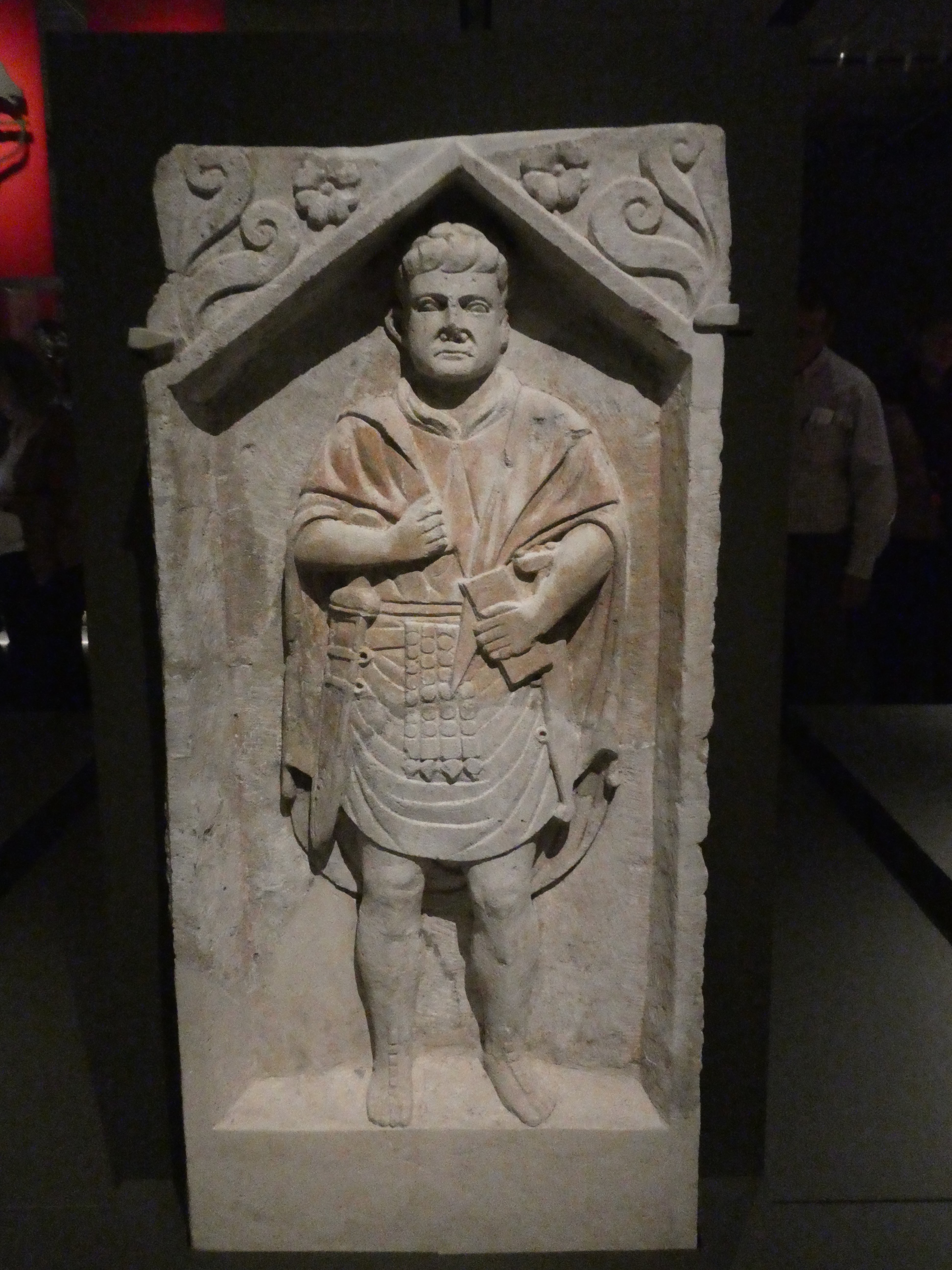
There were quite a few depictions of actual soldiers in their equipment, taken from their funeral monuments - it seems that they signed up for 25 years service, but only about 50% survived to see out the full term, owing to disease as much as battle. Many of the monuments were to men aged 30 or below.  I took pictures of a small selection of them, including a young Centurion named Marcus Favonius Facilis,  who had died at Colchester sometime before the Boudicca revolt of 61AD.  


Literate soldier holding a book 

Standard Bearer with 'Emperor head'


Grave Monument of a Centurion (Marcus Favonius Facilis) at Colchester, 50-60AD 

Legionary Shield and Boss

..and from the back

Now this was really interesting, and may be the only complete example of such a shield in existence?  It was stated that the wood and leather construction means that the curve has been exagerrated by shrinkage/warping over time, it would originally have been more gently curved. Note also the metal boss, of course.  It was fantastic to see this item, along with one or two others (see below) it was worth the price of admission just to see that! 


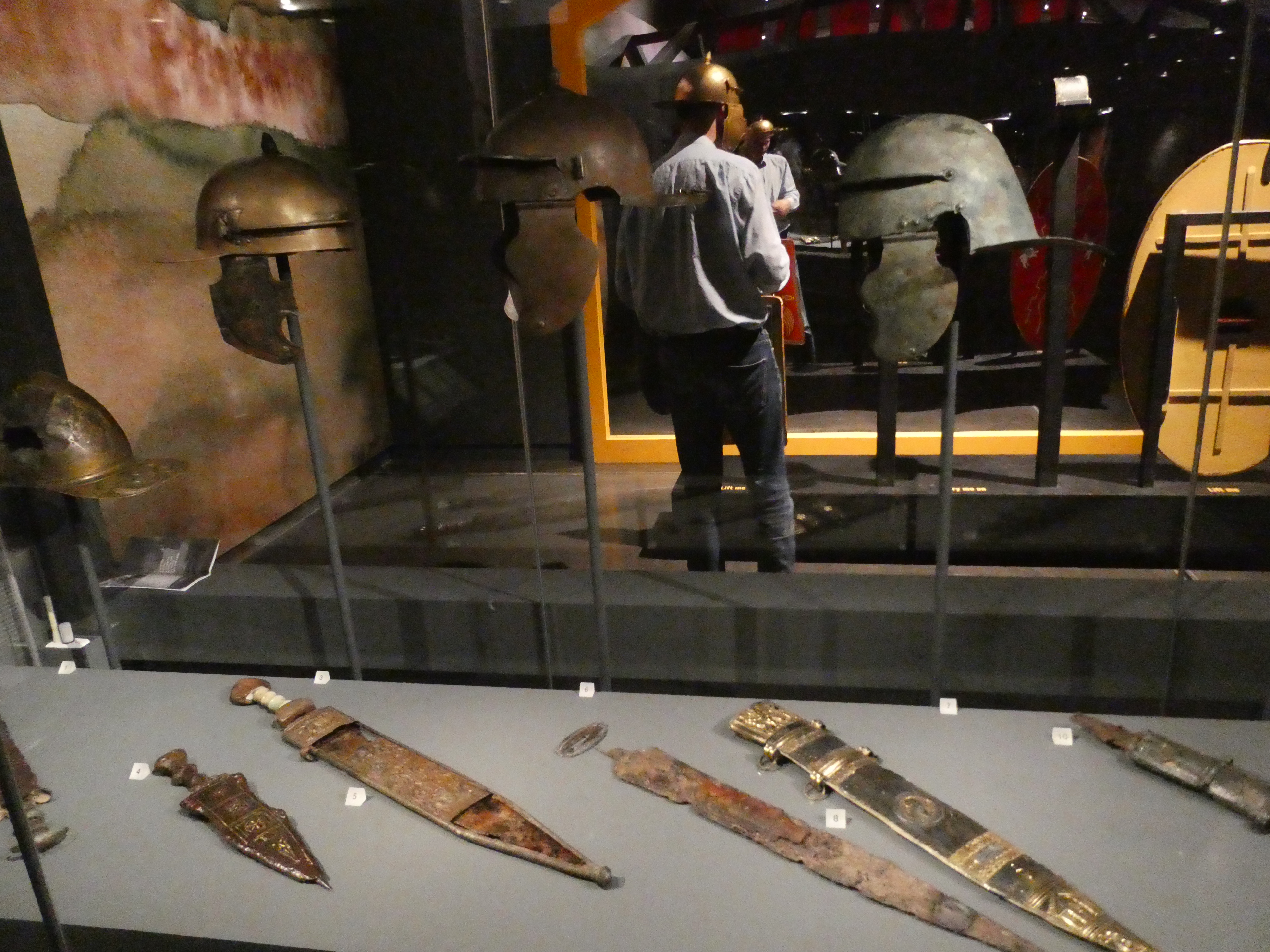
Swords, Daggers and Helmets (and someone trying on a replica helmet!)


'new pattern' short sword, c.79AD

high-quality helmet and segmented armour

Legionaries in Battle Formation

Cataphract Horse Armour c.200AD - amazing stuff!

The Cataphract Horse Armour was another real eye-opener - if you are interested in the later Roman army, you probaly have to see it.   Pretty much the entire 'trunk' of the horse was covered by overlapping metal scales, which must have been pretty heavy, too!   

And then to complete a trio of wonders, an almost-complete Legionary Cuirass...  This was stated to have come from the battle site of the huge defeat in  9 AD , at the hands of Arminius ( aka 'Herman the German')  in the Teutoburger Wald, and I think stated to be the most complete that has been found.   Another 'worth the price on its own' moment? 

Complete Legionary Cuirass - from Teutoburger Wald


Father and Son soldiers - with hand-me-down equipment

After the required 25 years there would be a handsome bonus for retiring soldiers - and non-citizen auxiliaries would be granted citizenship. The Army was a tough life, but was clearly seen as a good career, and sons would follow fathers into the ranks - sometimes weapons and equipment would be passed down, as depicted above. 

I was also interested to learn about the size of the army - we are told that when Augustus first instituted the Imperial  Roman army,  it had a strength of about 300,000 (half of them Legionaries),  while the population of the Empire stodd at about 60 million.  A map of the empire about 100 years later ( which I really should have photographed!) showed I think about 20 to  30  legions and where they were stationed in the Empire - unsurprisingly, most were along the borders with barbarian areas and other empires such as the Parthians. From my memory, the whole of Gaul required only one Legion.  Given the sheer size of the Empire, a surprisingly modest establishment?   ( c.f. today's British army, also defending about 60 million population - much less than 300,000! )   

If all this (and the chance to wear a replica helmet at one point, which I did not take alas )  inspires the re-enactor in you, the gift shop will oblige - I was slightly surprised that the armour was priced at about £200 - I think I would have expected it to be more! Didn't see anyone buying, though. The exhibition catalogue is well-produced and  doubtless most interesting, but at £30 for the paperback version, I thought I'm not quite enough of a Romanist.. 


from the Gift Shop : be your own Legion (for a few hundred quid)

And finally, there had to be a gaming angle - in a display on camp/barracks life,  examples of a Roman board game -  and  a dice tower, just as many gamers would use today. The caption stated that these were seen as a way of preventing cheating when rolling dice. Nothing new under the sun...  

nothing new under the sun: that's a Roman Dice Tower! 

That's about all the pictures I took, I probably should have taken many more and made extensive notes, but it would have been a much slower visit, and I was with a 'civilian' ( i.e.  non-wargaming!) friend! Going at an average visitor pace it was about a 90-minute visit,  I suspect I could have stayed longer. Lunch was required, and the Italian Cafe ( 'Tropea' ) in Russell Square gardens seemed highly appropriate, on a nice sunny spring day.  The exhibition was a thoroughly worthwhile visit;  if you are interested and able to get to London easily then I'd recommend it. 

Meanwhile I have made slow progress painting WW2 Indian infantry, so hope to show the results soon, but next time  I think a bit more recent Roman-related sightseeing. Until then, keep well, everyone.

Thursday, 25 April 2024

Here are the Heer - and Punjab Preparations

I'm pleased to say that my D-Day Dodgers WW2 Italian Campaign has taken another baby step forward, as I have now  completed my first German infantry battalion in  Rapid Fire Reloaded format. Without further ado, here they are: 


Counting from the front (left to right) we have 1st, 2nd and 3rd Rifle Companies and Battalion HQ with commander's Steyr car;  on the middle row the 4th (Heavy) Company with MGs and Mortar, Steyr and Opel Blitz, and at the back the Support Company with AT Gun, Infantry Gun and two more Opel Blitz trucks.  All in all a handy little unit, I hope, and ready to take on the 'West Suffolks'  in the battle for Italy.  As previously discussed, the only missing element is a decent name for them, preferably 'fictional but credible', though borrowing a real unit name might also be an option. Still thinking about that one! 

Next recruits for this project will be an Indian battalion - indeed I think I am aiming for an Indian Brigade, where the attached British battalion is the West Suffolks.  This will be largely built from the Strelets plastic 1/72 Indian WW2 sets (below).


An interesting challenge that has emerged relates to the varied headwear of different troops in the Indian army, and how to depict them. The Strelets boxes have a variety of different headgear, including the standard British 'tin hat' but also what looks to be 2 or 3 different styles of turban - Sikh, Punjabi  (Muslim)  and possibly also Baluchi.  Identification of these was aided (of course) by a little light web-browsing, coming up with the splendidly-named MilitarySunHelmets.com, with a page on Turbans of the Indian Army .   

As I understand it the Indian army generally had regiments recruited from specific ethnic groups, so there were Sikh regiments, Punjabi regiments etc,  so I need to reflect that. The variety of heads on the figures should help with that, but in fact it's become clear that we have an embarrasment of riches here. For illustration, here is the range of headwear on the Strelets figures: 

'Punjabi' style turban and British 'tin hat' 


..Sikh turban

... 'Baluchi' style

 A crucial line from the above website (and other sources I've seen ) is as follows: By the start of World War II typically only Sikhs continued the tradition of wearing turbans into combat, although turbans of various styles are used in both India and Pakistan today.   Which means that for absolute accuracy all I need are the 'tin hat' troops, and maybe some with Sikh turbans if I want a Sikh battalion. Hmmm.. 

Well to be honest that seems a bit dull!  I'm afraid I am going to romanticise things a bit, and do a bit of an 'imagi-nation' here..  I liked the Punjabi/Muslim style turban and there were a good number of them in the Strelets set, and along with the steel helmet-wearing  figures I can put together a decent selection - albeit the turbans probably wouldn't have actually been worn in combat!  But after all this is a slightly fictionalised view of Italy 1943-45, and the turbans add a lot of character, so I am quite  relaxed about using them - and they make a visual distinction for the unit, after all. I will simply assume that my Indian soldiers are brave lads, many of whom disdain the effete steel helmet..       

a mix of Punjab and Steel Helmets
 

The above selection came from one box of Strelets Indian infantry - so to make a battalion of about 50 figures, I am probably going to need another box, unless I start chopping heads off Sikhs and replacing them with steeel helmets from other unused plastic figures ( the rather disappointing Airfix 1970s British might be useful ),  or perhaps remodelling Sikh turbans to Muslim versions. Hopefully none of this gives any offence to any ethnic or cultural group!     

So, still plenty to do and think about, but this is a decent beginning to the recruitment  of what will become the  11/8th Punjab battalion - a fine body of  (entirely fictional) men. Now to start painting, and looking at how to get the correct number of troops - plus heavy weapons etc ( the 'support weapons' Strelets set seems to be heavily biased towards Sikhs, which is another challenge! ) to make a full battalion. 

In the meantime, maybe it's time the completed British and German battalions faced off in a beginner  game of Rapid Fire Reloaded - which I will report on in a future post,  if I can get it up and running. Until then keep well, everyone.


Sunday, 14 April 2024

Salute 2024

The title if this post 'does exactly what it says on the tin' - this Saturday I visited Salute 2024, at the Excel centre in London.  Arriving at about 10:30am (I like to miss the enormous queue!) this is the prospect one was faced with: 

I know I've been before, but cor blimey it's big.. just a huge barn of a hall, with low-ish lighting and quite a high noise level simply from the conversation of several thousand(?)  people.  The funny thing is that being such a large space, it's quite hard to make out what's going on at first - you can't really take in the 'layout' of the room. But of course, there are umpteen games and traders in there, and you just have to plunge in - having checked the program and noted where some of the most interesting ones are located, so as not to miss them ( I still missed some!).  I pretty much started at the entrance and worked my way along the lines of games and traders, gradually moving towards the back of the hall - and I have to admit, I didn't really reach there until late afternoon! But that was partly due to some nice social diversions, so I can't complain.  Of course I tried to take some pictures of games that interested me, and I present them here, more or less in the order I saw them. I have to give one caveat - I don't really 'do' Fantasy or Sci-Fi, so I'm afraid you won't see much of that here. Given that these days, probably more than half the show is devoted to such things, I may be accused of missing the point, and I accept that - but then again, I would have needed TWO days to see all of them as well!   So here we go: 

First up, the Continental Wars Society ( 19th Century Europe ) - always an interesting game. This time Gross Sachsen, 1849,  revolutionary Baden vs. reactionary Prussians etc.  


A specialtiy of the CWS seems to be to use very brief rules for their show games - good idea! This year's rules fit on one page, as follows: 


I had joined the Society a couple of years ago but 'lapsed' - forgot to renew - so I'm glad to say I signed up again on the spot. The magazine The Foreign Correspondent is  excellent, and membership is only £10 per year ( even cheaper for a pdf-only subscription ) - recommended. 

Simon Big Red Bat Cave Miller can be trusted to put on a big game (and emphasise participation), this year was no exception with his splendid Relief of Norchester fictional ECW game with his For King and Parliament rules  - I particularly liked the siege works and city walls.

view from the besieged walls


and the Parliamentary siege batteries

beleagured 'Norchester'

and masses of lovely figures, of course

In the same period, a demo game (by CCC games)  of the new Renatio et Glorium ruleset had rather nice big blocks of troops, which I liked. Friendly guys too, though I am waiting for the reviews before thinking of yet another set of rules(!). 

Renatio et Glorium demo


Best club banner motto goes to Hailsham Wargames Club 'where we all throw low!' , and always good to see appropriate headgear for their WW1 game ( Scouts Out rules )..


Also well-dressed dressed, some players, and the table, of this 6mm ACW game - though I'm afraid I don't remember who they were : 

Most spectacular large game by far,  Masterstroke Games   Force of Virtue,  'a skirmish wargame set in Renaissance Italy' - in the biggest model walled town you'll ever see! This is a reconstruction of the Italian town of Gradara.  Amazing stuff. 


Also pretty big, the one piece of sci-fi I photographed was from  the Titan Owners Club - Full Scale Warhammer Adeptus Titanicus Showcase, it says here... I am none the wiser, but they looked quite something en masse.. 


Now we step back 40 or more years, as the Warlords' 'Salute Hall of Fame' display this year paid tribute to Gavin Lyall's classic Operation Warboard :  they actually showed three games side-by-side, featuring different levels of modelling/painting/terrain,  reflecting the different ways these rules were likely to have been played - starting with the young kids with unpainted plastics, i.e me, back in the day ( though with Charles Grant or Terry Wise rules! ) - remember those one-piece Airfix trucks, 25-pdrs and tanks? And progressing ( further from camera ) to 'student' and 'adult' levels, quite a nice idea.  


 Another contestant for simply the biggest game of the day - 'Yarkshire Gamer' Ken Reilly's  Jutland. Just a huge table, and loads of ship models, which looked rather lovely up close.


Back on land, the Milton Hundred club ( hosts of the excellent 'Broadside' show in June ) and Sheppey Models put on WW2 Company Commander, which is apparently 'a tabletop wargaming app using augmented reality'  from Victrix -  is this the future of wargaming? I didn't get to discuss that, and I am still attached to rolling dice, however poor the results, but it was a nice looking table anyway :


'Peter's Paper Boys' brought us The American Civil War in Paper - using Peter Dennis'  paperboys figures and scenery, I think in 15/18mm scale. I really liked the look of this, and it occurred that even if the troops are a bit fiddly to cut out and glue in large numbers, the trees were rather  nice and could provide a heavily-forested tabletop for very little effort and only the expense of a few sheets of photocopying.. 


Caseshot Publishing's Assault on Fort Mulgrave, Toulon 1793 (using Black Powder rules)  showed how nice a table  can be made with hex terrain, and took us to the perhaps lesser-known end of the Revolutionary/Napoleonic Wars period ( perhaps inspired by a certain recent Hollywood Blockbuster, but hopefully omtting the film's historical travesties! )

Cornwall Wargames Association had travelled a long way to bring us another splendid 'big game', this one being Gallants of Fowey: the French take revenge on on the Cornish pirates, 1457,  using Never Mind the Boathooks rules.   I loved this one, because every year when I was a kid ( 1970s,  not 1450s )  we went to Fowey for our holidays -  I know that the French did indeed ravage the town, being fought off by  Lady Elizabeth Treffry of the manor of Place.  The game expanded on that a bit, adding an English royal fleet coming to the aid of the Fowey Gallants. A really nice-looking game, and the terrain layout looked to replicate Fowey harbour and waterfront pretty well!


    From a little nearer, the ever- reliable  Loughton Strike Force gave us Saigon 68, a 28mm Vietnam skirmish game, with typically high-quality modelling 


 Equally reliable for high-quality scenery are of course TooFat Lardies - they put on a great-looking large participation game with  their What a Tanker rules.


All that loose rubble scattered around made me wonder how they pack up at the end of the day, do they hoover it all up with a dustbuster?(!) 

My one real regret game-wise, was that I was too slow to reach the back of the hall where  1/72 Wargames (aka John Kersey) were putting on their Boer War participation game of The Defence of Duffer's Drift. I think this is such a great idea - it's based on the book of the same title by Captain E.D. Swinton, which was written as a sort of instruction manual for young British  officers at the time, as the author realised how outdated their training had been.  If you don't know the book, then I absolutely implore you to seek out a copy and read it - it's just brilliant!  I'm afraid I was too late to take part in the game, and could only take a picture that probably doesn't do it justice - 20mm Jacklex figures feature heavily.  The game has also featured in a recent article by John Kersey in Miniature Wargames magazine  March 2024 issue ( no. 491 ) - well worth finding that, if you are interested. 


                                                    ( read this book - that's an order! )

Finally a couple of great games I have seen and shown before : first Maidstone Wargames Society's The Summer of 77  Battle of Britain game 


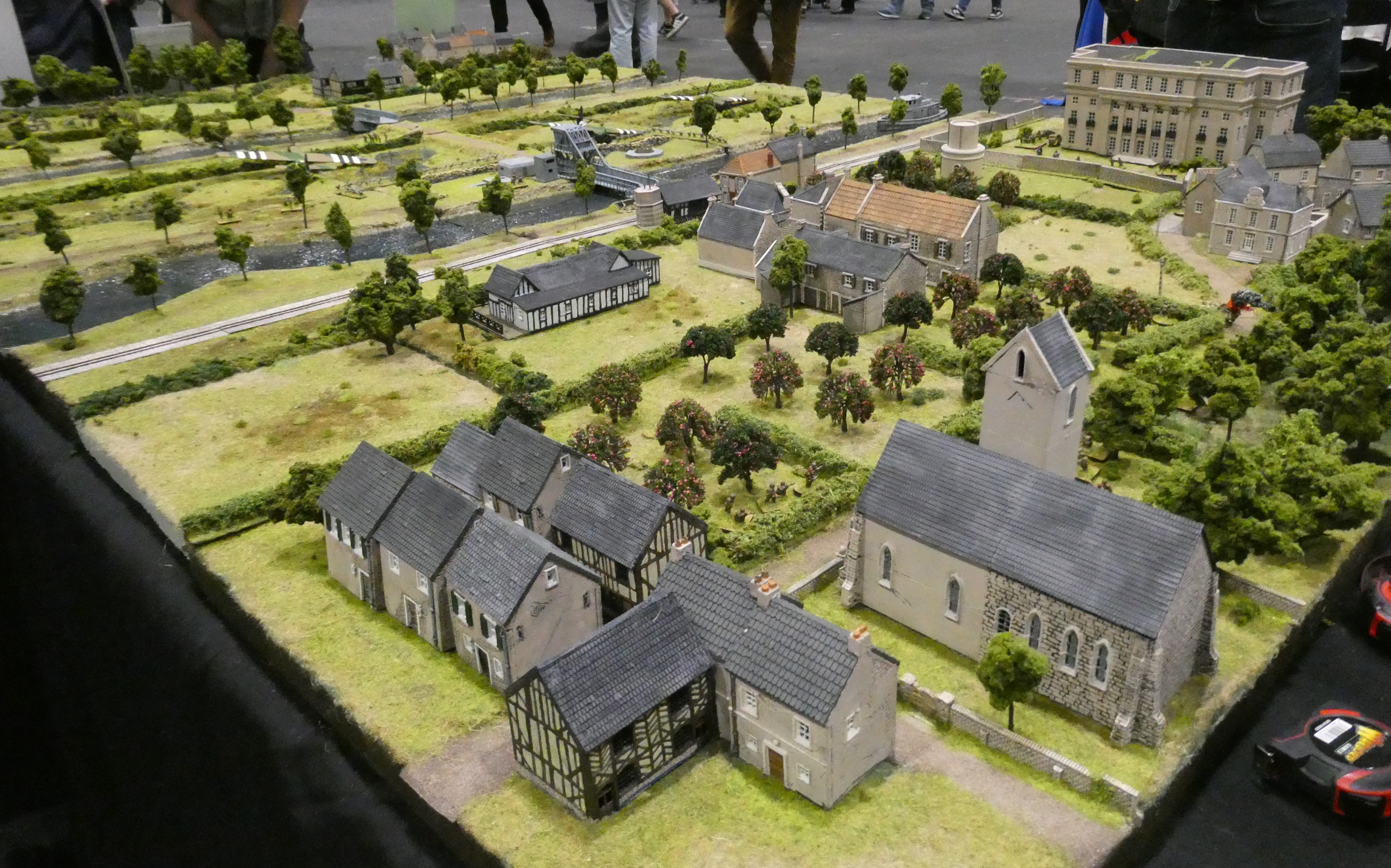
 and of course who could forget the excellent Hold Until Relieved D-Day game using Rapid Fire  by Retired Wargamers Reloaded - always a pleasure to see. 


That's about all for the games I saw - but I freely admit, looking at the program  I must have missed loads of other games!  I was a bit slow getting round, but for good reasons - I had a couple of good social catch-ups, with  old friend Tony of the aforementioned Retired Wargames Reloaded, and Chris aka Nundanket of Horse and Musket Gaming blog. Chris and I also stopped in at the Bloggers' meet-up organised by Ray,  Lee and 'Postie'of the Postie's Rejects group - nice to meet some other bloggers, we chatted to  the proprietor of  Travels with Khusru,  Steve of General Reeve, Tamsin Wargaming Girl. - and Ken  Yarkshire Gamer (on a brief break from that monster Jutland game) - nice to meet you all!  Sadly I didn't realise that also present was a 'follower' of this blog, Carl Packham of  Hitting on a Double One - so sorry not to say hello, Carl.  Carl has also posted about the show, with a better balance of Sci-Fi vs historical than me!     

Finally a little light shopping was done, of course  - most notably, and in keeping with subscribing to the Continental Wars Society,  I picked up a lovely book on Armies of the Italian Risorgimento, by Gabriele Esposito, at a good price from Paul Meekins books. It's a long-term potential future project.. in 6mm scale, if at all! 

another new period? Well, maybe..
 

And that's about it. I left about 5pm as the show was closing - 'tired but happy' as they say. A good day, if rather exhausting, and great to see all those games and traders, and especially to catch up with friends old and new! Many thanks to all involved in organising and putting on games and tradestands etc.   Finally, of course there are going to be loads of other reports of the show, which will have many more and better pictures than I have here  -  you should certainly see Big Lee's report on his Miniature Adventures blog/youtube (the video version runs 20 minutes and I'm sure he will have captured prety much every game! ) , and Ray's equally massive report on his Don't Throw a One blog - both excellent as ever. 

Back to more normal hobby activites next time, after I've rested my aching feet  - until then keep well, everyone.