Wednesday, 6 October 2021

Fnurban #10 : Wargames shows are like buses..

 ...you wait two years with none at all, and then loads come along all at once..

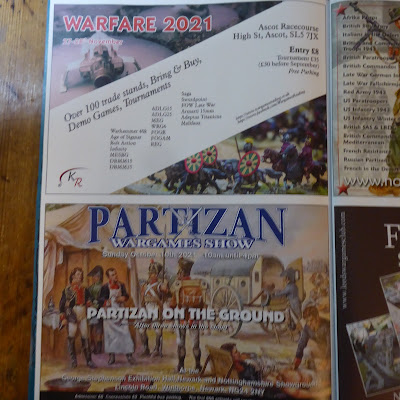
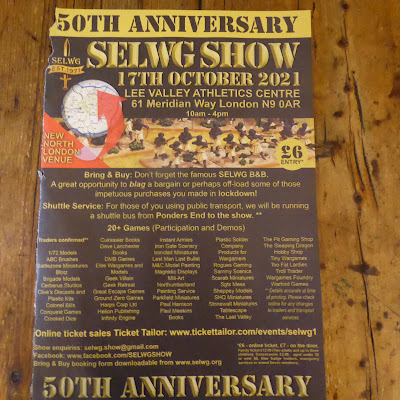
Having bought the current edition of 'Wargames Illustrated', I'm rather taken aback by the re-appearance of - advertisements for Wargames shows!  Like this old favourite : 

SELWG or NELWG?

SELWG 2019 was the last show I attended, and I always liked this event.  It seemed like a bit of a 'Goldilocks' show - not too big, not too small -  just right!  A good range of traders and games, and all very managable in an afternoon. Notice the new venue - gone perhaps will be the slightly surreal juxtapositions of gamers ( not necessarily the most athletic-looking crowd ) edging past the Crystal Palace swimming pool while synchro swimmers do their stuff in the water,  and the evocative whiff of chlorine ( did anyone do a WW1 game there, with that in mind? ).  Though I notice the new venue is also an Athletics Centre, so maybe plus ca change..  For me, the journey will be easier too, as they have moved to North-East London - should it be renamed NELWG?   Barring some catastrophic Covid surge/lockdown/fuel crisis situation, I am planning to go along, shopping list and camera in hand.   It will be great to be back! 

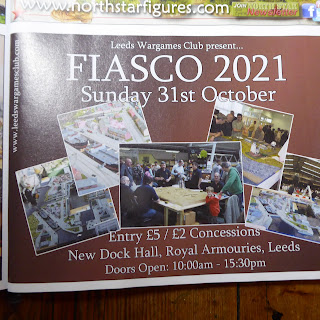
But that's not all  - from the same magazine issue, we have these: 

hang on - that's this weekend!

 and this...

not at all grim up North

And not to mention, for us Southerners the daddy of them all -  'Salute' returns on 13th  November.   On a more modest scale Ray from Don't Throw a One informs us that 'Broadside' is back in December, also with a new venue, at Gillingham.  It looks like a determined gamer with the ability to travel around England could do a show nearly every week for the next couple of months!  I admit I am not quite that desperate for my fix of games, tradestands and expensive coffees as to try to get to all of these - I'll start with SELWG and see how it goes,  have a think about 'Salute', and 'Broadside' would  be fun, and an easy journey ( and it's near my childhood home -  Rainham Wargames Club, are you there?  I was, about 1976 to 1981..)    These sports centre/exhibition hall  venues are quite large spaces, with hopefully good modern  ventilation systems, and the demographic of attendees is pretty surely double-jabbed ( some already in the 'booster' age groups, dare I say? ) - so I hope all will be well.  

So, what does the team think?  Are you keen to go along to one of these, or still a bit wary of crowds?  We all have to do what we are comfortable with, and I wouldn't criticise anyone for being careful. However to me, this seems a welcome development, a sign of societal recovery - my only concern being that perhaps there are too many shows in quick succession, will gamers suffer 'show fatigue' and attendances drop as a result?   Let's hope not - at least there is a decent geographical spread. It will feel  almost a duty to be generous in our support of the traders too, so - see you ( weighed down by long-delayed metal, resin and and paper purchases )  at SELWG, maybe? 

Keep well, everyone!

Wednesday, 29 September 2021

Kilsyth gamed; or William Baillie's Vindication

From the North, near the end : my right wing gone!

 Welcome back, all. Things have been quiet here hobby-wise, but there has been remote gaming. What now seems an age (but was in fact around two weeks) ago, I was lucky to be part of  M.S. Foy's remote gaming extravaganza,  re-fighting the battle of Kilsyth, 1645.  Readers of this blog have very likely seen his description, preceded  by the extensive and excellent research and preparations, on his brilliant Prometheus in Aspic blog.   It was great fun, and I can't resist giving my version of events. I took a couple of screenshots near the end, of which the above is one ( by this time my right wing seems to have mostly evaporated ).

When it came to choosing sides, I thought I'd better go with my ( possibly imagined ) ancestry; my paternal grandmother being a Campbell. As a child I was under the firm impression of being at least one-quarter Scottish, and was told that members of that side of the  family in the 1930s/40s would don the tartan and dance the sword-dance at parties ( I later traced the family tree, and found that my Campbell ancestors came from as far North as - Enfield. I did at least learn that one of them managed to be present at Tel-el-Kebir, with a detachement of Royal Engineeers ). I digress. 

Anyhoo.. when it transpired that the Government/Covenantor regime was headed by Archibald Campbell, 1st Marquess of Argyle,   I thought that was good enough reason to opt for the role of William Baillie, the Government commander.  That left the dashing Montrose to be impersonated by my good friend  and fellow Dave, the proprietor of St Cyr on Wheels blog - whose Scouse roots probably gave him good claim to command the formidable Irish Brigade, mainstay of Montrose's army.


Initial setup - courtesy of our host

The forces in their starting positions were as shown in Foy's map (above) provided by him as a playing aid;  Baillie's units are shown in blue.  Though the armies were equal in numbers of units ( 12 each ), I was very much aware of having only two cavalry units  ('TR' = Trotters) to Montrose's  three, and only one veteran foot  (FT)  regiment  (Home's) against three in the form of the Irish Brigade.  I had three 'Raw' foot units, the Fife Levies on the left, not much use at all - Montrose had four 'Raw' units but these were the Highlanders (HI), who had a compensatory ability to charge further than a normal foot unit,  albeit also not being equipped with muskets - so hand-to-hand combat only.  I did have the only gun - marked 'MG' , which designation may have given me a misplaced sense of its possible fire effect.  Overall I thought I had a slightly inferior force, and not being the most dynamic of commanders, my conclusion was to hold my position, take a defensive posture and see if I could shoot the Royalists down as they came to attack me. It turned out that this chimed with Baillie's preferred plan for the actual battle, since he knew reinforcements were on their way to him, hence saw  little point in risking attack before their arrival. In real life, he was overruled by his political masters (and by some of his units getting carried away) and forced to attack - with disastrous results. Could I do better, by staying true to Baillie's own idea?

Despite a built-in disadvantage  for the more plodding Baillie against dynamic Montrose when it came to  initiative die rolls, I did get lucky at the start and won the initiative on the first couple of turns - I used my commanded shot and infantry to occupy the hills,  ruins and mill in the centre-right, and hoped to hinder Montrose's advance with them. Meanwhile I gathered most of my infantry into a fairly formidable-looking defensive line around the hills at my left-centre. But it all unravelled very soon, especially as Montrose's men were aided by a massive lucky streak of die-rolling throughout the evening. When it came to shooting and combat, they won every time, and my units were blown away - starting with the Commanded Shot, who never actually got a volley off, being ridden down immeditely by a Royalist cavalry charge!  A cavalry fight ensued, which Dave/Montrose duly won, while he brought forward his Irish veterans,  and my cavalry and  a further  Infantry unit  bit the dust. My Veteran ( Home's ) regiment held up well, and might have knocked out one of Montrose's infantry units, if I hadn't decided to use their combat roll against the opposing  cavalry - the dice gave no hits, but would have been 4 hits against foot! That was fairly typical of the 'dice gods' attitude that evening.  Added to that over on my left, one hard-marching Royalist infantry regiment managed to dispatch my gun ( which got one shot off - and missed, of course ) and one of the Fife levy units.  All too soon, it was 7 Victory Points to 'them' and zero to 'us',  and the game was over. Oh well, even with the cursed Royalist dice, it was still great fun and a jolly evening! 

From the South: Fife Levies about to succumb

I should say something about Foy's  rules - his  'Ramekin' variation on 'Command and Colours', adpated for Pike and Shot warfare.  I liked their rather elegant  simplicity - for example in handling Pike and Shot units, no need to try to remember what proportion have pike or musket. Basically one combat dice per remaining 'block' in the regiment -  in close combat, if the unit has pikes, just add one more dice.  When firing, if pikes present, subtract one dice. Simples!  The 'Ramekin' part is the allocation of  command actions, replacing the the C&C card deck, the number of actions each turn  being decided by a modified die roll. I like that, as I always thought the C&C card deck was problematic - it has an uncanny knack of giving me loads of actions in the sector where I have no units or don't want to attack, which is very frustrating!  

If I have one 'note' on the system, I think I might look at the way that given a limited number of actions per turn, both sides can easily get fixated on only one part of the battlefield. Once fighting starts, one tends to want to focus more actions on it, knowing that the other guy will do the same, and I think that tends to mean that just one battlefield sector  sees all the action. In 'Pike and Shot' armies there was a definite command structure of 'wings' and 'centre' each with their own leaders capable of independent  action, and/or following orders from the C-in-C,  and I wonder if it might be good to ensure each of those sub-commands were ensured a share of the action points, to allow them all to use their initiative. They could perhaps voluntarily 'hand back' their actions to the commander if just standing on the defensive in their sector, and the overall commander should perhaps have some actions he could allocate where he chose, to generate the main thrust of his attack. I wonder if that could work?  In this game, I especially noted that there was a stand-off in the centre, with my infantry and Montrose's Highlanders just scowling at each other, because all the action points were being expended on the Government right flank. I should have used some actions to go and try to shoot up the Highlanders, perhaps, but once the brawl began on my right flank, all energies were taken up with that. Hmmm...   


My own paper and blu-tak based play aid - worked OK!

 Having said all that, the game worked fine, the rules were easily memorised and easy to use - which set us free to be Generals, not clerks or lawyers.   In fact our host did all the calculation of die rolls etc - so the remote gaming setup actually made me feel more like a 'commander' than a 'player', because  my job was to simply  tell units to advance, retreat etc  and whether to charge or fire  -  the results were determined and relayed to us by Foy.  Alas the result didn't go my way (and how!), but I am the least competitive wargamer I know, and I was too busy enjoying myself to worry too much about losing! 

So, many thanks to MS Foy  for hosting and providing a lovely setup, fantastic game and possibly too much information on the battle - some of which I have not quite read even now ! And to Dave 'St Cyr' for being such a worthy and good-humoured opponent - clearly such a charming chap, indeed, that the very dice joined his army...

There was some jollity over the colloquial description of my ( probably not ) ancestor Archibald as 'The Bastard Campbell'  - for information, here he is in all his glory, presumably contemplating the  massacre of some wretched hambuger-vendors. Thanks to Foy for providing the image.

No, I do not require fries with that..
 

Finally  by pure chance, in the run-up to the game I was skimming through the Battlefields Trust magazine's latest issue, and in the book reviews they feature a recent publication from Partizan Press - 'William Baillie's Vindication' by Stuart Reid, which discusses the papers presented by Baillie to a court of enquiry into the defeat at Kilsyth.  The review points out that 'accounts of the battle are typically from the Royalist side', so this is presumably a valuable counter-weight, and from the primary source, too. Worth a read,  I suspect, for all students of Montrose's campaign. 

'The dice were against us, alas..' 


I'll leave it there. A great time had by all, once again many thanks to MS Foy, and it has restored my blogging mojo too!  A bit too much of real life recently meant no time for this whimsy -  time to spend some time in hobby world again.  Keep well, everyone.
 

Tuesday, 7 September 2021

Charity begins - In the Library

The warm response to my last post helped make my decision, and so  I scooted back to the British Heart Foundation shop on Monday morning, made the appropriate donation to their funds, and  am now the proud owner of this rather nice book : 

This is volume II covering 1714 to 1760, so just the right period for me. Originally published 1941, this is a reprint from 1971, with the price printed on the inside dustjacket - all of £3.30 , 50 years ago - which I am told would be about £48 today, so quite a luxury item.  Lawson was an eminent artist as well as a military historian, and the pages are stuffed with his illustrations - no less than 220 of them in about 270 pages.  Page 1 gives a good flavour of what is to come : 


And here are  few more pages taken fairly randomly to give an idea of the contents. Chapters on Infantry of George I and II,  Marines,  Scots  in both British and foreign service, Cavalry ( including saddlery, colours and standards ) , Artillery and Engineers, Militia and Volumteers, Hanoverians, 'and many, many more'.. 


It really must have been a labour of love...  

There are only a couple of colour plates - both showing musicians,  rather fine too.


I love the syle of the whole thing, and there is a serious amount of information too. I had not really considered a British element to my 7YW forces, but of course one gets tempted when looking through this. I wonder if a mercenary Scots or Irish unit might be added? Or perhaps a Hanoverian contingent? 

It also has that essential element that my partner summed up so well :  'it smells of old book'..

Keep well, and safe, everyone. 


Sunday, 5 September 2021

Bank Holiday Bodging, and Books, Books, Books


What to do with a dull, overcast Bank Holiday Monday, at the end of the dullest, most overcast   August? Well, given those conditions I felt very little guilt about staying indoors at my desk and working on some of the model kits in the 'plastic pile'.  After rather too many hours, I have at least completed the build of the above two : the Puma armoured car acquired the other  week, and the 'Wespe' self-propelled gun, bought about this time last year (oops!).  I'll admit it was quite a challenge. Most of the kits I have built previously were by Armorfast or Plastic Soldier Company, and very simple to assemble - for example  the suspension usually being moulded as one piece per side, just cement it to the hull in one operation. Not so these - for the Puma, each wheel assembly  had 3 parts to put together before cementing to the hull,  and of course there are no less than 8 wheels.  Doubtless all this is great fun for dedicated modellers for whom the painstaking build is the whole point, but of course I just want to get something more or less recognisable onto the gaming table, ASAP! Factor in a surprising number of very tiny parts ( e.g headlights and smoke grenade projectors ) and my pudgy fingers and middle-aged eyesight, and the time and frustration increased many-fold!   A lesson learned, and I may be looking harder at resin-cast or 3D-printed models in future. I have the  M7 Priest to build next - with 116 parts, to the Wespe's 54 and Puma 69, it may be a long haul!   But at least the above two are built, and can now be painted, ready for action. I like them both, and was surprised by how compact the Wespe turned out to be. Of course the chassis was that of a Panzer II, so I should have realised it would be relatively small.  The Puma rather dwarfs it!  

Another project that has been ongoing far too long also came to fruition - a second unit of Austrian Cuirassiers for the Seven Years War.  Work on these  started  while sat in the garden  on a sunny day - in February! It's been a funny old year. I think most of my limited hobby time was used (as it probably should be ) on gaming, so painting took second place, and the Prussian infantry primed at the same time as these remain resolutely uncoloured ( like a regiment on some sort of 'punishment parade' in their underclothes!), looking at me balefully from a shelf.  I am going to try, now, to have a regular 'hobby hour' ( or half-hour might be more realistic ) and get on with painting and modelling for at least some of that time.  A strange side-effect of the pandemic is that despite working from home and not having to commute, work and domestic 'stuff' seems to take more time than it did before - I can't explain that.    These chaps won't win any prizes, of course, and the dry brush and 3-layer highlight remain unknown in these parts, but given aforesaid fingers/eyesight combination and a lifetime of manual incompetence ( school metalwork classes still a traumatic memory ),  I'm quite pleased with them. One advantage of solo gaming is that no pesky opponent is going to pick up the figures and look at them too closely - they will always be seen at 'battlefield distance'.  


Somehow, more books can always be acquired - a week's 'staycation'  resulted in visits to Bury St. Edmunds and Woodbridge, both of which boast  Oxfam bookshops. Thus the above two for under a fiver altogether.  Gary Sheffield will be known to many readers, as he is not only a military historian by profession, but also a hobby wargamer - a semi-regular opponent of Bob Cordery, for example, and I've heard him guesting on both  Henry Hyde's 'Battlechat'  and Al Murray's 'We Have Ways' podcasts. I've started his book, and it promises to be worthwhile - he begins by outlining the rather simplistic 'Lions and Donkeys' view of 1914-1918 handed down to most of us, and no doubt aims to challenge those ideas.  'The Full Monty' has potential, too - I have only a rather superficial idea of him, and this promises to give the back story, since it covers his life up to 1942 - the making of the man, so to speak.


Finally, one that I didn't actually buy, but was interested to see , in a charity shop in Sudbury this very afternoon.  C.C.P. Lawson's 'Uniforms of the British Army' - volume 2 of 4.  Originally published in 1941, I think, and this looks to be a 1970s reprint.  It features many rather charming sketches by the author ( himself an artist, I gather ), and it does appeal, given its 'old school' connotations - I bet Peter Young would have had a copy in his library.  Someone at the charity has done their homework, though, and the asking price is £14 - which to be fair looks about what you'd pay on Abebooks. Does it need 'rescuing', and to be 'given a good home', do you reckon?  

 It must be time to get back to some gaming, soon,  perhaps that should be the subject of my next post. Meanwhile, keep well, and safe, everyone.
Saturday, 21 August 2021

Al Murrays and Aquisitions..*

Well now, where were we?  Several weeks seem to have gone by, and nothing from The Ragged Soldier - sorry about that.  I'm afraid real life ( work, mainly ) got in the way. As a result, no gaming took place, but I did manage some reading,  and some acquisitions, that will feed into future campaigning. 


Al Murray's 'Watching War Films With My Dad' was a charity shop find ( for £1! ) which turned out to be a great fun read.  It's a sort of memoir - taking us from Al's WW2-obsessed 1970/80s childhood with Airfix kits and Action Man ( shades of Harry Pearson's 'Achtung Schweinhund' )  up to his attempts to present  military history to his own children.  He's a massive enthusiast for military history, he positively fizzes with it, with the result that he jumps  from topic to topic with dizzying speed. Obviously there are  a lot of jokes too,  but  (as listeners to his 'we have ways' podcast will know )  he is very well-read and knowledgable.  I was particularly interested in his views on Arnhem, which I confess I have little knowledge of myself  -  and of course the film 'A Bridge Too Far' gets a fair amount of discussion in the book. Did they really use Leopard tanks? Oh no!  He doesn't seem to have tried wargaming , though - should someone be inviting him to a show?       
 

Having enthused about a year ago over the joys of the local model shop, I'm afraid I didn't get back to Model Junction in Bury St. Edmunds until the other week. But I found them trading OK, and as friendly and helpful as ever.  They have a pretty wide selection of modelling paints ( at least 4 or 5 brands ), and a room full of plastic kits. I've been wanting to add some anti-aircraft capability to my 'D-Day Dodgers' Italian campaign forces, so the Airfix  Bofors AA gun will do nicely, and I couldn't quite resist the Sd Kfz 234 'Puma'  for the Germans. Worthy additions to the 'plastic pile',and it's about time for another go at a WW2 game and a trial of Bob Cordery's 'Portable Wargame'  rules for aerial attacks and AA guns. 


Another great book find was courtesy of an antique shop in Lavenham which includes a couple of shelves of history books curated by someone who clearly has a military bent ( so to speak, missis!) - and there was Geoffrey Parker's 'The Military Revolution'. I know I'm about 30 years behind on this one, though I do have his books on The Thirty Years War and The Army of Flanders and the Spanish Road - the latter read a memory-wiping long, long time ago.   As a paid-up member of the Pike and Shot Society, I'm really looking forward to reading this and bringing my knowledge of theories of military history bang up-to-date - albeit the 1980s date..


One aspect of The Military Revolution being the Trace Italienne and new fortification techniques culminating in Vauban's  formidable legacy - so it was a very pleasant surprise to coincidentally  receive a splendid gift, from a modest and retiring fellow blogger, of a seriously impressive resin model of a Vauban fort!  It's actually 15mm scale, I am told, but I think it should pass muster in  my Seven Years War campaigning, on the principle of 'under-scale' buildings and scenery. I can see it as a small fortified outpost being fought over  in my central European backwater, or cunningly deployed along the edge of the table to suggest a section of the walls of some larger defended place. Whatever, I am very chuffed indeed with this lovely piece of generosity. No payment was required - I will compensate with a suitable charity donation, perhaps to MSF. 


Finally, an update on another generous gift, which I had received from RossMac of 'Battle Game of the Month' fame.  Here is MacFarlane's Scottish regiment of foot, with their associated troop of 'border horse'  Lancers , their  prized regimental cannon, supply wagons and self-propelling food supplies ( i.e. livestock ! ). I've given the foot and the horse new bases to fit my system, and given the horse back their missing lances, but left Ross' 1970s paintwork untouched, it's just fine as it is. The infantry have a preponderance of musketeers and very few pikes, so they may find themselves used as 'commanded musketeers', but there are some splendid axe- and sword-wielding highanders, and even a bagpiper! Also a couple of kilted  musketeers with socket bayonets, who look distinctly 18th century, but I couldn't separate them from their fellows after the long voyage,  so they stayed in the ranks. Their comrades may be bemused by 'Hamish and Dougal, with all  their new-fangled ideas'. 

The bases are just thin card, since the plan is to fit magnetic strip underneath, and use steel paper movement trays, which will add to the thickenss. Maybe I need to texture them a bit, to match Ross' bases for the wagons, gun and livestock. Though I am an adherent to minimally plain basing normally, a bit of texture would be true to their original spirit, I think.  Now they will be needing an excuse to get to grips with the Imperials, or the French, depending which side offers the best pay, of course.. 

That's enough for now, I'm glad to have got back onto the blogging bike, so to speak, and there's lots of gaming posibilities to be thinking  about in the near future.  Meanwhile keep well, and safe, everyone.


* title loosely inspired by that good old standby of adventure-story writers - 'Alarums and Excursions', of course !  I'll get my coat..

Thursday, 29 July 2021

Hussars! Hussars!

Last time we set up the Austrian cavalry raid on Prussian-held Piesport in my 'Soldier King' 7YW campaign; so let's see how it turned out.  I used Bob Cordery's 'Portable Napoleonic Wargame' with my own home-grown 7YW modifications, and some tinkering with the close combat rules based on modifications by Mike Lewis. 

where we left off - first combat
 

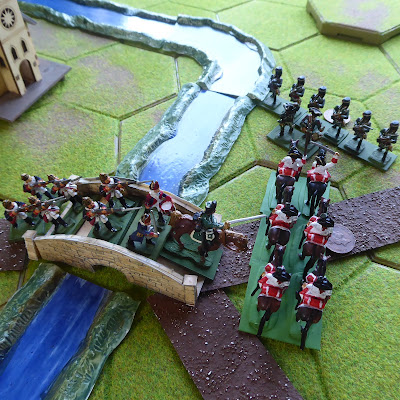
We left the game at Turn 4, as the leading squadron of Grenze Hussars charged over the bridge  and crashed into the Prussian Fusilier battalion.  The dice were rolled, and the Fusiliers ( helped by the presence of their commander, Oberst von Fruhling ) came out on top. The Hussars  took a 'retreat' result and were thus repulsed by the steady Fusiliers, and back over the bridge they went. To add to their discomfort, the Prussians' activation phase came next, and the Fusiliers gave them a musket volley for good measure,  and took 1 SP: not the best start for the dashing Hussars. Meanwhile, the Prussian supply convoy with its escorting von Kleist Frei Korps battalion  plodded warily along the road towards safety.. and realised that 3rd Squadron Grenzers was in front of them. 

trouble for the convoy?
 

Next turn, Von Fruhling  won the initiative roll for first activation , and his trusty Prussian foot used musketry to good effect again - both Hussar units forced to retreat further by steady fire from Fusilier and von Kleist battalions.  The Austrians rolled hopefully for their next unit's arrival - and scored a '1' -  their comrades must have stopped to water the horses..


A different approach from the Grenzers

Having failed with a dashing charge on solid Prussian Fusilers, with no reinforcements nearby,  and  no way of getting around the enemy flank,   the 1st squadron Grenze changed their approach. They dismounted, and prepared to use their skirmishing fire to pin down and annoy their opponents ( handily, when I bought the figures from Eric Knowles colleciton, the Austrian Grenze Hussars had both mounted and dismounted contingents - at last, they can be used properly! ). And so commenced a firefight across the river,  Prussian volleys versus a 'popping fire' from the Grenzers,  the Fusiliers getting the best of it, repeatedly hitting and forcing  retreats on the Grenzers, whose own shooting was distinctly lacklustre. 

Convoy escort outflanked!

On Turn 6, the next Austrian unit failed to arrive yet again, but 3rd Squadron Grenze Hussars (though raw recruits)  used their speed and the cover of the woods to surprise  von Kleist foot with a flank charge - and the dice were with them, von Kleist losing 1 SP.  The men of the Frei Korps tried to stand and fight in their turn, but were  disadvantaged by losing the first round of melee,  and were forced to retreat, deserting  the precious wagons!  The Hussars gleefully fell back and captured the wagons, shrugging off a long-range volley from the dispirited von Kleists.

Austrian Cuirassiers charge..
 

Further good news for Austria, as the 3rd Hussar squadron began escorting the captured wagons away. Finally on Turn 8 their next unit (of newly-raised Cuirassiers) arrived on the table, closely followed next turn by the last cavalry unit,  2nd Squadron Hussars.  The Cuirassiers were keen to make up for their later arrival,  immediately charging the unfortunate von Kleist battalion in the flank as they made for the bridge. The dice rolled - a draw - von Kleist held steady.  The Cuiraissiers charge had brought them next to the bridge, and von Fruhling saw his chance - 'My Brave Fusiliers - charge!' The Fusiliers swarmed over the bridge, took the Austrian Horsemen ( already embroiled in combat with Von Kleist ) in the flank, and took 1 SP off them.  This put the heart back in von Kleist, who fought back ( and rolled a 6 to the cavalry's 2 ), and took another 1SP from the Cuirassiers.  Being a raw unit, the Cuirassiers onlt started with 2 SPs - so they were destroyed, on their first turn of combat!   A bitter blow for the Austrians, and at the end of Turn 9 their losses were 3SP to Prussia's 1 SP. However,  those captured wagons kept plodding away, under escort..


...but meet their Fusilier-shaped doom

Over the next few turns, the stout  Prussian infantry kept up their fire against 1st and 2nd Grenze Hussar squadrons, but could not prevent the supply wagons being shepherded away: and I had decided that if the wagons were captured and escorted off the table, each one would cost 1SP loss to the Prussians.  


Supply wagons hurried away

This was their downfall, hastened by the dismounted 1st Grenzers finally managing to shoot straight and take 1SP from the Fusiliers - this left the losses  at end of Turn 12 as Austrians 3SP, Prussians 4SP , and Prussian exhaustion point was reached. Defeat loomed  for von Fruhling. Sadly he ordered his men to fall back, the von Kleist battalion almost reaching the bridge - only to be charged in their flank by the fresh 2nd squadron of Hussars!  The Frei Korps were forced to retreat, whereupon the Hussars followed up, and inflicted a further  1 SP loss. To add insult, 3rd Hussar squadron, returned from escorting wagons, piled in and charged von Kleist in the rear! But the dice were with the Prussians (who had been joined by their commander), and the combat was drawn. With great relief, the Prussians won the initiative roll on Turn 14, and the battered von Kleists made it across the bridge to safety, while their Fusilier comrades gave covering fire, taking 1 SP from 3rd Hussar squadron. 

The last charge at the bridge
 

And there it ended, the Austrians deciding to retire with their prizes, not fancying further Prussian musket vollies.  Losses were Austrians 4SP, Prussians 5SP,  thanks to the capture of the supply wagons.   But the Austrians had lost a vital part of their force,  the newly-raised Cuirassiers being destroyed, and thus removed from the campaign game. The Prussian infantry had acquitted themselves well, apart  from  the loss of their vital supplies. They may be hungry, but they are still in the game!  

Given the small forces and the lack of  'balance' in them, this turned out rather an intriguing game; I think largely due to the fall of the dice, which kept half the Austrian cavalry force off the table for no less than eight turns.  Perhaps it was harsh to penalise the Prussians so heavily  for the capture of the wagons - with their exhaustion point at 4SP, it only took a loss of 2 SPs  in addition to the wagons to defeat them, which was perhaps too easy.  But were  they were too timid? Perhaps the Fusiliers should have taken the offensive rather than sheltering behind the bridge?  I was pleasantly surprised by how challenging the game was for both sides, and how it wasn't, as I had feared, all over and done with in a few turns.  With a little thought, and the interesting way the dice seem to help things along, even a small and limited  game can be a bit of a nail-biter! 

I hope this has been interesting and fun to read, as it was to play. I feel the result favours the Prussians in the overall campaign, and that a climactic 'big battle' may be approaching. We shall see ; meanwhile keep well, and safe, everyone.

Thursday, 22 July 2021

Here come the Cavalry!

At last, back to my 'Soldier King' Seven Years War campaign, and the cavalry raid on Piesport that resulted from the recent map moves.  Four units of Austrian Cavalry are about to  descend upon the junction and river crossing town, which is held by two rather lonely units of Prussian foot. 

The Hussars are coming..

How to make an interesting game out of a very 'asymmetric' (and quite small)  pair of opposing forces?  I decided to use Bob Cordery's 'Portable Napoleonic Wargame' , with my home-grown 7YW adaptations, and so  those forces became : 

Prussians  : 

            Oberst von Fruhling :   3 SP 

            One battalion Fusilers,  rated Average , 4SP 

            One battalion von Kleist foot,  rated Average, 4SP 

            Two supply wagons 

             Total : 11 SP,  Exhaustion point 4 SP

Austrians: 

             Oberst  Knurrer :  3SP 

            Two squadrons Grenze Hussars, rated Average  each 3SP

            One squadron Cuirassiers , rated Poor ,  2SP

            One squadron Grenze Hussars, rated Poor , 2SP. 

            Total :  13 SP,  Exhaustion Point 5 SP. 

( I decided that for such small forces the commanders would be quite 'junior' and therefore only worth half the normal 6SP. )

Each side has its challenges : the Prussians could just hunker down in the town and be untouchable, so they have to be given a reason to be out and about. The Austrians could just sweep in, line abreast, and ride 'em down, so they have to be strung out on the road, at least, and not certain of timely arrival. 

So I decided that the Prussians would happen to be escorting their regular supply wagon convoy into town that day.  The Von Kleist foot would accompany the wagons, which would enter from the Northern road;  meanwhile the Fusiliers would guard the town and bridge. There would be some uncertainty over the arrival time of the convoy - a die roll would decide when it arrived on-table, with a 5 or 6 needed on turn 1,  4/5/6 on turn 2, and 3/4/5/6 on turn 3 or later. The wagons would aim to reach the bridge and cross into the town and safety - presuming that the bridge  was still in friendly  hands when they arrived!

Meanwhile the Austrians would enter from  the South-Eastern road, but would also not necessarily be punctual : again on turn 1,  a roll of 5 or 6 would be required for a unit to enter, then 4/5/6 on turn 2, and 3/4/5/6 on turn 3 or later - and only one unit could arrive each turn.  I decided in advance the order that the squadrons would arrive. In the hurry along the roads, with some units of lower quality or less experience, they may have  become somewhat separated. In this way I hoped to inject some random chance into both side's situation.     Finally, regarding  the wagons : if captured by the Austrians and escorted off the table at the Austrian entry point, each wagon would cause the loss of  1 SP  to the Prussians. 

And so it began - or rather, it didn't. On Turn 1 the Prussian Fusiliers kept a watch from their sentry posts, looking forward to the arrival of the convoy with welcome supplies and news, but also alert to the rumours of the dreaded enemy Hussars in the vicinity.  But both sides rolled a '1' for unit entry, so nothing happened!  Oh well, Turn 2 : Prussians rolled '1' again, no supply train. But the Austrians scored a splendid '5', heralding the clatter of hooves and the arrival of 1st Grenze Hussar Squadron on the South-East road. Prussian sentries couldn't miss that..

Arrivals - that convoy is rather late
 

Turn 3 came, the Austrians rolled high again, and their 3rd Grenzer squadron ( an untried, new-raised unit ) appeared, while the first squadron made all speed for the bridge. Prussians finally got their convoy onto the table , with  Von Kleist foot leading it, while von Fruhling in the town chivvied his Fusiliers into firing line, covering the bridge.  And without further ado, on Turn 4, 1st Grenze Hussars put spur to flank, and charged over the bridge! 

Grenzers charge!
 

So, first combat - how will it go? Will the Hussars sweep all before them and capture the bridge, or will the Fusiliers hold their nerve and inflict a bloody repulse?  We shall see.  'Tune in next time,  folks...'

This would be too long a posting if it covered the whole game, so we'll be back next time with the conclusion.  Until then keep well, and safe, everyone.